


 Francais
 Deutsch
 Italiano
Refine Your Search
Prison physical examination. stock footage and images
- Showing 3325 to 3330 of 3715 results more
more Hide
Hide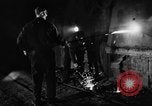
Steel production covers open hearth furnace, ingot molding, and hot strip milling.
Examines the steel industry in Youngstown, Ohio during World War II. Focuses on the steel production including the open hearth furnace and hot strip mill. Workers Mike Ubinski and Earl Strong remove a molten sample from an open hearth furnace and quench it in water. They then hammer the sample to prepare it for analysis. Earl Strong playing bass in the Youngstown Orchestra. The conductor is Michael Ficocelli, who is also time keeper at the steel mill. Shot of old man playing the violin. At the steel mill, the open hearth furnace is tapped. A 'pit gang,' several worker, throw alloy metal into the pit furnace from above. The 100 ton ladle containing molten steel is moved by crane and poured into ingot molds. A worker pulls another molten test sample from the ingots for testing. Ingots on train move from open hearth furnace to the ingot mill. Hot ingots being rolled by machine into slabs. Workers George Bannin and Clarence Ginny manipulate controls for machinery that rolls ingots into slabs. Worker Fred Ingram controls machinery that cuts steel slab using hydraulic sheers. Union workers gathered at a conference table as union leader Fred Ingram leads them in discussion. Hot strip mill where steels slabs are rolled into steel sheets. Sheet of hot steel moves down conveyor to end of mill. Steel workers leaving the steel plant at end of their shift. Exterior views of steel plant in Youngstown, Ohio.
Recruitment and activities of young officers in the Department of State and Foreign Service Officers Training School
Secretary of State office, Cordell Hull seated. Applicants take written and oral examinations for recruitment in Department of State. Door sign 'Appointments : Dept. of State'. Selected candidate sworn in before joining. Successful candidate at probationary service, signs documents. People awaiting their turns in Passport registration office. Foreign service officer listens to a man and checks his passport. Door sign of 'Foreign Service Officers Training School'. Candidates attend protocol classes. Young diplomats seated around table. Cordell Hull addressing. Name of U.S. officials on wall plaque. Officer talking to a foreign family in U.S. Consulate. Other officer talks to a man. Ship at sea. Diplomat talks to a Navy officer and plan the evacuation of U.S. citizens from Spain during Spanish Civil War. Refugees board ship. Cordell Hull talks to a diplomat.
United States interests in South America and Latin America just before World War 2, and German presence in the Americas
Opening scene shows U.S. State Department officials of the Division of the American Republics in a meeting. They examine a map titled "Inter-American Highway" showing a proposed highway running from the border of the U.S. and Mexico at Laredo Texas, all the way through Mexico, Latin America, and into South America. View of South American farmers loading hay into a horse cart, then of cattle in a stockyard being herded by a cowboy on a horse. Aerial view of city of Rio de Janeiro Brazil circa 1938. Narrator discusses threat of dictatorships in countries of South America. Views of German ships and German contracted ships loading and unloading at Buenos Aires harbor. Narrator describes system of barter where Argentina sends goods to Germany in exchange for German-made goods. Swastika flag on one of the cargo ships. Dock crane with German sign "Deutsche Maschinenfabrik A.G. Duisburg". Letters on side of a ship reads 'Buenos Aires Maru'. Supplies unloaded from ship. Cargo stacked including wooden boxes with German writing labeled "Vorsicht - San Paulo Brasilien". In a Latin American or South American city, view of the storefront for luxury goods by Herm Stoltz & Co. A Nazi German flag hangs above the store entrance. Fine leather goods, cameras, figurines, steins, etc from Germany are shown in store window displays. View of Nazi German books on display in storefronts, including closeup of translated book "Mein Kampf" ("Mi Lucha") by Adolf Hitler, bearing an image of Hitler on front cover. A German passenger aircraft parked at an airfield, which narrator describes as being part of a German airline offering service to South America within two days of Berlin, Germany. More German airplanes are shown at an airport in South America. View of government offices in Rio de Janeiro Brazil. Large crest with a bird atop an entrance. Interior office view of President Getúlio Vargas of Brazil seated in discussion with American diplomats. Narrator indicates that Vargas learned of German colonists in Brazil planning his overthrow by assassination, and therefore outlawed all Nazi activity. Poster of Vargas communicating his policies. Scene switches to exterior view of the State, War, and Navy Building (later the Executive Office Building) in Washington DC, with the First Division Monument in the foreground. Interior view of office door bearing sign for Under Secretary of State. Inside, Sumner Welles is seen in discussion with officials. He is asked about the American attitude toward Latin America. Welles describes the importance of strengthening ties between the countries of the Americas. Under Secretary Welles states that the welfare of all of the countries in the region may depend on their continued solidarity.
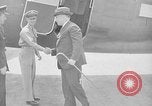
Frank Knox arrives at Patuxent River; assorted other scenes of Japanese military leaders and allied military leaders
A government official arrives by a plane and greeted by military officer during World War 2. Next scene is unrelated and shows Japanese General Hideki Tojo and an aide seated at a ceremony, with Imperial Japanese navy pilots seated behind and others including civilians in the audience. Next scene shows officers of Navy of Imperial Japan in conference as they examine a map on a ship deck. Scene shifts to another greeting of unnamed Allied officials meeting and greeting at an airstrip. Next scene shows a Pacific Island battlefield with both dead troops on beach area and live American troops walking nearby. Next scenes shows U.S. Secretary of Navy, Frank Knox, as he arrives at Patuxent River Naval Air Station in a plane. Frank Knox and other officials leave. Various views of radio towers are seen in between scenes in the clip.
Montage of scenes showing the continuous close coordination between the United States and Britain during World War II
Film shows an invasion task force at sea overwritten by a slate reading, "Casablanca." Narrator speaks of January, 1943, in World War 2. View of the city of Casablanca in Morocco. U.S. President Franklin D. Roosevelt seated next to British Prime Minister, Winston Churchill as they meet in Casablanca, at the Anfa Hotel, January 14–24, 1943, during World War 2. Roosevelt wears a black armband on his left sleeve in mourning over the death of his mother, in 1941. Backs of Military officers seen from behind, with Churchill and Roosevelt on chairs in the background. Then a closeup of Roosevelt and Churchill seated with high ranking Allied military officers behind them, including U.S. Admiral Ernest King and U.S. General George Marshall. View from directly overhead of marching American soldiers. Huge number of British soldiers led by a Rolls Royce armored car, are seen walking across the desert, celebrating their victory over German forces at Tunisia. Prime Minister Churchill and President Roosevelt seated on the lawn in front of the White House during the third Washington Conference (code-named Trident) held in Washington DC, from May 12 to May 25, 1943. Closeups of both men. Scene shifts to a U.S. invasion task force in the Pacific. Glimpse of a Benson-Livermore class destroyer near hills in the Pacific. A navy Douglas Dauntless dive bomber flies over ships in an invasion task force. U.S. troops are seen in a Higgins Boat landing craft from the transport ship USS President Jackson (APA-18). Troops storming ashore from landing craft. U.S. troops firing artillery field pieces, and raising the U.S. flag on a captured island in the Pacific. Scene shifts to European theater, where an Allied warship is firing its guns during Allied invasion of Sicily, code named Operation Husky, 9 July – 17 August 1943. Amphibious assault taking place. A jeep is seen pulling an artillery piece through shallow surf. An army truck drives through shallow surf, out of a landing craft. Breech view of artillery gun being fired and shell ejecting. A shell exploding near the camera. Camouflaged antiaircraft guns firing. Series of brief scenes showing Soviet Russian infantry and tanks advancing against German forces in Russia. Next scene shows Benito Mussolini in military dress uniform, giving a speech, and then posing next to a Bronze statue of Roman emperor, Julius Caesar, in Rome, Italy, as troops march past him. A bust of Mussolini being pulled down. Rioting Italians. Axis defenders in Sicily, carrying a white flag as they surrender to Allied powers. Views of Lieutenant General Mark Clark and a Major General pleased at the surrender. American troops being cheered by Sicilians as they ride in jeeps. Italian men receiving food after the surrender, as a British soldier stands nearby. U.S. Army Air Force B-24 Liberator bombers in flight over the Northwest Pacific. Aerial view of Kiska in the Aleutians. B-17 flying Fortress bomber in flight with bomb bays open. Bombardier at his station in the aircraft he presses button to release bombs. Formation of B-24 bombers dropping bombs. View from aircraft of them exploding on the ground. Aerial view of surfaced German submarine being strafed by Allied aircraft. After several attacks it is sunk. B-24 bombers raining bombs over Germany. Huge explosions on the ground raising plumes of white smoke. Bombed out remains of Coventry Cathedral in England. Religious services being held in the ruins. View of the Pentagon building just outside Washington DC, and the British Prime Minister's residence at 10 Downing Street, London, England. View of Quebec Canada. A Canadian sentry on a hill. The Wolfe–Montcalm Monument in Governors' Garden beside the Château Frontenac, Quebec, Canada. Views of the Chateau Frontenac. Canadian troops patrolling around the Hotel. Royal Northwest Mounted Police on the grounds. Canadian soldiers with antiaircraft guns, scanning sky for possible threats. Armed couriers loading bags of official dispatches into a car. The dispatches being delivered to waiting aircraft. Censors examining postal mail. Conference attendees showing their passes to Canadian Mounted police officers at the hotel entrance. Closeup of an actual pass issued to a U.S. Army Major.
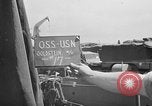
Loading and checking vehicles aboard LST (WW2)
Preparations prior to the Allied invasion of France in World War II. American officers examine loaded vehicles aboard LST. Officers and crew watch. Elevator rises. Troops push away a truck from elevator. Signalman signals. Truck backs onto elevator. Officers smile.
CRITICALPAST.COM: About Us | Contact Us | FAQs - How to Order | License Agreement | My Account | My Lightboxes | Shopping Cart | Advanced Search | Featured Collections | Website Terms & Conditions | Privacy Policy ©2026 CriticalPast LLC.
License Agreement |
Terms & Conditions |
Privacy Policy
©2026 CriticalPast LLC.