


 Francais
 Deutsch
 Italiano
Refine Your Search
Prison physical examination. stock footage and images
- Showing 3655 to 3660 of 3715 results more
more Hide
Hide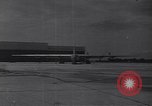
First flight of Convair XB-36 in Fort Worth, Texas
First flight of Convair XB-36, on August 8, 1946, piloted by Chief test pilot Beryl Erickson and copilot Gus Green. Air and ground crews doing extensive inspections and preflight checks of the XB-36 parked on ramp. Two of the team standing on horizontal stabilizer examining the vertical stabilizer. Tail number 213570 clearly painted on vertical stabilizer. Two Air Force personnel standing next to one of the huge single main gear tires. Engines are started and XB-36 taxis toward runway. It spins around on active runway towards direction of takeoff, and commences takeoff roll, gradually breaking ground in a shallow climb angle.
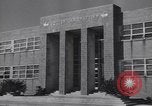
Innovations in communication equipment from the U.S. Signal Corps engineers working in Squier Laboratory during World War 2
Soldiers of the U.S. Signal Corps working on radio equipment in the United States. The exterior of a U.S. Army Signal Corps building with "Squier laboratory" written outside the building. The interior of the laboratory. Engineers conducting experiments and working on various equipment for communications, including Radar, Color Radio Telephoto, and single sideband transmission for long haul radio communication. A machine that appears to be spinning and heating hot glass. An engineer operating a machine beneath a sign that says "Thermionic Shake Tests." An engineer tests various signal lights. Signal Corps men observing a radio tower. Instructors teach and demonstrate various kinds of radio relay equipment to other Signal Corps personnel. A large board reads "Multiplex terminating." An officer explains a diagram to the Signal Corps personnel. Soldiers examine disassembled radios. Demonstration of a map being transmitted to a soldier in the field via facsimile machine. Close views of a spinning drum on the facsimile machine and the map visible on it. A dramatized shot of a B-17 bomber aircraft in flight. The pilot in the cockpit of the aircraft. The pilot looks at the signals transmitted through the radar. The aircraft navigates with the radar in bad weather. A map locates Boston, Lynn, Nantasket and Quincy and it is compared to the radar image of the same region.
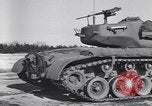
The mechanism the engine of U.S. T26E3 tank being explained in the United States.
A film about the U.S. T26E3 tank. A tank parked on the ground. Man points at the wheel of the tank. The working of the engine as the tank is being explained. The power train is examined. The engine of the tank. The location of the oil coolers and the engine radiators in the engine. The gas tanks, having their own fillers. View of radiator fill, where cap must be securely tighten against the seal. The security measures prevent the engine failure.
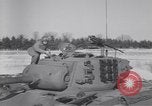
The storage space and other controls inside the fighting compartment of the T26E3 tank in the United States.
A film about the U.S. T26E3 tank. A tank parked on the ground. The tank commander stands near the tank. He boards the tank. He opens the door and enters the tank. He looks outside from the space in the tank with the door closed. The fighting compartment of the tank is examined. The storage space for ammunition in the fighting compartment. The filters must be cleaned. Men inside the tank. Guns mounted aboard the tank with the help of spring recoil mechanism. Generator in the tank which provides the electricity needed. The electric traversing motor. The firing switch, control handle, tank commander's control lever. The gun can be elevated and depressed. Shells stored inside the tank. (World War II period).
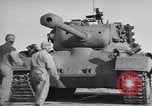
The drivers at the controls in the driving compartment of the U.S. T26E3 tank in the United States.
A film about the U.S. T26E3 tank. A tank parked on the ground. The driving compartment of the tank is examined. The doors of the tank are easy to operate because of the torsion rings. Men working on the tank. Interior of the tank and the driver compartment. The driver and the assistant driver at the controls of the tank. The steering lever and other controls of the tank. Both the driver and the assistant can operate the tank. The instrument panel. The fuel indication at the panel. As the engine is started, the engine transmission and differential warning lights start. Points out the driver's responsibility while operating the tank. Tank moves on the field.
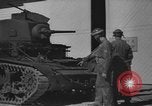
U.S. Army soldiers working and checking the engine and other parts of a M3 Stuart Light tank in the United States (WW2)
A World War II training film depicts functions of army tanks in the United States (M3 Stuart light tanks and M3 Lee Medium tanks). A M3 Stuart Light tank parked on a street. Men standing nearby and working on the tank. The gasoline engine is checked and turned over by hands. A man working. He checks the fuel tank. The oil filler pipe in the engine is examined. Interior of the tank. A man seated inside. He checks other parts of the tank and puts off a battery switch. He checks the transmission oil gauge. The steering levers, the clutch paddle and the accelerator paddle is checked and operated properly. The driver pushes the clutch and starts the engine. The transmission oil is checked. The tank is moved forward slowly. A man standing near the tank.
CRITICALPAST.COM: About Us | Contact Us | FAQs - How to Order | License Agreement | My Account | My Lightboxes | Shopping Cart | Advanced Search | Featured Collections | Website Terms & Conditions | Privacy Policy ©2026 CriticalPast LLC.
License Agreement |
Terms & Conditions |
Privacy Policy
©2026 CriticalPast LLC.