


 Francais
 Deutsch
 Italiano
Refine Your Search
Prison physical examination. stock footage and images
- Showing 3661 to 3666 of 3715 results more
more Hide
Hide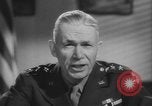
ASF Commanding General Brehon Somervell speaking about the problem of substitution and conversion of needed World War 2 supplies
Production of supplies for American soldiers during World War II. Commanding General of Army Service Forces( ASF ) Brehon B. Somervell seated at a desk in his office in the United States. He explains the serious problem of substitution and conversion and what is being done by American science to meet these needs. Somervell states that he is issuing an order: A command to think along new lines regarding every product essential to the war. He asks: 1) Can it be made as well of some less critical material; 2) Can it be made better, faster, or in greater quantity by some other method of production? He calls on viewers to draw on the brains and ingenuity. View of ordnance insignia. Interior of an office. An officer and a draftsman examine a machine gun. Exhibit of mannequins wearing uniforms with supplies for soldiers and nurses. Miniature tents and kitchen equipment. An officer and executives from two rubber production companies check synthetic rubber and collaborate on improvements. Radio engineers at work in front of equipment checking new type equipment. Workers weighing equipment and finding ways to make needed supplies lighter in weight. Chemical warfare officers at work. A soldier with a new plastic gas mask comes out of a room. Medical and other industry leaders around a conference table. Men gathered around tables planning improvements. Workers entering a large aircraft production factory. A man places a paper in a suggestion box labeled "ideas for increasing production."
Replica of a fortified town in Germany and visual aids being used during a training of soldiers in the United States.
A film titled: 'The Sergeant Shows em How' on training of U.S. soldiers during World War 2. Tents being erected on the ground. Soldiers washing their faces. A soldier wipes with face with a cloth. Soldiers washing their mess kits after a meal. A replica of a fortified town in Germany is built at the camp. View of artificial houses along street sides. Soldiers construct buildings. Target boards in a trench. Nazi German flags flying on flag poles on the buildings of the trainin camp. Soldiers discussing amongst themselves. Men working inside a building. Several visual aids being used for the training purposes. Opened equipment is wrapped in plexiglass so men can examine the pieces during training to understand how the equipment works. Soldiers explaining about various war equipment and ammunition.
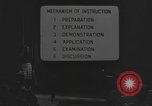
Correct mechanism and methods of instruction are explained to soldiers in the United States.
Training methodology for U.S. soldiers in the United States. An instructor instructs soldiers seated in a class room. He speaks about the correct methodology of teaching. A chart on a board reads 'Mechanism of instruction'. There are six steps in the mechanism of instruction. They are 'Preparation, Explanation, Demonstration, Application, Examination and Discussion'. The methods of instructions are also explained. These things should be considered while instructing 'The Lecture, the Conference, the Demonstration, the Group Performance Method and the Coach and Pupil method'. The lecture should be brief and interesting. Training films, slides, maps, models and other devices should be used. An instructor instructing a class. He takes a long lecture. The soldiers sleep in the class. (World War II period).
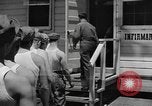
Recruits board a train as they leave for their first assignment in the United States.
A training film in the United States depicts training of soldiers in the army. A board outside a building reads: 'Infirmary'. The recruits enter the building. A medical examination being conducted. The recruits seated in a theater. A surgeon talking about contamination of diseases by the soldiers. The recruits drill. An officer instructing them. The recruits sweeping the ground with brooms. Some of the recruits cleaning containers and dishes in a mess. A bugler blows a bugle. The U.S. flag flying on a flag pole. Officers and the recruits saluting the flag. They arrive at a railroad station with their personal belongings. They board a train and the train moves on the railroads. They move for their first assignment. Men seated in a house discussing about the training. (World War II period).
Technicians at control panels conducting stress tests of airplanes in Ohio, United States.
Stress tests of airplanes in Ohio, United States. Structural test hangar facilities in Ohio. Aircraft enclosed in test equipment and girders with instruments to measure force, stress and strain under normal and adverse conditions. Technicians at control panels examining the aircraft.
President Franklin D. Roosevelt visits the Works Projects Administration Pine Valley Farm Colony in Georgia during the Great Depression
Opening newsreel slate reads: "Roosevelt inspects GA. Farm Colony." President Franklin D. Roosevelt is seen driving his 1931 Plymouth Phaeton car with hand controls, along a rural road on the way to visit the Pine Valley Farm Colony established by the Works Projects Administration of Georgia. In change of scene, camera shows a poultry farm with the farmer walking through broadcasting grain to feed the chickens. Another scene shows three farmers walking through and examining their crop of cabbages. Next, cattle are seen in a field. Scene changes again to focus on the President's car driving onto the the Pine Valley farms. A large number of the community are crowded around to greet him. Closeups of serious-looking school children watching the President. Closeups of unsmiling men in the group. Closeup of President Roosevelt at the controls of the car, with his personal secretary, Marguerite Alice "Missy" LeHand sharing the front seat. Two unidentified men occupy the rear seat. View of large number of somber community resident spectators, packed together near trees with whitewash partway up their trunks. Roosevelt maneuvers his car to the right, where spectators stand behind a rope line.
CRITICALPAST.COM: About Us | Contact Us | FAQs - How to Order | License Agreement | My Account | My Lightboxes | Shopping Cart | Advanced Search | Featured Collections | Website Terms & Conditions | Privacy Policy ©2026 CriticalPast LLC.
License Agreement |
Terms & Conditions |
Privacy Policy
©2026 CriticalPast LLC.