


 Francais
 Deutsch
 Italiano
Refine Your Search
Puerto Princesa Island Philippines 1945 stock footage and images
- Showing 1519 to 1524 of 9920 results more
more Hide
Hide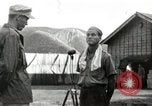
An American prisoner talks about the harsh treatment at a Japanese prison camp in Honshu, Japan during World War II.
American prisoners of war being interviewed at a Japanese prison camp in Honshu, Japan after World War II. A U.S. officer interviews a prisoner who has been liberated from a Japanese prison camp. The prisoner says that his name is James Robertson. He says that he is from St. Louis and was born in Chicago, United States. He speaks that he came to fight against the Japanese on April 22, 1941. He states that he was captured by the Japanese on May 6, 1942 in Corregidor, Philippines. He narrates an incident to prove that they were tortured at the prison camps. He also states how hot tea was poured on the legs of a prisoner.
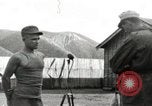
A freed American prisoner talks about the experiences at a Japanese prison camp in Honshu, Japan during World War II.
American prisoners of war being interviewed at Japanese prison camp number 3, in Honshu, Japan after World War II. A U.S. officer interviews a prisoner who has been liberated from a Japanese prison camp. The prisoner says that his name is Benini. He says that he is from Pennsylvania, United States. The officer asks him whether he was in the Philippines and when was he captured. He states he was captured before the Bataan Death March. He narrates his experiences of his prison camp, noting that a building in the prison camp was called the white house because it was large and painted white.
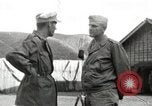
An American medical officer talks about the experiences at a Japanese prison camp in Honshu, Japan during World War II.
American prisoners of war being interviewed at a Japanese prison camp in Honshu, Japan after World War II. A U.S. officer interviews a medical officer who has been liberated from a Japanese prison camp. The medic says that he is from San Antonio, Texas. He talks about his early days. He says that he came to the Philippines on November 3, 1940. He discusses the difficulties faced by the medical officers at the prison camp. He narrates an incident where a soldier developed an infection in his foot and he lost nearly 20-30 kilos of weight. The medical officer also talks about the scarcity of medical supplies at the prison camp. He states that many men died due to malnutrition at the camp.

U.S. Secretary of Agriculture Clinton P. Anderson presents land to war hero Thomas Eugene Atkins in the United States.
Neighbors build a home for United States World War II hero and Congressional Medal of Honor recipient Thomas Eugene Atkins, in the United States. U.S. Secretary of Agriculture Clinton P. Anderson presents land and the home to the war hero. Atkins, a U.S. Army Private and war hero during service in the Philippines, shakes hands with Anderson. Atkins walks with his wife into the house. An plaque on the wall of the house commemorating the gift. Atkins and his neighbors eating during a country barbecue in Campobello South Carolina near Spartanburg, South Carolina.
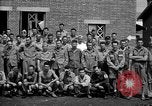
Japanese prisoners of war work under American guards and former American prisoners of war at a camp area in Mukden, Manchuria.
Showing change of prisoners from American to Japanese in Mukden, Manchuria during last days of World War II. Former POW (prisoners of war) Constant J. Wasilewaki, surviving POWs from cattle boat in which 1,623 POWs left the Philippines but only 400 reached Japan. Survivors of Bataan "Death March" includes Lieutenant Colonel Tarpley, Trspnell, Wilson and Lieutenant C.Y. Christis, men of 200th Coast Artillery corps. American prisoners of war Criville A. Johnson, Robert E. Butler worth play bass and guitar that they made while in prison. Cartoon called 'Changie- Changie' drawn by Benny Pinson, depicting change of prisoners from American to Japanese. Prison wall. High tension wire on top. Lieutenant Christie stack Red Cross carton atop pile. Japanese prisoners carry supplies under guard.

Technicians carry out tests on foot and mouth disease virus at the Plum Island Animal Disease Center in Long Island, New York.
A film based on the Plum Island Animal Disease Center in Long Island, New York which is dedicated to study of foreign animal diseases. Animated map of the United States of America depicts the New England region of the U.S. affected with foot and mouth disease of animals during year 1870 and Mexico and Canada affected by epizootics in 1946 and 1952 respectively. A technician stores animal foot and mouth disease virus in a laboratory freezer.
CRITICALPAST.COM: About Us | Contact Us | FAQs - How to Order | License Agreement | My Account | My Lightboxes | Shopping Cart | Advanced Search | Featured Collections | Website Terms & Conditions | Privacy Policy ©2026 CriticalPast LLC.
License Agreement |
Terms & Conditions |
Privacy Policy
©2026 CriticalPast LLC.