


 Francais
 Deutsch
 Italiano

Refine Your Search
Puerto Princesa Island Philippines 1945 stock footage and images
- Showing 2317 to 2322 of 9932 results more
 Hide
Color Sound

8th Fighter Group load trucks with equipment, barrack bags and supplies on Morotai Island, Indonesia, in World War II
Activities of U.S. Army Air Force 8th Fighter Group at Squadron Area on Morotai Island, Indonesia during World War 2. An operations building after being torn down. Trucks are loaded with equipment. 5 gallon water casks ready for shipment. Soldiers load the trucks. They cover the trucks The soldiers load barracks bags on a truck. The truck drives out. A supply officer inspects a water trailer. Several trucks drive out. Fighter pilots walk and talk. A dismantled mess hall. Mess hall refrigerators crated for shipment. The Squadron Area after tents have been torn down.
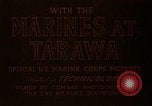
2nd Marine Division aboard transport ships headed to Tarawa, Gilbert Islands, during World War II
U.S. Marines boarding troop transport ships in World War 2. A line of the transport ships underway in the Pacific, en route to Tarawa, Gilbert Islands. The Destroyer, USS Frazier (DD-607) seen close to port, astern, with a line extending to the transport ship. A sealed packet of orders for the transport and the Marines is delivered over the line. Scene shifts to an officer briefing marines with help of a large relief map of Betio in the Tarawa atoll. The map is complete, in every detail, down to models of structures there. Marines are seen belting machine gun ammunition and test firing their weapons. Marines on deck exercise doing calisthenics. Officer briefing Coast Guard and Navy coxswains who will be operating landing craft during the amphibious assault. Religious service being conducted on deck by a military Chaplains, on evening of November 19, 1943. Catholic chaplain, Father Francis W. Kelly, Chaplain, U.S.N.R. saying Mass, for marines. (Narrator comments that many of these Marines were killed the next morning.)
U.S. Army 1st Cavalry unit: reenactment battle against Indians at Little Big Horn; actual battle footage in World War 2 at Los Negros Islands, Pacific
A documentary titled 'Hell For Leather' shows combat activities of the U.S. 1st Cavalry Division during wars. Dramatization shows a 1st Cavalry soldier seated on a step and his son touches the insignia of the U.S. 1st Cavalry division on the uniform. Reenacted footage of Cavalry unit battling Native American Indians at the Battle of Little Big Horn. Next scene shows training of U.S. Army cavalry troops for World War 2, as they run an obstacle course and practice bayonet drills. The troops undergo combat training. They practice amphibious landings and crawling near razor wire. Animated map shows the amphibious attacks on Los Negros Island in 1944. A ship underway and soldiers on the deck of the ship. Ship guns are fired in Battle of Los Negros. The U.S. Army troops load a Landing Craft and it gets underway. They approach the shore and get off from the landing craft at the beach. The troops hold guns and advance in jungle region, firing rifles and machine guns, engaging enemy Japanese marines protecting the airfield. The U.S. Army troops firing and advancing against the Japanese. The wounded soldiers on a stretcher. The soldiers fire artillery and mortars. View of dead Japanese troops. The U.S. troops advance. U.S. General MacArthur praises a soldier. 'Bataan' written on the barrel of a gun.

U.S. Brigadier General Haywood S.Hansell Jr. pilots the first B-29 to land on Saipan, Marianas Islands, during World War II.
The first U.S. Army Air Force B-29 to be based on Saipan, comes in for a landing and taxis onto the ramp at Isley Airfield, Saipan, Marianas Islands, during World War II. A Crowd of U.S. military personnel surround the airplane. Brigadier General Haywood S.Hansell Jr., Chief of 21st Bomber Command, who flew the airplane, is greeted by Colonel Robertson, Colonel Shelmeyer, and other officers, on the ramp in front of the aircraft. Many C-47s and one C-54 cargo aircraft is seen on the ramp. The aircrew stand beside B-29, which bears "T Square 5" tail markings, identifying it as belonging to the 73rd Bombardment Wing, 498th Bomb Group, 873rd Bomb Squadron. Its tail number is: 42-24614. (It is named: "Joltin' Josie, The Pacific Pioneer." )

U.S. Army Air Force mechanics perform nighttime maintenance on B-29 engine, Saipan, Marianas Islands, in WW II
U.S. Army air Forces B-29 Super Fortress mechanics working on engine of a B-29 at night, on Saipan, Marianas Islands, in World War Two. Maintenance stands are set up around the engine and lights illuminate the scene for the mechanics.
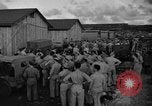
B-29 crews of 73rd Bomb Wing receive mission briefings at Isley Airbase, Saipan, Marianas Islands, during World War 2
United States Army Air Force B-29 crews prepare for a mission on Saipan, Marianas Islands, in the Pacific. Crews assembled outside a briefing hut. Crews who have already been briefed leave the briefing center. Those waiting enter. Views inside the briefing hall. Mission briefer refers to large map on the wall as he points out information and Japanese targets.
CRITICALPAST.COM: About Us | Contact Us | FAQs - How to Order | License Agreement | My Account | My Lightboxes | Shopping Cart | Advanced Search | Featured Collections | Website Terms & Conditions | Privacy Policy ©2026 CriticalPast LLC.
License Agreement |
Terms & Conditions |
Privacy Policy
©2026 CriticalPast LLC.