


 Francais
 Deutsch
 Italiano

Refine Your Search
Puerto Princesa Island Philippines 1945 stock footage and images
- Showing 3229 to 3234 of 9932 results more
 Hide
Color Sound
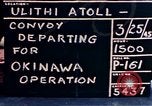
U.S. Convoy departs for Okinawa operation from Ulithi Atoll in Caroline Islands.
U.S. convoy departs for Okinawa operation. View from side of ship, convoy leaves Ulithi Harbor. LST (Landing Ship, Tank) sails ahead. Craft with signal flags up. Anchor comes up from water. Ship rides roughly in sea.
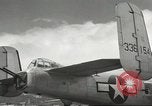
United States B-25 bomber and crew at Alexai point Landing Field, Attu Island, Alaska
Shown is tail section of a U.S. B-25 medium bomber, tail number 43-36154, assigned to the 11th Air Force, 77th Bombardment Squadron (Medium). Twin tails and tail gunner position and guns visible. Snowy slopes seen in background. In the first scene that shows members of the flight crew standing in front of number two engine, they are believed to be: starting back left (moving to the right behind the propeller): Armorer/Tail gunner: Samuel Ward Craig (Shelocta, PA), Pilot: Willard L. Castledine (Three Rivers, MA), Radioman/Waist Gunner: Hugh W. Wilson (Paducah, KY), (coming around to the front of the propeller on the right moving left), Navigator/Bombardier: Kemmer W. Schricker (Davenport, IA), Co-Pilot: Kenneth H. Wait (Rickreal, OR), Engineer/Turret Gunner: Roman F. Ales (Luling, TX) The crew members pull engine #2 through, with the propeller, to assure against hydraulic lock, before starting. (World War II period).

General Simon Bolivar Buckner, Admiral Mitscher and Admiral Richmond K Turner plan an invasion of Okinawa.
Invasion of Okinawa. U.S. Army and Navy headquarters in Guam, Pacific Ocean. Army and Navy officers walk along path in exteriors of building. Officer arrives to his flagship at fleet's starting point. U.S. convoy underway at sea. General Simon Bolivar Buckner, Admiral Mitscher and Admiral Richmond K Turner in conference examine map. Map shows Kerama Islands near Okinawa. U.S. convoy underway and naval bombardment. Landing crafts advance toward island in Kerama group. Amphibious landings on islands in the Kerama group by 77th Division and the 305th Regimental Combat Team. Troops advance and fight enemy. Dead Japanese soldiers. U.S. soldiers question Japanese prisoners and natives. (World War II period).
United States soldier finds and destroys a Japanese Shinyo suicide motorboat (WW2)
A Japanese suicide boat near the Kerama Islands (32 kilometers south-west of Okinawa Island), Japan during World War 2. A coast in the Kerama Islands. A Shinyo-class suicide motorboat is found covered with foliage as camouflage. A United States soldier throws a phosphorus grenade into the suicide boat. Suicide boat in flames. Scattered remains of a suicide boat after its destruction. Motor parts are scattered in the jungle. A soldier inspects remains of suicide boat.

U.S. PBY Catalina flying boat picks up pilot survivors off the coast of Midway during World War II.
Survivors of crashed and ditched U.S. planes are rescued on Midway Island after Battle of Midway during World War 2. U.S. Army personnel on Midway Island after securing the same. Damaged buildings and pieces of Japanese planes on island. Gooney birds roam the island. U.S. PBY Catalina flying boat in flight. Crews of crashed U.S. planes leaving PBYs after being rescued. Some are carried on stretchers and placed in an ambulances. Ambulance is driven away (with door still open). A ditched U.S. airplane afloat and a ship nearby. Remains of destroyed hospital.
Major General Hardigg's speech on fat and oil recycling efforts; view of Halloran Army Hospital kitchen, Staten Island, New York
United States Army Major General Hardigg speaks about the need for saving waste fats and oils for recycling and reuse in the war effort during World War 2. Kitchen of Halloran Army Hospital is shown with Chefs preparing chicken and other foods, and saving fats. Homemakers and housewives shown straining fats through strainers to reserve and save fats. A housewife speaks to another woman. A girl presents a can of reserved fats to a store clerk who weighs it and gives the girl back a ration receipt.
CRITICALPAST.COM: About Us | Contact Us | FAQs - How to Order | License Agreement | My Account | My Lightboxes | Shopping Cart | Advanced Search | Featured Collections | Website Terms & Conditions | Privacy Policy ©2026 CriticalPast LLC.
License Agreement |
Terms & Conditions |
Privacy Policy
©2026 CriticalPast LLC.