


 Francais
 Deutsch
 Italiano
Refine Your Search
Puerto Princesa Island Philippines 1945 stock footage and images
- Showing 3223 to 3228 of 9920 results more
more Hide
Hide
Interview of Major Charles Sweeney, pilot of the B-29 that dropped the atomic bomb on Nagasaki.
Setting: North Field, Tinian Island in Marianas Islands. Major Charles Sweeney, pilot of the B-29 that dropped the atomic bomb on Nagasaki, is interviewed by Public Affairs Officer, Major John F. Moynahan, who identifies Sweeney as the "pilot of 'The Great Artiste', the second B-29 to drop an atomic bomb on the Empire." (Note: Major Sweeney was the regular pilot of the B-29, "The Great Artiste", which was scheduled to carry the bomb. But it needed to be re-instrumented for the mission. So, instead, he and his crew simply switched airplanes with Captain Frederick C. Bock and crew, whose B-29 "BocksCar" was already properly configured. Thus, "BocksCar" was the airplane from which Sweeney and crew actually dropped the bomb.) In the brief interview, Major Sweeney describes their difficulties in three tries at the primary target and their decision to proceed to their secondary target, Nagasaki. With less remaining fuel than planned, they were forced to recover at Okinawa. (World War II period).
A ship sails in the Hawaiian Islands. Coconut and fruit trees on island.
View of wash (loose broken water) and wake (disturbed water and waves) of a vessel as it moves along in water. Aerial view of a town in Hawaii. Bunch of coconuts on tree. View of leaves with fruit hanging on small branches. A large country house.
Bob Hope and his USO Troupe visit a U.S. Navy base on Mios Woendi island, Schouten Islands, Papua New Guinea, during World War II.
Bob Hope and members of his USO troupe ride on a PT boat during visit to entertain U.S. Navy personnel during World War 2. In opening scene, Bob Hope doffs his pith helmet as he strolls past the camera to climb aboard a PT boat (PT-331) of U.S. Navy Motor Torpedo Boat Squadron 21, where several naval officers greet him. Members of Hope's USO troupe, Patty Thomas, and Francis Langford, step from jeeps to board the PT boat. Next, the two are seen in the cockpit of the boat next to its captain, Lieutenant Kermit W. Montz, USNR, as the boat speeds along in the water. Among sailors occasionally glimpsed behind them is Radioman 1st Class bill Thielen. In change of scene, Bob Hope climbs out a hatch, holding onto his pith helmet to keep it from blowing off. The boat's number, 331 is clearly displayed on superstructure behind him. Various Navy sailors on deck. (Note: Squadron 21 received a Presidential Unit Citation for outstanding performance during the Huon Peninsula Campaign against Japanese forces from October 1943 to March 1944.)
Men aboard the USS Nautilus (SS-168) bombard Butaritari Island’s Lagoon (of Makin Atoll) on August 17th, 1942, during the Makin Island Raid.
USS Nautilus underway in the Pacific Ocean during World War II. Conning tower of the submarine. Men rushing to battle stations. They ready guns for firing. In the distance, smoke rises from two Japanese ships that the Nautilus hit in Butaritari’s lagoon. The bombardment was called in by men of the 2nd Raider Battalion during the 2nd Raiders’ famed Makin Raid of August 17-18, 1942.
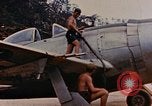
USAAF 464th Fighter Squadron crew members refuel P-47N on Ie Shima, near end of World War II
Shirtless U.S. Army Air Forces ground crew members refuel a 464th Fighter Squadron, 507th Fighter Group, P-47N airplane, on Ie Shima Island, Ryukyu Islands, preparing to attack Kyushu, in final days of World War 2. Picture of a girl and the words 'Winkie Jean' painted on the nose of the P-47.
Aerial view of Arakabesan, Palau during a bombing mission (WW2)
Aerial view showing the coast, roads, and an airstrip during a U.S. Army Air Force bombing mission at Arakabesan, Palau in World War II. Clouds of smoke rises from bomb target sites on the Japanese held island. Aerial view shows other parts of the island.
CRITICALPAST.COM: About Us | Contact Us | FAQs - How to Order | License Agreement | My Account | My Lightboxes | Shopping Cart | Advanced Search | Featured Collections | Website Terms & Conditions | Privacy Policy ©2026 CriticalPast LLC.
License Agreement |
Terms & Conditions |
Privacy Policy
©2026 CriticalPast LLC.