


 Francais
 Deutsch
 Italiano
Refine Your Search
Puerto Rico 1966 stock footage and images
- Showing 193 to 198 of 1088 results more
more Hide
Hide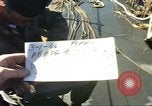
U.S. motorized Alvin craft enters the flooded well deck of a U.S. landing ship during aircraft salvage operations off Palomares.
Salvage operations off the coast of Palomares, Spain by the United States after 1966 Palomares B-52 crash incident. Motorized Alvin craft moves through water. The coastline of Palomares in the background. Alvin moves underway on the surface. Two lines run out to Alvin which is being towed. Divers are in the water next to Alvin. U.S. personnel on the deck of a ship and Alvin being pulled towards the side of the ship. Alvin enters the flooded well deck of an LSD (Landing Ship, Dock).
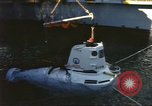
U.S. motorized Alvin craft hoisted to the deck of an LSD during aircraft salvage operations off Palomares, Spain.
Salvage operations off the coast of Palomares, Spain by the United States after the 1966 Palomares B-52 crash incident. A motorized Alvin craft enters the flooded well deck of an LSD (Landing Ship, Dock) off the coast of Palomares. Many lines are fastened to Alvin to pull in to proper position. The tail gate of the LSD rises for the closing of the well deck. A sling is lowered over Alvin. A man in the conning tower of Alvin and a man on the deck prepares to make a hook-up. Alvin in the flooded well deck. A rubber boat is alongside. A crewman jumps into the rubber boat from the deck. One man stands on the deck of Alvin. The sling is attached for hoisting Alvin out of the water. Alvin being hoisted high up into the air by the ship's crane. Several lines are extended to the left and the right to keep Alvin steady. Alvin in the air hanging from the crane hook, framed by a part of the LSD. Alvin is lowered to the deck of the LSD. A large group of men around Alvin with some holding guy lines and some looking on.
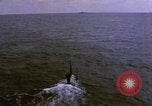
U.S. Submarine USS Sabalo (SS-302) torpedoes the U.S. Destroyer Escort, USS Foss (DE-59) in live fire test
The U.S. Submarine USS Sabalo (SS-302) torpedoes the U.S. Destroyer Escort, USS Foss (DE-59) in a live fire test of new proximity fuse for MK 16 torpedo. View from above, of the Sabalo heading toward the Foss, in the Pacific Ocean, off the California coast. Slight trace of the torpedo visible as it runs toward the Foss. The torpedo hits amidship with huge explosion that breaks the Foss in two. A LIVE TORPEDO TEST BY USS SABALO SS-302 6 September 1966
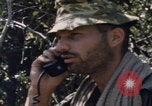
United States Marines assist in Haiti after devastation by Hurricane Inez
A United States Marine Corp (USMC) Marine uses a field telephone. A Marine smoking a cigarette seen from behind. Marines fighting in a jungle. Louis W. Walt, 3rd Marine Amphibious Force Commanding General in 1966, speaks about the Marines in various wars. A Marine with a cigar in his mouth. An impoverished woman with child. A young African girl holding a basket of bread. A United States Marine Corp Sikorsky H-34 helicopter in flight. Marine helicopter squadron 365 moving in from the aircraft carrier USS Boxer (CV-21) to Caribbean countries affected by Hurricane Inez such as Dominican Republic and Haiti. Sikorsky H-34 helicopter takes off from USS Boxer. Aerial view of a town damaged by Hurricane Inez. The Sikorsky H-34 helicopter lands in Haiti. Haitian civilians, including a Roman Catholic nun, talk to United States Marines. Haitian newspaper front page features news about President Duvalier “Le Président Duvalier agit contre les effets du Cyclone” in French. An English translation “President Duvalier acts against the effects of Hurricane Inez” replaces the headline. A Marine medic treats a patient while a Haitian man covers his face from the sun. An injured woman with her child with their heads covered by gauze. United States Marine checks head injuries of hurricane victims and put bandages on patients. Haitian civilians carry an injured man on a makeshift stretcher. Injured Haitian children and a girl with an arm cast. Civilians carry supplies. Children walk in a village destroyed by Hurricane Inez. A Marine carries corrugated aluminum sheet for roofing. Marines help Haitian civilians rebuild houses in the village.
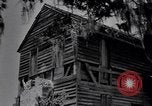
Forks of Cypress plantation home and other sites, likely in Alabama, circa 1939; African American man tending a large bell.
From the U.S. Department of Agriculture documentary "The Land." A seemingly abandoned, dilapidated house at an unidentified farm or former plantation location, possibly in Alabama, during the Great Depression. Spanish moss hanging from nearby trees. Views of a different, wooden, rundown house with a front porch, possibly at a different location. Scene changes again to a third different house, this one made of brick. A lone African American man emerges from double doors of the house. He walks up to a bell, cleans it, and rings it. Distant open view in front of the bell includes a valley and river (possibly the Tennessee River in western Lauderdale County, but not confirmed.) Scene changes again to show the first house and the trees with Spanish Moss. View returns to the location with the man tending the bell. Next scene shows the Forks of Cypress plantation house in Florence Alabama, (Lauderdale County). View of the old main Greek Revival Forks of Cypress house built in 1830 for James Jackson. View of the west elevation of the house. The smokehouse is seen behind and to the side of the main house. A clothes line with clothes on it is beside the smokehouse. Chickens walk on the porch of the house, past its tall colonnade of 24 ionic columns. (Note: The house burned completely in a 1966 fire). Next scene is again the elderly African American man at the brick house location. He looks around, mumbling to himself, walks back towards the house, and pauses on the front steps. The first wooden house with Spanish moss in nearby trees is shown again. Scene returns to the elderly African American man who enters the brick house and closes the doors behind him. Film directed and narrated by Robert Flaherty.
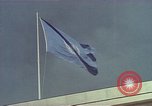
UN 18-Nation Committee on Disarmament meets in Geneva; Hundreds of thousands in Washington DC protest Vietnam war
Meeting of the Eighteen-Nation Committee on Disarmament (United Nations) on January 27, 1966, at the Palace of Nations, Geneva, Switzerland. Seen among others are: William C. Foster, U.S. representative,and Director of the Arms Control and Disarmament Agency; Soviet chief negotiator, S.K.Tsarapkin; and British representative, Lord Chalfont (Alun Arthur Gwynne Jones, Baron Chalfont). Views of the meeting starting with Mr. Tsarapkin as the Chair. Camera pans interior of the Palace of Nations. View of the outside of the building. Press briefing with closeup of Mr. Tsarapkin as he voices the USSR support for discussion of draft treaties to stop the spread of nuclear weapons. Closeups of U.S. delegate William Forster standing by a lake as narrator speaks of the hope for progress. Next scene is three years later: shows Joan Baez singing her song "Last night I had the strangest dream," at a Moratorium to End the War in Vietnam rally near the Washington Monument, in Washington, DC, on November 15, 1969. This gathering of hundreds of thousands of antiwar citizens, in peaceful protest, was organized by the National Mobilization Committee to End the War in Vietnam. View of peaceful crowd of demonstrators gathered on the Washington Monument Grounds, listening to Baez sing. Next scenes show views of various boy and girls all over the world. Children of many races and nationalities are seen including Indian, Middle eastern, African, Asian, European, and American children. Some of the children are smiling or playing. Some are standing near a radar or radio control tower. One boy is standing behind barbed wire. Clip ends with scene inside a United States nuclear missile silo (possibly Minuteman), with a team of two Air Force personnel on duty, always at the ready to launch missiles if required. Closeup view of a 24 hour clock is seen ticking, and one of the personnel in the silo watches it closely. A key hangs from the clock. Another airman is seated at a desk in the missile silo.