


 Francais
 Deutsch
 Italiano
Refine Your Search
Rio de Janeiro Brazil 1946 stock footage and images
- Showing 793 to 798 of 2633 results more
more Hide
Hide
Extracting salt from Lake Lake Baskunchak in the Soviet Union (USSR)
Salt being extracted from the surface of Lake Lake Baskunchak, 270 km North of the Caspian Sea, USSR. Narrator says it is sufficient for the needs of the entire Soviet Union. View of waves rippling over salt deposits in a part of the Russian lake. A dredging-type tool spins as it grinds and extracts salt from the lake surface. A conveyer system carrying the extracted salt to rail cars. A woman inside a control shack, on a railroad car, controls the speed of the conveyer with a large wheel. Salt is seen clearly deposited on the conveyer panels as they rise. View from below, of the control shack and water being discharged back into the lake from a pipe. View of the conveyer, mounted on its rail car, emptying salt into a train of open rail cars on a parallel set of tracks. At the same time water flows from its discharge pipe, on the opposite side, back into the lake. Finally, a locomotive is seen pulling rail cars filled with salt.
Horses in the Kirghiz Steppes of the USSR being moved to their winter quarters.
Hundreds of horses are seen being herded by Kyrgyz horsemen, inhabitants of the Kirghiz (Kyrgyz) Soviet Socialist Republic (formerly known as Kirghizia). The horses are being moved from summer quarters in the mountains to winter quarters. Closeup of horses and a famous breeder who is also a member of the Kirghiz parliament. He is in charge of the annual drive of horses to their winter quarters. Horses moving as a herd across mountainous land and later being escorted singly, by men on horseback, along a tree-lined trail. Narrator states these horses are generally a cross between Kirghiz breeds and English purebloods, and have won many races on Soviet racetracks. Next, men are seen riding their horses into Lake Issyk-Kul for a bath. They ride out again and across the sandy shore. Mountains are visible in the background. The final scene shows horses in their winter quarters stalls.
Ukrainians and Belorussians, who fled to France to escape poor treatment under Polish domination, return home after 20 years.
The Soviet ship Vyacheslav Molotov is seen, docked at the French port of Le Havre. A crane raises cargo onto the ship. Ukrainian and Belorussian passengers stand on the pier, ready to board the ship that will take them to their former hometowns. One woman walks up the gangplank with a flag and a carryall displaying the image of Joseph stalin. On the pier, French Army officers process the embarking passengers, as a Soviet Army officer stands nearby. Closeup of documents being stamped. (Narrator states that these refugees fled their homes for France, 20 years earlier, when they were under the domination of Poland.) The Soviet officer encouraging passengers up the gangplank. View from high on the ship, of passengers clustered around the processing station. Camera pans up to the ship's funnel, where Soviet hammer and sicle is displayed. View from behind people waving on the dock, of the passengers lining the railing of the ship, waving goodbye as the ship slowly begins to move forward and then is seen underway. Scene fades to reopen showing the ship in waters of the Black Sea approaching the port of Odessa, Ukraine. Buildings seen upon cliffs overlooking the port. Several views of the passengers assembled on deck looking toward shore. Closeups of passengers and their flags. A Ukrainian woman gives a speech about her joy at homecoming. Other passengers applaud. A man holds up a homemade sign reading (in Russian) "LONG LIVE SOVIET-HOMELAND I-EE-GOVERNMENT." Passengers disembarking down the gangplank, carrying flags and riding in open small trucks away from the ship.
People work for the development of a better community in rural Georgia, United States.
An organized effort for development of a better community in rural Georgia, United States. A woman works in a garden. A house in the background. A boy plays with pups. A girl in the garden. A family sits in the garden. A sign reads 'Atlanta, Chamber of Conference'. Men in a meeting. A document reads 'Farmer's Club'. They discuss about development of better community. A sign outside a building. The sign reads 'Chamber of Conference'. Traffic on a street. A newspaper headline reads 'The Atlanta Georgia'. A geographical map traces the communities in Georgia. People sit around a table. Community meetings take place. Men and women tend to gardens. School buildings are maintained. Women cook in kitchen. Children eat in a school mess. Hot lunch programs being instituted in the school. School children in a library. Medical check up and immunization of children. Signs of different communities.
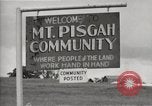
Improvement in dairy farming and poultry farming in rural Georgia, United States.
An organized effort for development of a better community in rural Georgia, United States. A sign reads 'Welcome, Mount Pisgah Community'. People work in farms. A tractor in a farm. Land improvement program for the development of better communities in rural Georgia. Farms are maintained. Men work in a poultry farm. Men clean glass jars. The men unload sacks and keep them in stores. Hens are kept in pens. A man collects eggs. Balanced farming programs in rural Georgia. Cattle on farms and dairy farming programs. New agricultural machinery on a farm.

Community meetings are held in rural Georgia for better development of Georgia, United States.
An organized effort for development of a better community in rural Georgia, United States. A family sits around a table and plans about food supply for better nutrition. Community meetings are held in rural Georgia for better development. A girl demonstrates cooking in a meeting as a group of women, a boy, and a man watch. Other members of the community are seated. Improvement of home gardens in Georgia. A man waters the plants and crops in a garden. Filled canning jars arranged on the shelves of a kitchen. A man keeps vegetables and meats in a home freezer. A teenage boy gets a jar from a kitchen cupboard or pantry. A community meeting being held. A man demonstrates latest developments. A woman works in a kitchen. Children enjoy on swings. A boy picks letters from the mail box at his home. Families stand in a group. A family sits on a sofa.
CRITICALPAST.COM: About Us | Contact Us | FAQs - How to Order | License Agreement | My Account | My Lightboxes | Shopping Cart | Advanced Search | Featured Collections | Website Terms & Conditions | Privacy Policy ©2026 CriticalPast LLC.
License Agreement |
Terms & Conditions |
Privacy Policy
©2026 CriticalPast LLC.