


 Francais
 Deutsch
 Italiano
Refine Your Search
Rio de Janeiro Brazil 1946 stock footage and images
- Showing 1885 to 1890 of 2633 results more
more Hide
Hide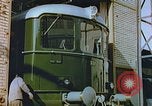
European rail and air transportation developments and operations after World War II
Postwar rail and air transportation facilities and operations in Europe. A new railroad locomotive moves out of a factory in Switzerland. The engineer looks out his side window as it rolls out. A train moves along a track next to a road that then crosses in a level crossing. A car stops for the train, as it passes. People walk on the modern concourse of Roma Termini railway station (Piazza dei Cinquecento, 1, 00185 Roma RM, Italy) in Rome, Italy. A train moves on the Lorraine railway viaduct (Lorraineviadukt 3013 Bern, Switzerland) in Bern, Switzerland. Views of several new bridges in Europe. Traffic on a road hub with cloverleaf loops. A British Overseas Airways Corporation (BOAC) De Havilland Comet jet passenger airliner taking off. Sign reads “Order of Formalities on arrival 1. Sanitary control 2. Passport control 3. Declaration of currencies 4. Baggage inspection”. Sign reads “…De Police control de Policia…”. An immigration officer stamps the passport of a female passenger. Sign reads “Controle Sanitaire Sanitary Control Arrival – Contro…”. Officer stamping passport at airport. “Controle Currency Control”. A man hands over his passport to an officer. Passenger opening baggage for inspection while going through customs at a French airport. Customs officer marks the baggage. View from under the tail of a DC-6 passenger plane taxiing out for takeoff. View of a Transworld Airlines (TWA) Lockheed Constellation passenger plane in flight shortly after takeoff from airport.
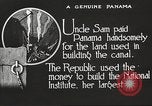
The National Institute building, Spanish style balconies and the President's house in Panama City, Republic of Panama.
New buildings in Panama City, Republic of Panama, after the opening of the Panama Canal. The National Institute building (C. Estudiante, Panamá, Provincia de Panamá, Panama) in Panama City. Spanish Colonial style balconies in a row of houses. A Panamanian boy with a rag tied around waist walks on a street. Views of the Palacio de las Garzas or the President's House (Av. Eloy Alfaro, Panamá, Provincia de Panamá, Panama). People walk past on a street.
Scenes of Paris, France and French civilians under German occupation during World War II.
The city of Paris, France under German occupation during World War 2. View from above of Place de l'Opera and l'Academie Nationale de Musique - Theatre de l'Opera, with citizens going in and out of the metro subway station. Many new German signs seen. Point of view from moving vehicle of pedestrians, shops, and busy streets of Paris. POV from moving vehicle of French civilians on bicycles and German soldiers on foot. German vehicles drive along the streets.The Hotel Crillon with Swastika flags in front. A large sign in German reads Deutsches Soldatenkino (for a German Soldier's cinema or movie theatre). Sign for "Soldatenheim der Kommandantur gross Paris" (German Military Commander's headquarters in Paris.) People ride bicycles. German trucks drive along the street. French civilians in a line in front of a store, queuing for rations or supplies.
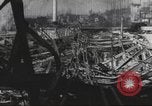
1937 Ohio Valley flood scenes, with major loss of property and life in the United States.
Damage caused by 1937 flood in the Ohio Valley area of the United States. A heavy loss of property due to a flood. Supplies being unloaded from trucks for the people. People being rescued from the areas affected by flood. Men aboard boats moving through buildings on the edge of the Ohio River that are submerged in water. Men moving a wooden casket. Destroyed houses and buildings in the areas. Flooded streets. A weather vane blowing briskly in wind. Narrator details how the weather bureau forecasts the weather and offers the information to help prevent losses from such disasters. Automatic typing machine records weather instrument readings. View of newspapers being printed at a printing press. A radio tower. People gather near injured flood victims. People lined up on the street to get supplies. Scenes of floodwaters below Memphis where flooding was effectively contained. Water rushing under the then new Bonnet Carre spillway of Lake Pontchartrain near New Orleans. Man opens a book published in Lisbon in 1605, now in the Library of Congress, written by Gabriel Lobo Lasso de la Vega, reporting on the exploration team of De Soto on leaf 300 of the book. De Soto's group, in 1543, reported on the flood they saw below current day Memphis, extending over 20 leagues of land, covering the tops of trees, but not overrunning the homes of the Native Americans who build shelter atop high poles. A view of submerged homes in the 1937 flood are shown as the narrator laments that more modern people did worse than the Native American Indians.
Bomb destroyed civic building in Madrid, Spain; items from Liria Palace spread on lawn after fire during Spanish Civil War
A fleet of aircraft in flight over Madrid, Spain. View of the damaged National Museum of Anthropology (C. de Alfonso XII, 68, 28014 Madrid, Spain) with rubble and bomb damage around. A hole-riddled and damaged portrait of a woman holding a skull in her hand. Next scene shows the Palacio de Liria (Liria Palace). Many items are strewn on the lawn of the palace, having been evacuated during fire in the palace. Smoldering ruins of parts of the Liria Palace (C. de la Princesa, 20, 28008 Madrid, Spain). A statue on the lawn presumably of a member of the House of Alba (possibly Jacobo Fitz-James Stuart, 17th Duke of Alba). Chairs and furniture scattered on the lawn. A royal carriage hastily moved onto the lawn. A man sitting inside another royal carriage. Desks, chairs, cabinets, sofas, and other furniture all over the garden lawn. Views of the damaged palace. A stuffed polar bear on the lawn. Piles of books and behind them a suit of armor. Close up views of many library books piled on the lawn, having been moved during the fire.
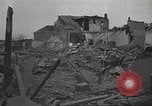
Children being rescued from the debris of bomb damaged buildings in Spain during Spanish Civil War.
Civilians and soldiers rush to clear debris and look for survivors in a town in Spain after it was bombed during the Spanish Civil War. Debris and rubble of damaged houses. People clear out the debris. Soldiers in what appear to be Republican uniforms assist civilians in combing through the wreckage and looking for survivors. They rescue trapped men and a trapped child from the debris. A man runs with a rescued girl and puts the child into a car for medical assistance. Concerned and upset citizens show grief and anguish on their faces. View of a poster or wall painting that shows gorilla arms painted with Nationalist flag markings, reaching toward a frightened woman dressed in a formal dress. The gorilla arms show the arrows symbol seen on the flag of the Falange Española Tradicionalista y de las Juntas de Ofensiva Nacional Sindicalista (FET y de las JONS). A concerned looking woman holds a young child in a blanket. Debris, furniture, and belongings scattered among the rubble. Another child is rescued by a group of people, but does not appear to be alive.