


 Francais
 Deutsch
 Italiano
Refine Your Search
Rio de Janeiro Brazil 1946 stock footage and images
- Showing 205 to 210 of 2632 results more
more Hide
Hide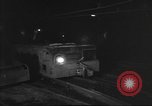
Westland Mine coal miners return to work after end of walkout of 400,000 miners called by United Mine Workers.
At start, the film shows coal miners riding on electric-powered open railway cars at the Westland Mine in Pennsylvania, owned by the Pittsburgh Coal Company. The miners wear hats with lights on them. A train of open hopper cars filled with coal is being pulled by the last railway car carrying miners. Scene changes to above ground where a string of minecarts filled with coal are emerging from the mine into a railroad yard. Closeup of large chunks of coal in the hopper cars. Another view of filled mine carts being pulled out of the mine. View of full-size open rail cars lined up underneath an overhanging wooden tipple discharging coal into them. Closeup from underneath the tipple showing coal dropping into full size open hopper cars. Next, a long train of full hopper cars are seen moving along a railroad track, being pushed by several electric-powered locomotives. They pass on tracks near other cars being loaded with coal. A miner writes: "Mon Dec 9," with chalk on a brick structure. (This is the day the miners returned to work, following announcement by United Mine Workers President John L. Lewis, on December 7, 1946, calling an end to a walkout of 400,000 coal miners that he had called on November 20). Two 2-8-2 Mikado steam locomotives owned by the Montour Railroad pull a long train of coal cars. View in background of duplex homes of the coal town in Westland, Pennsylvania. Next scene shows elevated view of city of Pittsburgh, Pennsylvania, from approximately Duquesne Heights area, with distant view of downtown buildings, and steel bridges over the three rivers area (Monongahela River, Ohio River, and Allegheny River). Next scene shows many industrial smoke stacks emitting smoke. Final scene shows a train of empty hopper cars returning to the coal mines.
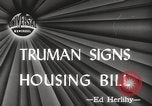
United States President Harry Truman signs housing bill in Washington D.C . that will help provide homes for the homeless.
United States President Harry S. Truman signs Housing Bill in Washington D.C., United States. President seated at desk as he signs the the Veterans Emergency Housing Act of 1946, during a housing shortage for veteran soldiers and their families after World War 2. Officials stand behind him at the White House. President Truman signs the bill that will help provide homes for the homeless. He speeds authorization of $250,000,000 for emergency homes.
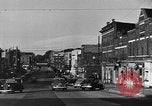
Traffic in business section of unidentified U.S. town; brief view of riverboat; then views of shops on West Main Street in Madison Wisconsin
Majority, but not all of clip shows Madison Wisconsin circa 1946. Clip opens with views of an unidentified town in the United States. Automobile traffic on street of the town. Long views in distance suggest possibly western United States. Next scene is a very brief view of a riverboat or steamboat on a river. Next scene is Main Street in Madison Wisconsin, with cars and trucks on street. Capitol building dome in Madison is visible in distance. Point of view from a moving vehicle of shops and businesses on West Main Street in Madison, Wisconsin. Businesses include The Drake; Fashion Shop; Chris Eckert; Edward Eckert at 125 and 127 W. Main Street. Next is "W. H. Hanger Plumbing and Heating at 123 West Main Street, Madison, Wisconsin. Then a Steak and Fried Chicken restaurant. Next is Margaret's Beauty Salon; Goodyear Tires; J.C. Penney Company. Scene changes to a house. A man comes out of a house carrying a fishing pole. Brief scene of two young men in a library.
Winston Churchill receives the Doctorate award at Westminster College in Fulton, Missouri.
In March 1946, Prime Minister of the United Kingdom Winston Churchill arrives in Fulton, Missouri. Winston Churchill arrives in a car. He exits the car. Churchill enters a building. U.S. President Harry S. Truman waves to the crowd. With him, Winston Churchill smokes a cigar and waves to the crowd. At Westminster College, Winston Churchill is seen dressed in a cap and gown. He receives a Doctorate award. View of people seated as audience in the auditorium hall. They applaud. Churchill seated on a platform. Harry S. Truman making a speech. Churchill speaking at the podium. (This was where Churchill delivered his famous "Iron Curtain" speech. The speech is not heard in this clip. Only German narration is heard.)
Hermann Goering testifies about Vidkun Quisling of Norway during the Nuremberg War Crime Trials in Germany.
1946: Nuremberg War Crime Trials in Nuremberg, Germany. A courtroom. The prisoners in dock showing German politician Hermann Goering and other defendants. An unidentified witness on a stand. People seated on a Bench. Justice Robert H. Jackson presiding. Goering walks to witness stand and sits down. The prisoners in the dock. Goering giving testimony about Vidkun Quisling of Norway. Spectators in the courtroom.
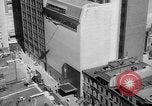
Men gets information from information booth regarding the Chiquita Banana program on the World Food Problem
Aerial and street level views of the CBS (Columbia Broadcasting System) recording studios in New York City in 1946. 1940's vehicles parked outside the CBS Studio building. Cars and a taxi pass by. Promotion for a Chiquita Banana benefit program on the World Food Problem. CBS lobby towards a street as a crowd exits. People at an information desk in CBS Studio. A girl in an information booth. A man gets information on where the Chiquita Banana show is within the building. Views of people getting information from the young woman in the information booth.
CRITICALPAST.COM: About Us | Contact Us | FAQs - How to Order | License Agreement | My Account | My Lightboxes | Shopping Cart | Advanced Search | Featured Collections | Website Terms & Conditions | Privacy Policy ©2026 CriticalPast LLC.
License Agreement |
Terms & Conditions |
Privacy Policy
©2026 CriticalPast LLC.