


 Francais
 Deutsch
 Italiano
Refine Your Search
Rio de Janeiro Brazil 1946 stock footage and images
- Showing 2311 to 2316 of 2632 results more
more Hide
Hide
A film sketch about U.S. President Ronald Reagan and tracing his personal history and career leading to the Presidency in the 1980 election.
Opening scene shows U.S. President Ronald Reagan holding a little girl, and then standing with officials and Secret Service agents, as he prepares to enter a car. Closeup of him smiling. Closeup of President Reagan signing his autograph for spectators in a crowd. Next, Reagan and his wife Nancy are seen on November 4, 1980 waving to supporters at the Century Plaza Hotel, celebrating his election victory as the 40th U.S. President. The President elect says a few words of thanks to them. Views of the crowd cheering. Adopted son, Michael Reagan holds his son Cameron as he and his wife, Colleen Reagan, join Ronald and Nancy Reagan on the stage, followed by daughter Patricia Reagan and son Ron Reagan. The crowd cheers the President elect and his family. At this point the film begins showing images about Ronald Regan's life, starting with baby pictures; his parents; Tampico, Illinois, where he was born; Dixon, where he is seen in a school picture and with boyhood friends. A photograph of "Dutch" Reagan President of his High School Class. Reagan in photo with other members of the Eureka College football team, in Eureka, Illinois. The seal of the college. Pictures of Reagan with college classmates and teammates. Reagan posing in bathing suit when he was swimming team coach. Young Reagan, after graduation, as a sports announcer, sitting at a microphone labeled: "WHO" in Davenport, Iowa. The broadcasting tower of that radio station. A Track and field event taking place. Reagan posing with a pipe in his mouth, at the WHO radio station in Des Moines, Iowa. A baseball game in progress before a full stadium of spectators. In 1937, a Chicago baseball team is seen boarding a ship to a Spring training camp in California. (Narrator states Reagan accompanied them.) Aerial view of buildings at the First National Studios (home of Warner Brothers) in Hollywood. Ronald and Nancy Reagan, circa 1952, being applauded at a gathering when he was President of the Screen Actors Guild. Views of Reagan in U.S. Army uniform. A U.S. Army C-47 aircraft taking off from a field under attack, with fires burning and smoke rising (possibly during Japanese December 7, 1941 attack on installations in Pearl Harbor, Hawaii). U.S. Airmen standing on a ramp next to a Douglas C-47B-1-DL transport aircraft (tail number: 43-16145). What appears to be a ViP version of a B-50 aircraft parked on a ramp with an honor guard at the stairway. Ronald Reagan, in uniform, signing up for active duty. Later, Captain Reagan, U.S. Army Air Forces, is seen with other uniformed men at a gathering in Warner Brothers studios. The entrance of Paramount Pictures studios in Hollywood. A large group of studio employees walking between buildings. Reagan speaking, as President, of the Screen Actors Guild, at an outdoor gathering. Actor Robert Young and film industry executives stand nearby. Reagan, as Chairman of the Motion Picture Industry Council, addresses a dinner gathering of that organization. He is also seen testifying before he House Committee on Un-American activities Committee (HUAC) on October 23, 1947.
Montage of battle scenes during major Allied counter offensive in World War I
Following bold attacks by German forces against English Channel ports in France, French General Ferdinand Foch orders a counter attack by all Allied armies. The film then depicts a montage of war scenes, growing shorter and in quicker succession as the film proceeds. Allied soldiers advancing across open battlefields on a broad front during counter offensive following German attacks against English Channel ports in France, during World War 1. Soldiers drop and take cover as shells explode in open field areas. Dead horses next to a destroyed wagon. Soldier running across open fields. German soldiers firing Maschinengewehr (Schwarzlose) M. 7 (Schwarzlose MG) machine gun. Allied gunners firing French 75 field artillery pieces. Allied soldiers carrying wounded on stretcher. Allied soldiers lifting and carrying shells from stacks of shells along their lines. A shell explosion close to the camera. German soldiers taking cover at upper edge of a bomb crater. One is struck and rolls backward. Allied soldiers wearing ponchos and firing machine gun. Soldiers with an artillery shell. German soldier falling back down embankment. Dead German soldier lying beside a knocked-out German machine gun. Ground level shot from trench or ditch of Allied soldiers emerging from trenches "over the top" and running on battlefield. Explosions on battlefield. Allied soldiers emerge from underground bunker with wood framed door. French soldiers marching on battlefield beside destroyed trees. French soldiers going over the top from trenches to advance in battle. Destroyed trees all around. Capture German soldiers marching along a trench. French soldiers carrying wounded soldier on litter. Trench with numerous bodies of dead soldiers. French soldiers hastily wheeling a wounded soldier on a cart. Numerous scenes of wounded French soldiers, some walking and bandaged. Flamethrowers being used on battlefield areas. Lines of multiple flamethrowers in use. French soldiers marching in a town. Some are supporting other soldiers and some hold rags to faces (possible gas attack victims). Schneider CA1 French tank moving in underbrush. French soldiers load and fire artillery. Heavy siege guns and howitzers being fired including an Italian siege howitzer Mortaio da 210/8. Dead German soldier on ground. French soldiers digging trench beside bodies of fallen soldiers. Shell being loaded in artillery gun. Explosions in valley as seen from high ridge overlooking battlefield. Heavily bandaged wounded soldier being carried by French soldiers and medics. Group of German prisoners; some bandaged. French carrying more wounded on stretchers. A French railway gun (Canon de 340 mm) on railway mounting is fired. Allied cavalry soldiers on horseback galloping across streams, some towing empty caissons that bounce going over embankments at high speed. Allied soldiers in trench. Large group of Allied soldiers taking cover in large bomb crater and then charging up and over the top through smoke screen.
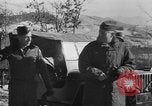
Lieutenant General Lucian K. Truscott assumes command of the 5th Army in Italy during World War II
On 10 December 1944, Lieutenant General Lucian K. Truscott, Jr. (newly appointed Commander of the 5th Army) arrives by jeep at a U.S. Army encampment in Italy during World War II. He is escorted the headquarters of II Corps, on the Apennine front below Bologna, where he is greeted by Major General Geoffrey T. Keyes. They walk together around a building. The next day General Truscott is seen saluting as he is escorted by Major General Willis D. Crittenberger, Commander 1V Corps. Next, General Truscott is seen at the headquarters of the Brazilian Expeditionary Forces contingent of the 5th Army, where he greets its Commander, General João Baptista Mascarenhas de Morais and his aides. As General Truscott leaves, his jeep passes a Brazilian honor of soldiers who salute him. Brigadier General, Donald Carlson. new Chief of Staff of the 5th Army, accompanies Generals Truscott and Crittenberger to a forward observation post near the village of Castelluccio. They observe from a bunker overlooking a valley, where white smoke is rising. (Narrator states that the smoke screen indicates the position of the Allied line of the IV Corps Sector on 11 December.) Next the three American officers are seen making their way up a mountain side, with smoke rising from the town of Vergato, in the background below, where heavy fighting is taking place. (World War II; WW II; World War 2; World War Two)
Germany institutes measures to increase war efforts on the home front during World War II
Captured German propaganda film designed to encourage the German population near the end of World War 2. The closed Theater des Volkes (Theater of the people) in Berlin is seen at it's start. Steel gates are being pulled across the entrance of the Deutsches Opernhaus (German Opera House). Steel gates are drawn across the entrance to the Schiller Theater on Bismarckstrasse in Berlin. A sign announcing the open hours at a play house, is covered by a cardboard. Likewise a sign at an opera theater is covered. (Narrator states that Joseph Goebbels, Nazi Reich Minister of Propaganda, has been given the title: "Reich Plenipotentiary for Total War.") City trams are diverted to carry war supplies. View of men loading boxes into one. A tram pulling rail cars loaded with freight. An automobile being towed by a tram. Morale boosting slogans posted in various places. (one reads "Relentlessly determined to win victory." Another reads "With the Leader (Fuhrer) to Victory." Joseph Goebbels, addressing a rally of armaments workers in the Rhineland District, tells them (according to the Narrator) "Before we admit the enemy to German soil, and submit ourselves to his will, we will first work our hands bloody and work to our last breath." The assembled workers applaud enthusiastically. Men and women over 65 years of age are mobilized to help with the war effort and seen engaged in light manufacturing. German miners coming off shift volunteer to dig trenches and prepare earthworks. The receive tools and march to a work site. Views of men digging defenses in East Prussia where it became urgent as the Soviet army drew near in October, 1944. In another similar scene, many women are seen working alongside men building defenses. A group of Nazi officers pose for pictures ostensibly working to also dig fortifications. A huge civilian work force is seen digging deep and wide ditches to stop or delay invaders.
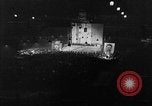
A Russian delegate speaks to French citizens at a Communist meeting in Paris France around the end of World War 2.
A Communist meeting in Paris France around the end of World War II. A sign "Bienvenue A La Delegation Sovietique" (welcome to the soviet deputation). Large photo images of Stalin and de Gaulle flank the stage on either side. A Russian delegate speaks in Russian to French citizens at the meeting. French audience seated in chairs. A French representative speaks to the audience.
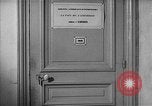
A secretary receives mails and speaks to listeners of 'The Voice of America' in Paris, France.
The office of 'The Voice of America' in Paris, France. An old woman delivers mail to Copans's secretary. She opens the door to Copans's office. The sign on the door reads "Service Americains D' Information, La Voix de L' Amerique, Simon J. Copans". View from the office: The secretary receives mail while speaking to a listener. A picture of Harry S. Truman on a wall. An old woman gives mail to her. The secretary selects important mail while speaking. Views of the listener while reading a booklet of 'VOIX'. The booklets of French and English versions of 'The Voice of America'.