


 Francais
 Deutsch
 Italiano
Refine Your Search
Rio de Janeiro Brazil 1946 stock footage and images
- Showing 241 to 246 of 2632 results more
more Hide
Hide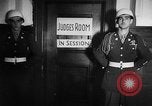
Nazi criminals are brought to justice as the Nuremberg Trials give final verdicts; scenes of World War 2 Nazi activities
Events related to the Nuremberg Trials held at the Palace of Justice in Nuremberg, Germany. Shows two guards standing outside the 'Judges Room'. Judges from Allied nations seated around a table. On 1st October 1946, judges give their final verdict. Scenes from the court room. Lord Justice Geoffrey Lawrence, President of the tribunal states the final verdict. Majority of the accused Nazi criminals are given death sentence, some of them given imprisonment and only a few are found not guilty. Multiple Nazi leaders are shown in the courtroom and in flashback scenes from the World War 2 years, including Hermann Göring, Rudolf Hess, Joachim von Ribbentrop and Wilhelm Keitel (both also shown at unidentified signing ceremonies), Ernst Kaltenbrunner, Alfred Rosenberg, Hans Frank, Wilhelm Frick, Julius Streicher, Walther Funk, Karl Dönitz, Erich Raeder, Baldur von Schirach, Fritz Sauckel, Alfred Jodl, Franz von Papen, Albert Speer, Konstantin von Neurath, Arthur Seyss-Inquart. Many flashback scenes show scenes of Nazi activities, Nazi atrocities, and the holocaust during World War 2 including: Boycott of Jewish shops and stores in 1930s, beating, dragging, and expulsion of resident Jews from ghettos, Nazi rallies with crowds giving Nazi salutes, book burning, massed overcrowded prisoner encampments, emaciated Concentration camp victims, nurses and doctors aiding starving and liberated concentration victims, gestapo dragging a man across a street, bin of gold teeth of murdered concentration camp victims being poured out for display, a German ship being launched, Erich Raeder meeting with Japanese military leaders or political leaders from Imperial Japan, and talking to Adolf Hitler; Hitler youth in training; Nazi slave labor workers at terraced hillside mines digging and doing mining operations; interior of a Nazi German submarine; German industrial worker at a steel furnace in a munitions war production factory. View of prison cells at Nuremberg Prison just north of Palace of Justice in Nuremberg, where some Nazi criminals were kept during the trials. View of exterior prison cell door of Hermann Goering. A guard patrols the roof of the Nuremberg Prison.
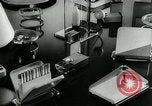
The challenges of reconstruction and rise of communism in Europe after World War II
Reconstruction problems in Europe in the aftermath of World War II. Examples of prewar Germany's industrial and commercial prowess, showing its consumer products and famous cameras. A German coal-burning power plant and miners extracting coal from Germany's vast natural supplies. Coal being transported by conveyer belt. Open rail cars loaded to capacity with German coal. A German iron and steel plant dependent on coal. Shift to postwar destruction including destroyed: German factory; locomotive; rail yards; trucks; farm machinery; fertilizer plant; farm fields lacking crops. Shift to prewar era with view of British coal cars getting ready to be emptied for export to Europe. Current postwar view of British coal cars and coal, that narrator says are barely enough for her own needs. View of prewar German coke being loaded onto conveyers. Coal miners receiving food ration cards. Animated map showing "Iron Curtain," of Soviet occupation, separating traditional German regions of agriculture from those of industry. British Foreign Secretary, Ernest Bevin; French Foreign Minister, Georges Bidault; Soviet Foreign Minister Vyacheslav Molotov; and U.S. Secretary of State, George Marshall; are seen at the Paris Conference in 1946 where they negotiated the postwar future of Germany. Reminder footage of Hitler with brownshirts in 1930s. Italian police coping with communist inspired unrest in Italy. Bombed out buildings in snow. Europeans literally scratching for bits of food from pavement and trash heaps. Two women fighting with each other during time of shortages and ration. Dejected woman. French Communist party leader, Maurice Thorez, speaking to a large crowd. Party flag with hammer and sickle behind him.
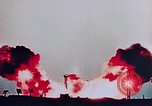
Test Launch of Soviet Intercontinental Ballistic Missile. Also aerial view of detonation of nuclear device in ocean.
Test launchings of R-16 intercontinental ballistic missiles from their underground silos. (Missiles are also designated by NATO code name SS-7 "Saddler" or as Soviet GRAU-8k64). Next scene shows detonation of a atomic bomb or nuclear device in water with ships surrounding the blast area. (Possibly from U.S. nuclear test in Operation Crossroads in 1946)

Hanging of a Nazi war criminal in Landsberg, Germany after end of World War II
Hanging of a Nazi war criminal in Landsberg, Germany after end of World War 2. . American Military officers stand and converse near the gallows. The condemned man, attended by guards and a priest, comes out of a building. They climb the stairs of the scaffold for hanging. An American Field Grade Officer speaks of charges against the condemned man. Soldiers stand near the gallows and watch the hanging. The hooded, condemned man is dropped through a trap by the executioner, Johann Reichhardt, who wears the traditional German executioners’ attire of black coat, white shirt and, black bow tie and black hat. (Reichardt who is clearly seen standing on the platform, was a principal executioner for the Third Reich. But he was subsequently employed by the Occupation Authorities from November 1945, through May, 1946. to help execute Nazi war criminals at Landsberg am Lech by hanging. He was subsequently arrested in 1947, interned, and tried in a tribunal at Munich, where he was sentenced to strict punishment measures.) A military doctor uses a stethoscope to confirm death of the hanging man.
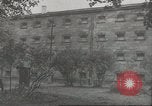
World War II war crimes trials; flashback views during World War 2; Nazi prison cells in Nuremberg; Japanese war criminals
Prison at Nuremberg, north of the Palace of Justice, where Nazi prisoners are held during Nuremberg trials in 1946. Cell of Nazi Admiral Doenitz is seen, with his name over the prison cell door. Nazi Admirals, Karl Doenitz and Erich Raeder, during the war. Views of war crimes at sea, with burning ships in flames at night. American soldier looks into prison cell of Joachim von Ribbentrop. Von Ribbentrop boarding an airplane, during the war. A German American Bund rally in the United States at Madison Square Garden in 1939, with Patriotic image of George Washington and massed American flags. Americans giving Nazi salute as Fritz Kuhn speaks. Fight or scuffle on the stage of the meeting. American military guard places food into cell of Nazi Julius Streicher. View of Julius Streicher giving a speech. Street scenes of Jewish shops being vandalized and boycotted in Germany. Boycott of Jewish-owned stores in Germany including posters and paint labeling Jewish businesses, and a poster that says, "Die juden sind unser unglück" (which means "The Jews are our misfortune"). Emaciated and thin liberated Concentration camp inmates being deloused. American soldier looks into prison cell of Hermann Goering. View of Goering in civilian clothes, sitting with companions, before the war. The Graf Zeppelin airship in flight over New York City. Officer on board Zeppelin shown plotting a course from the bridge. Shadow of the zeppelin air ship cast over an ocean liner at sea. Prison guard opens a door and goes in. Prisoners file out of the building, ostensibly to face firing squad. Airplane landing at Japanese airfield and scenes of military staff and military gathering of Imperial Japanese forces in Tokyo Japan during World War 2. Japanese General staff in a meeting. A Japanese military leader during a surrender meeting in World War II.
Work and achievements of Harry S. Truman during his first Presidential term in the United States
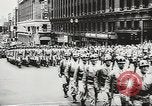
President Harry S. Truman marches with veteran soldiers of U.S. Army Company D (129th Field Artillery) with whom he served as an officer in World War 1. Wide view of men lined up on White House lawn. Disabled veteran soldiers of World War 2 greet the President. Narrator discusses problem of lack of housing for veterans and their families after World War 2. Aerial view of trailer homes or recreational vehicle (RV) camper units lined up in open space, serving as temporary housing for veterans. Truman sitting at desk while he signs the Veterans Emergency Housing Act of 1946. Views of long lines of new homes being built, and construction workers hammering to build frames of new houses in the United States. During a time of price inflation, scene shows grocer changing price signs on eggs, meats, cheeses to show increasing prices. Truman ata work in his office reviewing paperwork at his desk. Narrator mentions Taft Hartley Labor Act that Truman vetoed. View of car on road with sign on side that reads, "Veto Hartley Taft Slave Labor Bill." President Truman reading at his desk. Close up view of cover page of report entitled "To Secure These Rights. The Report of The President's Committee on Civil Rights. View of Episcopal church Bishop Henry Knox Sherrill seated at a desk. Bishop Sherrill is talking to another man. Narrator states that Truman acted on a civil rights program recommended by Bishop Sherrill, head of the Civil Rights Commission. Car pulling up to portico of White House and view of President Truman shaking hands with visiting President of Mexico, Miguel Alemán. President Truman being presented a sacred Torah by Israeli President Weizmann. Discusses foreign policy matters with Secretary of State George Marshall and comes up with Truman doctrine, Marshall plan and European recovery program. View of Truman signing Economic Cooperation Act of 1948 on April 3, 1948 (of which the Marshall Plan was a part).