


 Francais
 Deutsch
 Italiano
Refine Your Search
Romorantin France 1918 stock footage and images
- Showing 67 to 72 of 6001 results more
more Hide
Hide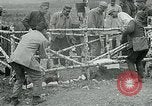
U.S. and French soldiers repair the grave of Lieutenant Quentin Roosevelt in World War I
French and American soldiers remove a makeshift fence from around the grave of Lieutenant Quentin Roosevelt (son of former President Theodore Roosevelt) who was killed during aerial combat in skies over Chamery, France, on June 14, 1918. He was buried with honors, in a battlefield grave, marked with a simple wooden cross, by German fliers. Now American and French soldiers are seen placing a new fence around the grave, along with a new cross and headstone, engraved in French. They also place floral pieces on the grave.
World War I armistice celebrations; Allied soldiers being decorated by General Pershing
People celebrate on the streets of New York after the Germans sign the armistice agreement ending World War 1 on November 11, 1918. People cheer and wave their caps. A French couple thanks Allied soldiers for rescuing them from Germany. Allied soldiers lined up in a field in France as U.S. General John J. Pershing decorates them. Troops of the United States 42nd Division march at a parade as General Pershing reviews them. Soldiers carry American flags at the parade.
U.S. Naval officers in Europe and the United States at the end of World War I
A glimpse of two U.S. Navy Captains exiting a dark alley, somewhere in France right after World War 1. Scene shifts to U.S. Admiral William S. Benson, the first Chief of Naval Operations, posing with Vice Admiral William S.Sims, Commander of all U.S. Naval forces in Europe. Several French men watch from inside an alley in the background. The two admirals turn to enter the building in the background. Next, a U.S. Navy Captain is seen standing on deck of a ship alongside another officer. Two American Naval officers smile and converse at a waterfront, in the United States. One is dressed in work overalls.A workman sits behind them in a shack that has a hand-scrawled message on the door reading:""No Smoking Allowed in here." Complete change of scene shows a line of young U.S. Naval officers replete with swords, entering a large brick Georgian revival building by way of a stairway at a side door. It appears they are entering an auditorium. What looks like a 1918 Phaeton car is parked at the curb outside. The officers number in the dozens. Another change of scene shows closeup of a an unidentified, relatively young, clean shaven, U.S. Naval Rear Admiral, posing in front of a stone wall behind which the tops of several widely separated buildings are seen. He removes his hat.
America embraces marksmanship training after Spanish-American War. American troops fire weapons in World War I
The uses and importance of weapons since ancient times in the United States. Pages showing U.S Congress Act creating the National Bureau for the Promotion of Rifle Practice, 1903. Exteriors of the 71st Regiment National Guard Armory building in New York City at Park Avenue and 33rd Street. People enter the building. German troops on parade circa 1914. American troops mobilized for World War 1, and traveling on troop trains in 1918. Troops moving along a muddy road, with military supplies in wagons being pulled by horses. American soldiers firing their 1903 Springfield rifles, from a bunker in France. Americans firing a M1914 Hotchkiss air-cooled machine gun and another U.S. gun crew firing a Browning M1917 water-cooled machine gun. U.S. troops wearing gas masks, firing a trench mortar. American gun crew firing a 155mm howitzer (as some hold their ears).French troops walk past destroyed buildings above which a blimp is seen flying with French observers in a gondola suspended underneath.
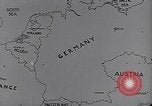
Human Liberty Bell; WWI leaders British General Haig, French General Petain, Italian General Diaz and King Albert of Belgium
Map showing Germany and nearby regions after conclusion of World War I. Writing indicates areas on map including Battle Line at End of Hostilities, Line to Which Germans Must Retreat, and Neutral Zone (between the two areas). Slate indicates that German Kaiser Wilhelm II had just abdicated (28 November, 1918) and shows footage of Kaiser Wilhelm II on horseback at a formal event. Next scene shows a massive human formation of soldiers in the shape of the Liberty Bell known as "The Human Liberty Bell", formed by 25,000 officers and men at Camp Dix, New Jersey to celebrate the armistice in World War 1 and the abdication of German Kaiser Wilhelm II. Camera pans upward to show the human bell from base to top. Next scenes show key Allied military leaders in World War I: British General Haig reviewing troops; France General Philippe Petain emerging from a building; Group of French soldiers marching; Italian General Diaz together with French officers reviewing troops; and King Albert of Belgium exiting a building outside Paris during World War 1 and entering a waiting horse-drawn carriage. View of United States President Woodrow Wilson reading newspaper and seated in a chair. (World War I; World War 1; WWI; WW1)
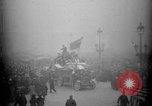
Armistice Day celebrations in Paris. Crowded streets, street lamps , flags everywhere.
Celebrations in Paris marking the signing of Armistice ending conflict in World War I, November 11, 1918. Open bus is packed to capacity with celebrants. Jubilant crowds are jammed together, waving flags, and shouting for joy. Man erects huge banner reading: "LArmistice est signe, La Guerre est gegnee, Vive La France, Vivent Les Allies!" Huge American flag is waved from center of crowd. Flags of the Allies are waved by people on balcony of building with lettering identifying it as "Mme Georgette".French sailors, in crowd, sing and wave flags. French Boy Scouts, in uniforms, run down the street towards the camera, followed by people of every age, size, and sort, all celebrating the end of war. Several French officers stand by as an impromptu parade begins.
CRITICALPAST.COM: About Us | Contact Us | FAQs - How to Order | License Agreement | My Account | My Lightboxes | Shopping Cart | Advanced Search | Featured Collections | Website Terms & Conditions | Privacy Policy ©2026 CriticalPast LLC.
License Agreement |
Terms & Conditions |
Privacy Policy
©2026 CriticalPast LLC.