


 Francais
 Deutsch
 Italiano
Refine Your Search
Romorantin France 1918 stock footage and images
- Showing 73 to 78 of 6001 results more
more Hide
Hide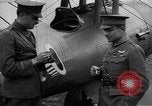
Major John W.F.M. Huffer and Major Raoul Lufbery beside a Nieuport 28c.1 airplane, during World War I
United States Army Air Service 94th Fighter Squadron in Toul, France during World War 1. Commanding Officer 94th Aero Pursuit Squadron Major John W.F.M. Huffer and Major Raoul Lufbery (French and American fighter pilot) standing beside a Nieuport 28c.1 fighter in late April 1918. "Hat in Ring" insignia painted on the side of the aircraft. Maj. Huffer lights Major Lufbery's cigarette. Major Huffer smokes a cigarette. (WWI,WW1, World War One, First World War)
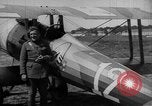
Pilots of the U.S. Army Air Service 94th Aero Squadron standing near airplanes displaying their Squadron insignia, in World War I
United States Army Air Service 94th Fighter Squadron near Toul, Meurthe-et-Moselie, France, April 30, 1918, during World War 1. Captain Ken Marr standing beside the cockpit of #12 Nieuport 28c.1 airplane. He starts walking. "Hat in Ring" insignia seen on the side of the airplane. Captain Eddie Rickenbacker standing beside "Hat in Ring" insignia on side of Nieuport 28c.1. Others photographed individually at various times, posing by airplanes all displaying their "Hat in Ring" insignia, include: Lieutenant Allan F. Winslow; Captain J. A. Meissner; Captain D. M. Peterson; Captain J.N.Hall; 1st Lieutenant Douglas Campbell; and Captain Ken Marr.
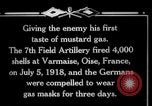
Combat in World War I. U.S. Army 7th Field Artillery troops firing mustard gas shells. American soldiers fighting while under gas attack.
American gunners of the 7th Field Artllery fire mustard gas shells from a French 75 field piece in a sandbagged revetment at Varmaise in Oise, France, on July 5, 1918. As they rapid fire, traces of mustard gas emerge from their gun, so they all don their personal gas masks, and continue firing the gas shells. Change of scene shows American troops at a trench in a field, donning gas masks when warned of a German gas attack. With gas masks in place, they commence firing a trench mortar. A string of explosions is seen in the distance, presumably from a number of mortars firing. Scene shifts, again, to troops wearing gas masks, firing their Springfield rifles, from their trench. It appears that they are following a reported World War I practice of loading their magazines to capacity with a 5-round stripper clip, and then firing only single rounds, with the magazine cutoff in "off," to save the reserve for emergencies.
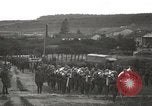
A U.S. band leading a funeral ceremony and clergy leading burial ceremony following Battle of Saint-Mihiel in World War 1.
U.S. soldiers near St. Mihiel, France during World War I. A band of American soldiers leads a funeral procession. A caisson moves across a field towards a graveyard. Houses in the background. Newly dug graves in the graveyard. Closeup view of cross at the grave of Major Harry A. Harvey of the 103rd Field Artillery, who died on September 12, 1918. Clergy and soldiers seen during the funeral ceremony for Major Harry Aloysius Harvey and other soldiers killed in the Battle of St Mihiel.

U.S. soldiers decontaminate combat vehicles and tanks during training; also flashback WW1 mustard gas aftermath scenes
World War 2 training film teaching U.S. soldiers about decontamination of combat vehicles, at Aberdeen Proving Grounds in Maryland. Soldiers during a decontamination procedure with real mustard gas. The soldiers in armored vehicles. A group of soldiers prepares for the decontamination. An aircraft flying at low height. A stationary U.S. Army Pershing tank. Two soldiers in a jeep. Soldiers wearing gas masks decontaminate a vehicle. Flashback scenes to August 1918 in World War I in France, with many mustard gas attack victims being cared for at a field hospital (which narrator says is Field Hospital number 326). Medic washing eyes and face of a World War 1 gas attack victim. Next view is a soldier in 1942 with mustard gas burns on his hand, being treated by a medic. Next scene returns to World War 1 in 1918, showing mustard gas burns on arms, hands, legs, and feet of U.S. Army soldiers.
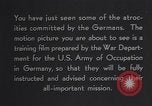
Training film for U.S. troops with the Army of occupation in Germany after world War II
Opens with bell tolling Victory against Germany in World War II. Next, a slate reads: "Victory Leads to Peace," and a farmer is seen with cattle pulling a plow. But narrator says "the problem now is future peace," and a map of Germany is shown overlaid with "Your Job in Germany." A cartoon of a soldier is superimposed on the map, along with one of a World War 1 American soldier and a figure of possible future soldier with similar mission. Camera focuses on parts of German aircraft in a jumbled heap. Closeups of weary defeated German soldiers at end ot World War II. Glimpse of Adolf Hitler speaking and haranguing an audience from a podium in an animated and forceful way. Swastika flags displayed from houses in a quaint German town. Joseph Goebbels, Nazi Reich Minister of Propaganda, at a microphone. Glimpse of a German concentration camp. But as they appear, each of the Nazi elements promptly disappears, showing the scenes without such Nazi symbols and persons. Skeleton remains of bombed buildings. Flower displays. Bucolic German rural countryside and quaint old villages in peaceful settings. Camera focuses on a book titled "German History." Chapter I, titled "Blood and Iron," shows Image of Otto von Bismarck. German troops march in a parade. Narrator states that "under Bismarck, the German empire was built." (He formed the German Empire in 1871, unifying Germany with himself as Imperial Chancellor, while retaining control of Prussia at the same time.) The film shows mounted German lancers as it alludes to Bismarck's campaigns against Denmark in 1867; Austria in 1866; and France, in 1870. Germany's leaders celebrating its status, in 1871, as the mightiest power in Europe. Troops marching and girls dancing nearby. Farmers plowing field with a horse and cow. Classic peaceful rural alpine scenes with local people in agricultural pursuits. A group of local German musicians playing folk music as village people dance outdoors. Back to the book, Kaiser Wilhelm II is shown on Chapter 2, entitled: "Deutschland über Alles." Gathering of German soldiers in Pickelhaube (spiked helmets). A German Big Bertha howitzer firing. German troops marching against Serbia; Russia; and France (with view of war damaged French cathedral). German invasion of Belgium in 1940 (with view of clock tower resting in rubble). German troops seen in Italy, walking past battle-damaged buildings. German Zeppelin dropping bombs on British targets and view of bombed out London neighborhood. Next scene shows a capsized ship with survivors running across its hull. Film slate labels the scene as United States, as if it is a U.S. ship attacked by Germany. (Actually, it is the Austro-Hungarian Battleship, SMS Szent Istvan, torpedoed, by Italian torpedo boats, during World War I.) Next, American soldiers in trench are seen going "over the top" and into "no man's land" on the western front of World War 1. Glimpse through a window of Kaiser Wilhelm II, after defeat of Germany, in 1918. View of Germans in a Beer Garden. Picturesque view of German town. A German orchestra performing. American soldiers marching out of Germany, with flags waving. Back to the history book,as chapter III is revealed, entitled "Today Germany, tomorrow, the world," and featuring Adolf Hitler. German troops invading Austria (where a civilian lies dead on the ground). German troops entering Czechoslovakia (where local people in tears render the Nazi salute). They march into Poland (where a girl weeps over someone, not seen, on the ground). They march into France (where a wounded, bandaged child cries in a bed). Next, is a scene from England, where a British child victim of bombing lies dead in the remains of a shelter. German troops invading Norway, Holland, Denmark, Belgium, Luxembourg and Russia (where a woman tries to rouse a dead woman). They invade Yugoslavia (where women sit near coffins of children) and Greece (where a woman rescues a naked child). A U.S. merchant ship explodes after being torpedoed by a German submarine (unseen). Scenes of destruction with people plucking dead victims from rubble of buildings. American troops invading Normandy, France on D-day, June 6, 1944. Several American soldiers fall to German gunfire on the beach. Wounded American soldiers being transported in jeeps on the battlefield and being placed on landing craft for evacuation. Americans walking past huge piles of destroyed aircraft parts. A landing craft filled with wounded American soldiers. American wounded and dead on a battlefield. Sailors abandoning a burning American ship by jumping into the sea. A sailor picked up in a life boat. A wounded American soldier being dragged from the beachhead at Normandy. Various wounds being treated by U.S. Medical Corps personnel. More scenes of American wounded being moved on stretchers. Scene shifts abruptly to German people folk dancing. Film concludes with question marks about the future.
CRITICALPAST.COM: About Us | Contact Us | FAQs - How to Order | License Agreement | My Account | My Lightboxes | Shopping Cart | Advanced Search | Featured Collections | Website Terms & Conditions | Privacy Policy ©2026 CriticalPast LLC.
License Agreement |
Terms & Conditions |
Privacy Policy
©2026 CriticalPast LLC.