


 Francais
 Deutsch
 Italiano
Refine Your Search
Romorantin France 1918 stock footage and images
- Showing 139 to 144 of 6001 results more
more Hide
Hide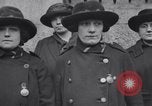
Women join ranks of police reserves in New York City, during World War I.
Closeup of women in the New York City Police reserve, during World War 1. They stand outside the 23rd Police Precinct ("Tenderloin") Station House on West 30th Street, Manhattan, New York City. Their uniforms include round-brimmed hats and overcoats, and they have round badges topped with eagles, pinned to their coats. Next, about 15 are seen, walking two abreast. All wear white gloves and badges, but otherwise, their uniforms are not identical. One supervisor woman walks beside the group, wearing a slightly different badge. Walking casually, a short distance behind the group is a woman (probably Mary Noonan) in the uniform of a captain (with "railroad tracks" insignia on her collar). Scene shifts to a street filled with a traffic mix of horse-drawn and motor vehicles, all staying fairly clear of trolley tracks visible in the center of the road. A police reserve woman stands in the center of the street, directing traffic. Next, a large group of school children is seen standing on a street corner, accompanied by a woman police officer. They begin to cross the street under the watchful eye of another woman reserve police officer, directing traffic in the street. Some adults cross behind the children. (Note: On May 9, 1918, the New York City Police Department announced formation of a new Police Reserve, that would include a women's contingent. This was the idea of Special Deputy Commissioner Rodman Wanamaker, who reasoned, since New York women had received the vote, on November 6th 1917, they should have a role in enforcing the laws. Over 3,000 women were recruited. Their Captain was Mary Noonan. Their duties did not involve direct dealings with criminals. According to the New York Times of May 10, 1918, "If need arose for use of the nightstick or other instrument for curbing crime,the work would be referred to the men members of the force.")
Chemists experiment with chlorine gas for influenza immunizations at Chemical Warfare Service in the United States.
Experiments with chlorine gas for influenza immunizations in United States. A World War I tank sprays gas in a field. View of American soldiers during 1917 to 1918 period of World War I, in a trench, wearing gas masks, and firing rifles at enemy positions. Post war tests on use of Chlorine gas to control the flu (emerging from 1918 Spanish Flu epidemic), inspired by low rate of influenza among United States soldiers exposed to chlorine gas during the war. Man enters a chlorine chamber at the Chemical Warfare Service. A chart on the wall showing results on symptoms after exposure in chlorine chamber. A woman in 1920s hat carrying a tissue is treated with chlorine gas. A testing apparatus on a table. Group of patients sit together in a chlorine chamber being exposed to the chlorine gas. A business man in a suit receives a portable chlorine gas treatment in his office as he is too busy to visit the chlorine chamber.
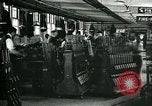
World War I United States arms factory
A U.S. arms manufacturing in World War 1. Hundreds of war production workers seen at shift change, waiting for their respective trolley cars passing on tracks between arms manufacturing plant's buildings. Women at work on metal working machines in an arms factory. Racks of Browning Automatic Rifles (Rifle, Caliber .30, Automatic, Browning, M1918) are being moved about. Assemblers are seen hand fitting parts for the Browning M1917 water cooled machine gun. One man makes final assembly adjustments to one of the machine guns set up on tripod in the factory. He enjoys firing the Browning M1917 machine gun. (Note:The M1917 and M1918 BAR were manufactured by numerous American arms makers. Colt, Remington, Marlin, Royal typewriter, Winchester. Most of the M1917 machine guns were manufactured by New England Westinghouse.)
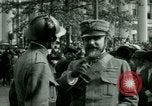
Italian Alpini and Bersaglieri visit the White House.
5 October 1918: Elite Italian Alpini (Alpines) troops and Bersaglieri (Marksmen) on a visit to meet with President Wilson at the White House. Italian General Guglielmotti gives orders to Bersagliere Captain Sani. A crowd outside the White House. Italian Grenatieri (Grenadiers) marching band proceeds into the White House building. Alpini follow them carrying Alpine sticks along with their regular equipment. Bersaglieri marching away from the White House at the end of their visit. (World War i; World War 1; WWI; WW1)

YMCA volunteer women provide refreshment to U.S. troops arriving in Coblenz, Germany. Troops visit YMCA library.
World War 1 U.S. troops greeted by YMCA volunteer women with refreshments upon arrival at train station in Koblenz,Germany. Troops seen checking out books and magazines and reading in a YMCA library.1917-1918.
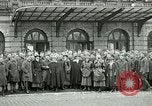
U.S. troops sightseeing on excursion steamer "City of Dusseldorf" along the Rhine River in Germany
U.S. troops, along with women volunteers sponsored by the YMCA ,take a sightseeing excursion by steamer,from Koblenz, in December, 1918.. Scenes of their visit to a monument. On board ship, U.S. army band musicians play music and a few couples dance. A few men dance with each other. At stopping place they visit and an army guide explains the site and its significance. (World War i; World War 1; WWI; WW1)
CRITICALPAST.COM: About Us | Contact Us | FAQs - How to Order | License Agreement | My Account | My Lightboxes | Shopping Cart | Advanced Search | Featured Collections | Website Terms & Conditions | Privacy Policy ©2026 CriticalPast LLC.
License Agreement |
Terms & Conditions |
Privacy Policy
©2026 CriticalPast LLC.