


 Francais
 Deutsch
 Italiano
Refine Your Search
Romorantin France 1918 stock footage and images
- Showing 133 to 138 of 6001 results more
more Hide
Hide
Charles Lindbergh takes off from Roosevelt Field for his famous solo flight from New York to Paris.
People gathered early on a misty morning at Roosevelt Field, Long Island, New York, to watch as Charles Lindbergh attempts to make a solo flight across the Atlantic Ocean in his airplane, The Spirit of St. Louis. The plane starts its takeoff role between groups of spectators, raising dust. The spectators move to get a better view as the plane continues, out of sight in the fog and mist. It is not clear where the plane is, although engine sound has changed. Spectators strain to see it through the mist. Then, some cheers are raised when the crowd realizes that Lindbergh has successfully taken off in his heavily laden airplane. The opening caption refers to Curtiss Field, where the Spirit of St. Louis was test flown and reportedly maintained in Hanger 16. there, from May 12th through the 20th. However, for the Paris flight, the plane was towed a mile to Roosevelt Field where, heavily loaded with fuel, it could take advantage of the longer runway for takeoff. (Note: Both fields were originally part of the old Hempstead Plains Field renamed Hazlehurst Field when taken over by the U.S. Army in 1917. U.S. Geological survey maps of 1918 show three areas named, respectively, Hazelhurst Aviation Field No. 1; Aviation Field No. 2; and Camp Albert L. Mills, abutting it. Field No. 2 was renamed Mitchel Field on July 16, 1918. The eastern part of Field No. 1 was dedicated as Roosevelt Field, on September 24, 1918. After the war, the western part of Field No. 1 became known as Curtiss Field, associated, as it was, with the Curtiss Aeroplane & Motor Company located there.)
The beginning and end of World War I.
World War 1 artillery guns fired, troops charge, formation of airplanes and heavy bombardment. People celebrate on Armistice Day on November 11, 1918.
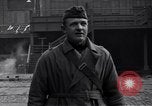
Christy Mathewson, Captain, U.S. Army Chemical Service, during World War I
Christopher "Christy" Mathewson, famous baseball pitcher for New York Giants and the Cincinnati Reds, who later managed the Cincinnati Reds. He voluntarily enlisted in the U.S. Army in 1918, as a Captain in the U.S. Army Chemical Service, during World War 1. This brief scene shows Matthewson in uniform, as a Captain in the U.S. Army.
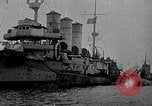
German submarines group together after armistice ending World War I. Men on Italian ship display their flags.
Following the Armistice ending World War 1, several German submarines are seen pulled up beside a ship. Washed clothes from crew members is seen drying on the decks. One of the submarines is U-91, commanded by Paul Koenig, which surrendered to the French on November 26, 1918. A large ship is crowded with men displaying Italian flags with cross and crown on them.
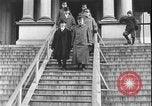
Secretary of War Newton D. Baker and General Tasker H. Bliss together with others during WWI, Major Fiorello La Guardia in uniform.
Secretary of War Newton D. Baker and General Tasker H. Bliss walk together, behind them are other members of a delegationduring World War 1. Secretary of War Newton D. Baker is wearing a bowler hat, glasses, necktie and thick black coat. General Tasker H. Bliss is wearing a thick army coat and hat. Secretary of War Newton D. Baker and General Tasker H. Bliss pose together for picture. Secretary of War Newton D. Baker and General Tasker H. Bliss shake hands with each other before they depart. Major Fiorello La Guardia, future mayor of New York City, seen in uniform in July 1918.
Allied forces hold air superiority in battle of Saint Mihiel during World War I.
This film shows numerous types and models of World War One aircraft in operation. It opens showing Allied airplanes preparing for a maximum air campaign in the battle of Saint Mihiel. View from inside a hanger as its flap opens and men push a Sopwith Camel airplane out onto airfield. Map of St Mihiel. American planes warm up on flight line in predawn, with flares burning at wingtips. Huge numbers of allied airplanes are marshaled on airfields throughout the theater of operations and begin taking off. Among them is a French Morane-Saulnier low wing monoplane. German fliers are seen loading small hand held bombs into the cockpit of their Albatross aircraft. Soldiers in combat on ground in "no man's land" during the battle of St. Mihiel. They take refuge in large shell and bomb craters and try to advance running between them.. Germans fliers dropping bombs, by hand, from airplane. Numerous Allied and German airplanes in aerial dogfights. American planes over clouds. American Observation balloon attacked in sky. Balloon in flames, and trailing black smoke as it falls to the ground. French flag flies at an airfield, where a nosed-over airplane sits, by a hangar, as airplanes fly overhead. Aircraft taxiing about in close quarters at airfield. Large formations of American airplanes flying overhead in a grand formation, following the Armistice, November 11, 1918 Then the film shifts dramatically from World War One to the post-WWII year of 1947. It illustrates the dramatic advances in warplanes since WWI by showing U.S. B-36 bombers and straight-wing F-84 Thunderjet fighters is formation.
CRITICALPAST.COM: About Us | Contact Us | FAQs - How to Order | License Agreement | My Account | My Lightboxes | Shopping Cart | Advanced Search | Featured Collections | Website Terms & Conditions | Privacy Policy ©2026 CriticalPast LLC.
License Agreement |
Terms & Conditions |
Privacy Policy
©2026 CriticalPast LLC.