


 Francais
 Deutsch
 Italiano

Refine Your Search
Romorantin France 1918 stock footage and images
- Showing 31 to 36 of 6013 results more
 Hide
Color Sound

U.S. 128th Field Artillery firing French 75-mm guns at Le Cotes de Forimont on September 27, 1918.
Closeup views of U.S. 128th Field Artillery troops firing French 75-mm guns at Le Cotes de Forimont (France) on September 27, 1918, during World War 1. Views of the gun breech, as shells are inserted, fired, and casings discharged.
Montage of World War I scenes. Postwar French military preparedness. Tensions between Germany and France early in World War II.
German cavalry on horseback entering Belgium and Berman infantry marching in France, at the start of World War 1 (1914). The famed Taxicab army is seen carrying French soldiers in Paris. General Ferdinand Foch reviewing elements of the French 9th Army. French and British troops firing a British BL 8-inch howitzer. French troops rushing across no-man's land of trenches and barbed wire, as shells burst. German soldiers taken prisoners in trench. General Foch shaking hands with U.S. General Pershing, aboard a U.S. warship. Sketch of signing of the armistice, November 1, 1918 on a railway carriage at Compiegne. Monument to Marshal Foch. Monument to Minister of War, Andre Maginot. concrete being poured. French construction of the Maginot Line. Animated illustrated cross-section of the line.View of troops moving on rail cars in the Maginot line. Glimpse of Maginot line guns on surface. At outbreak of World War 2, French troops deploy to the Maginot line. French troops inside bunkers and tunnels of Maginot Line. Marshal Petain reviewing the troops as they deploy. Muzzle of a Maginot line gun. Hitler with Military Chiefs planning. View of French Foreign Minsister, Aristide Briand,during signing of the 1928 Kellogg-Briand antiwar pact in Paris.Frank R. Kellogg, U.S. Secretary of State at the table to Briand's left. His signature on the document. A field full of French Morane 406 airplanes. French airman poses with Potez 58 airplane. French AMC 34 tanks. Crowd milling about at Renault Building and unrest elswhere in Paris, France. Newspapers chronicle failure of the League of Nations. Movie cartoon about weakening of France by Nazi inspired social strife and sabotage. French Army troops in mess hall eat at long tables and pour wine with meal. Idle French troops across the Rhine River targeted by German propaganda and psychological warfare including banners; messages by balloons;German bands playing French tunes; large loudspeakers broadcasting in French.
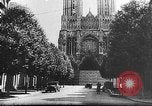
German forces advance in France in WW2; scenes of World War I monuments; Germans take Versailles in World War 2.
German occupation of France during World War 2. The cathedral in Reims, France. Vehicles and a few men on a road in front of the church. Trees lining the road. The railway car in which an armistice agreement was signed by Germany and the Allies at end of World War 1. The Memorial Tablet symbolic of the 1918 armistice, the Alsace-Lorraine, and Ferdinand Foch's Memorial in Compiegne Forest. Ferdinand Foch's carriage in which the first armistice was signed. In 1940 : German troops cross River Marne in rafts. A signboard showing the distances to Paris and Soissons. Another signboard showing the distances to Grand Fitz James and Paris. Troops on tanks moving on roads. A signboard shows distances to Pontarme and Paris. A soldier with a gun on his back. Soldiers moving with carriages on a path between fields. Trees lining the path. German troops moving on tanks advancing deeper into France. The troops on the road in front of the castle in Versailles. The German flag hoisted on a flag pole over the Palace of Versailles and German soldiers occupy the Palace of Versailles.

U.S. 39th and 58th infantry Regiments advance under fire at Montfaucon and Nantillois in Meuse, France, during World War I.
Shows U.S. Army troops at the war front in France during World War I. U.S. 39th and 58th infantry Regiments advance under machine gun and artillery fire at Montfaucon and Nantillois in Meuse, France on September 28,1918.

U.S. 305th and 306th Infantry, 77th Division troops march towards Longueval (France) during World War I.
Shows U.S. 305th and 306th Infantry, 77th Division approaching Longueval (France) under heavy enemy artillery fire on their drive from Vesle to the Aisne on September 5th, 1918. U.S. medical corps give first aid to wounded troops under heavy enemy fire. General Pershing decorates U.S. 42nd Divison troops at Bagneux (France).

U.S. Army casualties from poison gas are brought to a field hospital North of Royaumeix, France during World War I.
Gas casualties affected by a German enemy gas attack in World War I arrive at a field hospital in North of Royaumeix, France. The gas casualties on stretchers are taken in a truck for treatment. Soldiers affected by an enemy mustard gas attack in France during 1918 attack. The gas casualties are seen outside the field hospital as they could not be accommodated inside the over-capacity field hospital number 326. Doctors and nurses attend to them. A doctor applies medicine to the eyes of a mustard gas poisoned U.S. Army soldier lying on a stretcher.
CRITICALPAST.COM: About Us | Contact Us | FAQs - How to Order | License Agreement | My Account | My Lightboxes | Shopping Cart | Advanced Search | Featured Collections | Website Terms & Conditions | Privacy Policy ©2026 CriticalPast LLC.
License Agreement |
Terms & Conditions |
Privacy Policy
©2026 CriticalPast LLC.