


 Francais
 Deutsch
 Italiano

Refine Your Search
Romorantin France 1918 stock footage and images
- Showing 25 to 30 of 6013 results more
 Hide
Color Sound
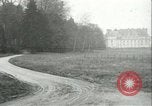
Railroad train carrying Marshal Ferdinand Foch to Compiegne, France for signing of Armistice ending World War I.
Views of the Chateau of Franc-port located close to the forest at Rethondes, near the town of Compiègne, where the German delegation was lodged during the World War 1armistice negotiations. On November 8, 1918, a steam locomotive pulls Marshal Foch's train through the railroad station in Compiègne, on the way to the armistice negotiations. Later, on November 11, 1918, after the Armistice is signed, the train is seen as it returns and slows to a stop at the station, in Compiègne. The train bears the name: " Compagnie Internationale Des Wagon-Lits Et Des Grands Express Europeens." Several cars of the train are seen close up, including the voiture-restaurant and dining car number 2419 D, in which the armistice was actually signed. Several French soldiers are seen inside the train, and looking out its windows. A large group of French troops pose and celebrate in front of the train, parked in the station.
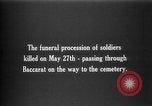
American Expeditionary Forces(A.E.F.) 42nd (Rainbow Division) bury their fallen at Baccarat, France, in World War I
A cortege of U.S. Army trucks, covered with American flags and laden with flag-covered coffins of American soldiers,who fell in combat on May 27th, 1918,proceeds through the streets of Baccarat, France, in World War 1. U.S. soldiers of the 42nd Infantry Division march as escorts, beside the trucks. Local citizens observe from the sides of the road. Scene shifts to Memorial Day (May 30, 1918), when U.S. Army Major General Charles T. Menoher and U.S. Army Colonel Douglas MacArthur,of the 42nd Infantry Division, are joined by French Generals Dupont and Penet, in decorating the graves of fallen American soldiers, during a ceremony at a rugged battlefield cemetery containing new graves marked by wooden crosses. A little French girl places a bouquet (reportedly made by Major General Menoher) upon the grave of an American soldier.She is accompanied by other French children who also place bouquets on the graves. An honor guard of American soldiers fires a salute. Scene shifts to a gathering of American soldiers at their base in Baccarat, where they surround a small outdoor stage, to watch a Miss Hart, of the YMCA theatrical Corps dance the Higland Fling. She is dressed in traditional costume of Scotland and accompanied by a violinist. A group of Army musicians, seated close to the stage, watch the performance along with the rest of the troops.
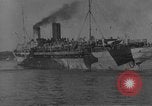
Belgian soldiers who had been fighting against German and Austrian forces, in Russia, in World War I, arrive by ship in Bordeaux, France.
The French line ship, SS Lorraine, in camouflage paint, seen backing into port at Bordeaux, France, on June 24, 1918. Belgian troops of the ACM Corps (Autos-Canons-Mitrailleuses, Belgian armored unit) disembark. They are seen as they walk down a gangway from the ship, in combat uniforms and steel helmets, and carrying their weapons and personal gear. (Note: Soldiers of this armored unit from Belgium fought alongside the Imperial Russian army against German and Austrian troops in 1915 in Russia, during World War 1, before the 1917 Bolshevik revolution, after which they were stranded in hostile territory. They left Vladivostok for the United States on the SS Sheridan, and docked at San Francisco on May 12, 1918. They were warmly greeted as they proceeded across the U.S. to New York city, where they participated in the Memorial Day Parade. After leaving New York City, aboard the SS La Lorraine, they reached Bordeaux on June 24 1918.)
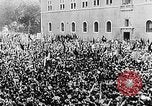
The fall of France and entry of Italy, on side of the Axis Powers, in World War II
Crowd fills the Plaza Venezia in Rome where Benito Mussolini appears on the balcony of the Piazza Venezia (formerly known as the Palace of St Mark) in Italy, on June 10, 1940. He announces that Italy has entered World War 2 on the side of the Axis powers. Views of the jubilant crowd waving Italian and some Swastika flags. Next, a road sign points to Paris and to Poissons, in France followed by view of German troops triumphantly entering Paris, through the Arc de Triomphe during occupation of France. View of the Eiffel Tower, and of a German flag flying atop it. More views of German troops marching through Paris. A German railway gun firing. (Narrator implies that the target is the Maginot Line, which is not correct. It was bypassed by the Germans, negating need to attack it directly.) Other German railway guns and siege mortars firing and many huge explosions and fires are seen, including some from flame throwers. Next, German troops are seen marching around a circle where a railroad car is parked near Compiègne, France. This rail car is the scene of Germany's surrender to France in World War I. Statue of French Marshal Foch, who had then, received the delegates of vanquished Germany here. Adolf Hitler walking past a German Honor Guard, salutes. He is accompanied by Marshal Hermann Goering and other high ranking military persons. The nearby 1918 "Alsace-Lorraine monument" is covered by a German flag. The German delegation headed by Hitler and Goering, enter the rail car and take their places. Outside, the French delegation, headed by General Charles Huntziger, is escorted by German officers. They enter the car and he German delegation stands. Both delegations exchange salutes. Next, Hitler is seen stepping from the rail car, followed by Goering. The German delegation walks past the honor guard, and Hitler salutes them. German and French officials still in the rail car exchange salutes. Hitler expresses jubilation.
France surrenders to Germany during World War 2
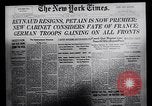
French Marshal Petain, now Premier, following Battle of France, walks to a car and seen later at conference table with Pierre Laval and other national leaders. View of Adolf Hitler, with close associates, expressing delight after signing of the second armistice at Compiegne,ending resistance by France, on June 22, 1940. German honor guard marching near Marshal Foch's railroad car where the 1918 armistice was signed. Monument of Marshal Foch. Hitler, Hermann Goering, and Admiral Raeder, head of the Kriegsmarine, review the honor guard. German stand at steps of the rail car. Raeder, and Goering, both carrying Marshal's batons, flank Hitler. French Army General Charles Huntziger, accompanied by General Jean Bergeret,Air Minister, Vice Admiral Le Luc, Commander of Maritime Forces, and Ambassador Leon Noel, are escorted by two German officers. They enter the railroad carriage. View inside, as Hitler, Goering and German representatives stand when they enter. Newspaper headline describes tax on France for German occupation. French prisoners of war in an outdoor yard and being moved to Germany. French prisoners in bucket brigade and carrying construction materials. French workers engaged in labor to support German war effort. Unhappy French children. Public funerals for persons executed by the Germans. German flag draped over the Foch statue. Hitler's touring motorcade passes Arc de Triomphe in Paris in early morning when streets are empty. Parisians gather on streets to hear German orders broadcast. Many express distress. In Southern France, Military units carry their colors as they depart for North Africa. General Charles de Gaulle is among the marchers. De Gaulle seen reviewing contingents of French military. Free French soldiers parading in London, England. Military officers salute as the ship carrying Regimental colors departs. French colors carried beside unit with American flag. General Charles de Gaulle and General Henri Giraud at 1943 Casablanca Conference (Roosevelt and Churchill seated).

Ground crewmen start the engine of a USAAS Nieuport 28 C-1 which takes off in France.
United States Army Air Service (USAAS) 94th Fighter Squadron in France during World War I. 2nd Lieutenant E. K. Delaney climbs into the cockpit of a USAAS De Havilland Airco DH-4 bomber. An officer and a ground crewman are standing near the nose of the aircraft. 2nd Lieutenant Allan F. Winslow seated in the cockpit of USAAS Nieuport 28 C-1 . A ground crewman turns the propeller of an Airco DH-4. Another crewman holds the first crewman's arm. The DH-4 bomber taxis away. The parked Nieuport 28 C-1 with its engine running. Lieutenant Douglas Campbell of the 94th fighter Squadron seated in the cockpit of the Nieuport 28 C-1. Two parked Nieuport 28 C-1s start to taxi. Third Nieuport 28 C-1 parked in the foreground. A Nieuport 28 C-1 taxis away. Bi-wing of a parked aircraft in the foreground. Ground crewmen starting the engine of a Nieuport 28 C-1. Ground crewmen hold onto the wings as the wheel chocks are removed and the aircraft turns. The aircraft takes off. Two ground crewmen standing beside a parked bi-winged aircraft in the foreground. American fighter ace Lieutenant Eddie Rickenbacker seated in the cockpit of a SPAD S. XIII fighter aircraft. 94th Aero Squadron "Hat in Ring" insignia on the side of the aircraft. Lieutenant Rickenbacker seated in the cockpit of a SPAD S. XIII near Rembercourt, Meurthe-et-Moselle, France on 18th October, 1918. A Nieuport 28 C-1 takes off.
CRITICALPAST.COM: About Us | Contact Us | FAQs - How to Order | License Agreement | My Account | My Lightboxes | Shopping Cart | Advanced Search | Featured Collections | Website Terms & Conditions | Privacy Policy ©2026 CriticalPast LLC.
License Agreement |
Terms & Conditions |
Privacy Policy
©2026 CriticalPast LLC.