


 Francais
 Deutsch
 Italiano
Refine Your Search
Rouen Normandy France 1944 stock footage and images
- Showing 595 to 600 of 9958 results more
more Hide
Hide
Paratroopers gather before D-Day (WW2)
Paratroopers of the 101st Airborne Division and the 502nd Infantry Regiment (502nd Parachute Infantry Regiment) arrive at an airfield for troop carriers in World War II. The troops happily wave with their helmets at the camera as they carry supplies. Some of the paratroopers’ faces are darkened. The paratroopers crowd to hear orders of the day. Some of the paratroopers’ helmets are seen with the distinctive heart shaped symbol of the 502nd Infantry Regiment. Paratroopers put on their life vests (Mae West) and chutes. The jump master gives out last minute instructions. Three paratroopers with blackened faces discuss plans. Lieutenant General Lewis H. Brereton bids good luck to a paratrooper chaplain and a medical corps officer before the paratroopers board their Douglas C-47 Skytrain transport plane. Paratroopers climb aboard the transport plane. General Brereton presents a paratrooper with a rabbit’s foot as a good luck charm Nose of Douglas C-47 Skytrain “That's All, Brother” (N88874) before taking off for Normandy, France on D-Day.
U.S. Navy ships in the English Channel shortly before D-day during World War II.
A U.S. Navy Destroyer escorts landing craft infantry toward invasion of Normandy, France during World War 2. More landing craft infantry are seen in the distance. A U.S. cargo ship, most likely an attack transport ship, is seen with the flotilla. A landing ship, dock (LSD) is shown sailing close by.
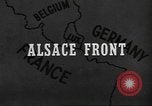
U.S. troops of the 79th Infantry Division engage German forces in the Alsace Front during World War II
Opening shows animated map of Alsace front at junction of Belgium, Germany, and France, in World War 2. Allied forces are schematically shown sweeping toward Wissembourg, Haguenau, and Strasbourg. Next, several U.S. Army M4A3(75) medium tanks are seen driving toward the camera on a rural road, during a pull back by the 7th Army in the first week of January, 1944, from advanced positions at the front. Some are filled with infantry riding atop them. The last of them is seen crossing a bridge 13 miles Northeast of Haguenau. The engineers of the 79th Division place demolition charges to destroy the bridge. Closeup of them placing and then remotely igniting the charge. A huge explosion ensues that completely destroys the bridge. Scene shifts to several U.S. soldiers of an engineer combat battalion preparing 100 pound of TNT in a captured blockhouse at Lauterbach, Alsace. Closeup of engineer carrying the explosives into the blockhouse and preparing the remote detonation device. The engineers string wire in the snow and setup their remote detonation device. One depresses a plunger to ignite the charge and blow up the blockhouse, which explodes in a huge cloud of black smoke. Next, elements of the 79th Infantry Division supported by tanks, are seen moving forward to counter German gains Southeast of Haguenau. (On January 5th the German forces had established a bridgehead across the Rhein (Rhine) river near Gansheim, Germany.) Scene shifts to Drusenheim, Germany where U.S. forces are engaging a Battalion of occupying German forces. Machine gun fire is heard constantly, as American infantry battle the hidden German defenders and tanks drive them from defensive positions near a bridge at the far end of town. Infantry move from behind tanks toward the bridge and are seen crossing it. An M4A3(75) medium tank risks crossing the narrow bridge and is immediately followed by many 79th Infantry troops. The battle continues on the other side of the bridge.

World War 2 film promoting public investment in War Bonds and stamps to aid the war effort and temper inflation
World War 2 era film that also includes some World War 1 scenes. Show girls or chorus girls in follies-like show, costumed as U.S. silver dollars and marching to tune and lyrics alluding to dramatic increase of currency in circulation, over the years. Animation with stacks of coins shows increase in national income from $46 billion,in 1933, to $71 billion, in 1939, and $142 billion in 1943. Back to the "follies dollars," a boy asks why, and then scenes of the Japanese attack on Pearl Harbor,are shown, with U.S. battleships being sunk. Wartime arms plants are shown. An M2A3 Light Tank rolls off a production line. Ships being constructed in a shipyard. B-24 Liberator bombers being built in a factory. Artillery shells being produced. Defense workers receiving their pay. The "follies dollars" group themselves to illustrate the fractions of income devoted to taxes and savings. But other spending is curtailed by wartime shortages. A woman talking with clerk in a drug store. U.S. Army troops crossing a pontoon bridge in open trucks, towing 75mm M1A1 howitzers. Infantry on the march. Animation showing industrial production devoted to war materiel and lots of dollars chasing few civilian goods. A grocery clerk offers to sell a woman customer butter for more than the established price, and she agrees. The "follies" performers then introduce the idea of an "inflationary dollar," and some history of past U.S. inflations. Animated examples of price inflation are shown. Glimpses of World War I scenes are seen, circa 1917 -1918, including: a 12-inch railway gun firing; a huge explosion from shell bursting near the camera; various scenes of United States infantry soldiers and French soldiers in battle action, running to bomb craters for cover and emerging from trenches to go up "over the top" into no-mans land during combat. Meanwhile, singing narration refers to the home front inflation due to competition for limited civilian goods. Map shows Europe and singing narration cites rising prices for food in occupied France and other countries suffering ravages of World War II. Montage of scenes showing needy civilians obtaining food in those countries. Animation shows increases, by 1944, in cost of U.S. civilian goods since the Pearl Harbor attack. "Follies" character called "Double-duty dollar," appears explaining he serves the war and curtails inflation on the home front by being saved through investments in War Bonds and stamps.
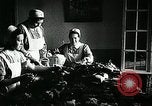
German Red Cross women pack Christmas gifts and German soldiers receive gifts and mail in the front lines.
German women Red Cross workers in Germany. They pack Christmas gifts for the German soldiers for Christmas 1944. The gifts on a table. Scene on front lines as German soldiers receive mail from home. A German soldier reads a letter and looks at a photograph. Separately, clips ends with views of the Allied invasion forces landing in France and German efforts at repulsing them. (World War II period).
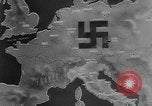
Scenes from Allied invasion of Europe during World War II.
Activities of Allied troops during invasion of Rome and invasion of France in Europe during World War 2. An animated map of Italy illustrates belligerents and battle lines. U.S. troops entering Rome. Buildings and streets in Rome. U.S. Army General Mark Clark shown. Russian troops proceeding from the East. Lines of Soviet Army troops marching. Russian Marshal Zhukov at a desk, reviewing battle maps. Views of Joseph Stalin smiling. Allied landing craft approaching the Cherbourg Penninsula during D-Day invasion of June 1944. American B-26 aircraft of the 9th Air Force flying over battle field and drop areas. Formation of B-26s painted in D-Day white stripes. Gun camera footage from Allied aircraft strafing German aircraft on the ground and in the air in lead-up to invasion. U.S. paratroopers dropping from C-47 aircraft. Close-up views of paratroopers jumping out of aircraft. On the ground, U.S. soldiers crawling in fields, taking up positions, and advancing while receiving and returning fire from enemy Germans. Some American troops firing a mortar on the ground. Supreme Allied Commander, General Dwight D. Eisenhower, together with British Field marshal Bernard Law Montgomery and British Air Chief Marshal Sir Arthur Teddar, at a conference table with key staff.
CRITICALPAST.COM: About Us | Contact Us | FAQs - How to Order | License Agreement | My Account | My Lightboxes | Shopping Cart | Advanced Search | Featured Collections | Website Terms & Conditions | Privacy Policy ©2026 CriticalPast LLC.
License Agreement |
Terms & Conditions |
Privacy Policy
©2026 CriticalPast LLC.