


 Francais
 Deutsch
 Italiano
Refine Your Search
Rouen Normandy France 1944 stock footage and images
- Showing 601 to 606 of 9958 results more
more Hide
Hide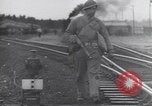
Troops board trains with war equipment and other supplies en route to ports of embarkation from the United States during World War II.
Plans underway in the United States in 1944 for participation in the invasion of France during World War 2 by Allied forces. A U.S. Army sentry of the Army Service Forces (ASF) patrols a rail line, where military men and equpment are being transported abroad., during World War 2. ASF soldiers drive DUKWs (amphibious vehicles) up a ramp for loading into railroad box cars. A long line of DUKWs being driven for loading. Many men load 55 gallon drums of petroleum products into rail cars. An M3 Stuart light tank being driven on an open rail car. Soldiers loading motorcycles on a train. An Army M3 Half-track Amored Personnel Carrier (APC) driving onto a railroad train. (Narrator notes that it requires 75 trains to transport a single Armored Division by rail.) Men loading a 105 mm Howitzer Motor Carriage M7 (Called Priest, by the British) onto a flat rail car and securing it in place with wooden supports. Army personnel that would participate in an invasion are shown. Paratroopers with their packs. Women's Army Corps (WACs) fill their duffel bags with clothing and other items, and are then seen climbing aboard an open stake truck. An Army band plays and marches giving troops a sendoff at a train station. U.S. soldiers board passenger railroad trains, carrying their field packs and weapons. A steam locomotive pulling a troop train. A train load of Sherman M4 medium tanks and other equipment, including a caterpillar tractor, is seen underway. Unidentified tanks being fastened to rail flat car. Many Army trucks and heavy equipment on train passing a town train station. Military equipment moving on trains over bridges. Two ladies under hair dryers at a salon, discussing boys in service going overseas. United States Army troops bound for the war front are seen boarding railroad trains and also changing trains, monitored by Army military police (MPs) at night. Soldiers inside a moving train car occupy themselves by playing cards; shooting craps; An African American porter watches a game. An Army chaplain talking with some of the soldiers. A soldier reading a magazine. His seat partner keeps falling asleep against him. American civilians at a newsstand. Newspaper headline reads: "London expects invasion of Europe at any hour."
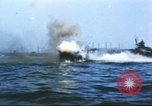
Color scenes of WWII including Pearl Harbor, D-Day, and Pacific campaign.
Montage of scenes dealing with Japanese attack on Pearl Harbor in World War 2. Bombs exploding and ships on fire; Japanese airplane diving from formation; a jeep driving past a burning airplane; hangars burning; Sailors firing anti-aircraft guns from an American ship; A New Orleans class American Cruiser firing her 8-inch guns; A South Dakota Class battleship firing her 16-inch guns; Group of American M3 Stuart light tanks in a field; U.S. Aviation Cadets marching between rows of Boeing Stearman Model 75 training biplanes; American soldiers marching in huge formations; Paratroopers in training jumps from towers; U.S. soldiers climbing down netting on side of troop transport ships to board small landing ships in the Pacific.; Marines in a landing craft carrying a large American flag; Landing craft in an amphious assault; Troops coming ashore from a Higgins boat, during training; An amphibious invasion task force at dusk; Troops wading ashore during the invasion of France in World War II, with barrage balloons aloft and support ships offshore. Staged scene of soldier on transport ship using flash light to read letter from home. Capital warships firing heavy guns and soldiers descending rope nets to enter landing craft. Soldiers landing on shore from Higgins Boats during training, and then on the shores of Normandy during the D-day invasion. American tank crew on an M26 Pershing tank. Major General George Patton with 1st Armored Division patch on his uniform sleeve. General George Marshall. General Dwight D. Eisenhower decorating an officer. Lieutenant General Henry (Hap) Arnold. Paratroopers jumping en masse from C-47 transport planes. German forces retreating in trucks along a road. Japanese General Yoshijirō Umezu, Chief of the Army General Staff, signing Surrender document aboard the USS Missouri, ending World War II, in the pacific. Glimpse of troop ship arriving in a U.S. harbor. View of U.S. military cemetery. Scene shifts to John Charles Daly, speaking in front of wall with names of Medal of Honor recipients, in the Hall of Heroes at the Pentagon, Arlington, Virginia, in 1968.
The 1944 U.S. Presidential election in World War II
On Election Day, November 7, 1944, in World War 2, Americans are seen waiting patiently to vote. They stand in a long line extending down a city sidewalk next to brick and stone buildings. Views of several persons in the line. Scene shifts in flashback to the election of Woodrow Wilson, in 1912. Four men on horseback arrive at a polling place. Another travels to vote, in his 1910 Ford Model T truck. Change of time and place shows farmer arriving by horse-drawn wagon and walking to polling place past 1930s car and truck. A fully laden truck stops at a rural gasoline station, temporarily serving as polling place. American town residential street scene in the 1930s. Citizens gathering to vote at a polling place set up at a laundry shop, in the Bronx Borough of New York City. Views of various places in the United States, serving as polling places. Americans seen waiting to vote at various places, in the 1944 national election. Among the sites shown is Bridgeport Central High School, built in 1916, (which later became Bridgeport City Hall), at 45 Lyon Terrace in Bridgeport, Connecticut. Persons in various places, registering to vote, including actor Lewis Stone, actress Esther Williams, and USO entertainer, Bob Hope. Voter closing curtain behind him as he votes in a voting booth. Views of voters' feet, below curtains, as they vote. Various types of boxes. Newspaper headline speaks of the large voter turnout in millions during the 1944 election. Shipyard workers at end of their shift, are seen heading to the polls to vote.
Americans voting and electioneering in national election on November 7, 1944, during World War II.
On November 7, 1944, during World War 2, citizens of Marblehead, Massachusetts, United States, are seen entering the Old Town House (built in 1727) to cast ballots in 40th quadrennial presidential election (in which incumbent President Franklin D. Roosevelt is running for an unprecedented 3th term). Scene shifts to inside a polling place, where voters stand in booths to privately mark their ballots. Others are seen depositing their marked, folded paper ballots in a collection box, as they finish voting. Closeups of several aged voters. One, an African American man, the narrator says is old enough that he was sold as a slave early in his life. Scene shifts to a full-blooded Native American Indian voter in Maryland, entering his polling place to cast a ballot. An old man who is a United States Civil War veteran, is shown sitting on a bench in a park in Los Angeles California, with friends. He holds a newspaper and wears a Civil War Union cap. A U.S. soldier wearing field uniform and steel helmet, looks at a bulletin board containing State-by-State voting information. A Technical Sergeant marks his paper ballot and leaves to mail it. A soldier takes an oath confirming legitimacy of his ballot as he turns it in at a military collection site. Sign in commercial establishment window of a U.S. town declares "Election Today." A bank window sign reads: "this Bank will observe Election Day, Tuesday, November 7th, a Legal Holiday." Sign in Bar window reads: "Bar Closed during Election Hours, Tuesday, Nov.7, 1944. Will Open at 9 PM." Republican political party workers advertise for their Presidential candidate, Thomas E. Dewey. Democratic political party workers drive a truck towing a trailer office plastered with advertisements for their candidate, Franklin Roosevelt. Republican and Democratic party voter information booths are seen next to one another where advertise their respective candidates to passersby on the sidewalk. A voting place identified by white wash sign on a window, and another, in a rural setting, by a sign pointing to it on a fence post. More signs and voters showing sentiments for their candidates. One displays a picture of Dewey on his car. A woman wears a large Roosevelt button on her sweater. Views of more imaginative signs for candidates and for ballot issues. People discussing ballot issues on the streets.
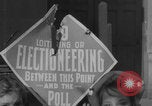
American voters head for the polls to vote in the 1944 Presidential Elections during WWII
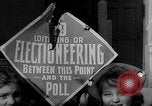
Sign saying “No loitering or electioneering between this point and the poll”. Long line to election poll in the United States during World War II. 1944 American voters wait in line on the street to vote. Woman, wearing a Tartan patterned headscarf and fur coat, waits outside. Cowboys gallop with their horses to the polling station. Man, wearing cowboy hat, gets off from his Ford Model-T car. Worker walks out to the street. A truck with workers on open-cargo area. A woman walks in an empty city street. View of crowd outside Bronx Beacon Laundry at W 169th Street Bronx NYC. People enter a house used as a polling station with a huge tree in front. View of different kinds of buildings used as polling stations for the 1944 United States Presidential Elections. Including the Barbara Fritchie House ( 154 W Patrick St Frederick, MD 21701) “Bridgeport High School” engraved in front of Bridgeport Central High school (44 Lyon Terrace Bridgeport, CT 06604 ) now Bridgeport City Hall. United Stastes voters wait in lines outside polling places. Two women eating biscuits together as they wait in line. A stylish woman, wearing a matching leopard print cocktail hat and scarf, smiles. A man, wearing cowboy hat, waits in line. A group of nuns, belonging to the Sisters of the Holy Cross (CSC) Congregation, waiting to vote. Man, with mustache and fedora, looks slightly up. View of American Red Cross volunteer. Americans forming a long line to the polling station to vote. A woman sits as she waits for her turn to vote. African-American voters waiting in line to vote. Woman, wearing a polka-dotted headscarf, glasses and overalls, waits in line. Men waiting in line in the suburbs. Americans wearing thick coats waiting in line to vote.
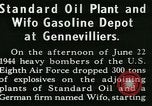
Standard Oil Plant and Wifo Gasoline Depot at Gennevilliers in Paris bombed by the U.S. Eighth Air Force on June 22, 1944 in World War 2.
Results of air assaults by the British Royal and U.S. Eighth Air Forces over industrial areas in and around German-occupied Paris during Wolrd War II. The adjoining Standard Oil Plant and German Wifo Gasoline Depot at Gennevilliers bombed by the U.S. Eighth Air Force heavy bombers on June 22, 1944. The destroyed manufacturing facilities, buildings, storage tanks, loading platforms, railroad tank cars. Damaged steel structures and collapsed roofs. Aerial view of the plant and the depot.
CRITICALPAST.COM: About Us | Contact Us | FAQs - How to Order | License Agreement | My Account | My Lightboxes | Shopping Cart | Advanced Search | Featured Collections | Website Terms & Conditions | Privacy Policy ©2026 CriticalPast LLC.
License Agreement |
Terms & Conditions |
Privacy Policy
©2026 CriticalPast LLC.