


 Francais
 Deutsch
 Italiano
Refine Your Search
Rouen Normandy France 1944 stock footage and images
- Showing 19 to 24 of 9958 results more
more Hide
Hide
Saga of the Allied invasion of Normandy in World War II, with emphasis on role of African American soldiers
Opening scene shows U.S. soldiers firing rifles as they advance in the hedge rows (Bocage) of Normandy after the D-Day invasion in World War 2. Lightning is seen as a storm begins. Various invasion ships and boats are seen being pummeled by wind and waves. Some ships are seen tilted against the shore and damage to beachhead installations is evident all across the shore the wake of the storm. Landing craft of various sizes are left where they had been driven by the storm onto the shore. Twisted steel and damaged boats are seen everywhere. Views of U.S. infantry advancing into the interior of Normandy, under fire. A Sherman tank camouflaged with foliage, moves past demolished building. Troops marching single file along the sides of a rural road. At TC: 00: 57, the film continues with enactments of German officers in conference. At TC: 01:06, the actual Normandy beachhead is seen again with troops and war materiel being delivered without port facilities. Amphibious 2 and a half ton trucks (DUKWs) are seen making their way from transport ships to the shore. View of cargoes being lowered from a transport ship to a DUKW. Views of crew on the ship's deck, including an African American operating the cargo hoist. Closeup of cargo net with supplies dropping into a DUKW. Closeup two soldiers (one an African American) riding in a DUKW. Trucks and cranes on the beach. A soldier operates a crane placing ammunition into a truck. Crew member on a transport ship passes Jerry cans of fuel to a soldier in a DUKW. An M36 tank destroyer (90 mm Gun Motor Carriage, M36) filled with soldier, drives from ashore from an LST. Numerous trucks gathered on the beachhead. Closeups of two soldiers at the front. Closeup of M36 tank destroyer moving toward the camera. Aerial overview of a beachhead. Soldiers with shovels fill holes in a roadway as trucks pass. A destroyed railroad yard. A destroyed airfield. A destroyed harbor. Destroyed rail line and communications lines at Valognes, in Normandy, France. African American soldiers using special equipment to string communications lines onto telephone poles. Closeups of them in vehicles designed for that purpose. Closeups of wires being unspooled. American soldiers connecting wires atop a pole. A group of African American soldiers working on telephone lines. Others are seen using mine detectors. An African American soldier operating a mobile crane. African American soldiers installing pierced steel plank (Marsden matting) on an airfield. A team of African American soldiers placing rails in place for a railroad. Others working on pipeline. One uses an acetylene torch to weld a pipe. Fuel gushing from a hose refueling an armored vehicle. The destroyed port of Cherbourg occupied by American troops. View a week later of the harbor in full operation. Cranes unloading a locomotive at the port. View of port operations on July 4, 1944. A German aircraft overhead and bombs exploding. More views of work being done on the port. Stockpiles of supplies at the port. A Sherman tank moving with infantry. Troops moving along sides of a road. An M36 tank destroyer is welcomed by local civilians as it moves through their town. A 75 mm Howitzer Motor Carriage M8 moves through a town 25 miles from Paris. American infantry marching through a town. Heavy army trucks carry supplies. Sign posted for the "Red Ball Express." Columns of trucks carrying supplies from the port of Cherbourg to the front. Mines exploding nearby as the trucks move at night. Closeup of an African American soldier driving one of the trucks.
D-Day invasion of Normandy during World War II.
Allied Invasion of Normandy, France during World War 2. British Armstrong Whitworth Whitley bomber in flight. Allied paratroopers of 6th British,and American 101st and 82nd Airborne Divisions jumping from aircraft. Allied troops in gliders being towed across the English Channel. A British pilot in cockpit of aircraft towing a glider. Several gliders descending over French farm fields.Formations of Martin B-26 bombers overhead. Allied Navy warships underway. Scenes on decks of the warships. Navy heavy guns being loaded and fired from Battleships and cruisers. American B-26s and British Armstrong Whitworth Whitley bombers in flight overhead. British spitfire fighter aircraft overhead. U.S. B-26 in D-day stripes. Bombs exploding on German enemy targets. Navy ships bombarding shore. Allied infantry descending rope nets from troop ships. B-17 bombers aloft.Gunner in a B-17. British warship in camouflage bombarding French coast. British spitfire zooming low over landing craft. Allied American and British soldiers in landing craft going ashore at several different Normandy beaches. London, with streets quiet, in early morning, June 6, 1944. Journalists assemble at British Ministry, and a U.S. Army Colonel tells them the invasion at Normandy is underway. The reporters run from the room to file their stories. People reading about it in their newspapers in various cities of the world.
U.S. Signal Corps employ the Eureka/Rebecca transponder system during the American airborne landings in Normandy, France.
The role and contribution of the U.S. Army Signal Corps in combat and war. Parachute drop-markers with radio signals guide an airborne operation in the European Theater. U.S. airborne troops board a U.S. Army Air Forces Douglas C-47 Skytrain or Dakota transport aircraft. A woman soldier greets the paratroopers as they prepare to board the aircraft. The paratroopers jump out and descend towards the ground. The paratroopers are furnished with markers for every dropping point. A paratrooper with a radio beacon hooked onto his belt. The beacon is the ground section of the Eureka/Rebecca transponder system. The paratrooper fixes the Eureka extension including the cable and the receiver transmitter. Animation depicts the working of the Eureka-Rebeca system. An aircraft unloads paratroopers over Normandy in France during World War II. Allied troops, landing crafts, landing ships arrive at Normandy on D-Day (6 June 1944). Soldiers wade through the water towards the shore and advance inland across the beach during Allied invasion of France.
United States 1st Infantry Division soldiers land at Normandy, France during D-Day invasion of France in World War II.
The role of United States 1st Infantry Division (Big Red One) in various campaigns during World War II. Allied ships underway in the Atlantic Ocean. Soldier of United States 1st Infantry division practice an amphibious landing during training in England. Naval guns being fired on D-Day, June 6th , 1944. Troops of 1st Infantry Division climb down landing nets onto a landing craft. Soldiers land at Normandy Omaha beach in France on D-Day. Some soldiers drop to ground, shot crossing the beach. Troops move inland. Tanks being fired among hedge rows. Troops fire guns from dugouts and provide medical aid to a wounded soldier.
Logistic operations on Omaha Beach, Normandy, France,during World War 2
Wreckage of U.S. landing craft USS LCI(L)-497 in water's edge at invasion beachhead in Normandy, France. Logistic operations are underway, following the June 6th Allied invasion in World War II. A barrage balloon flies above a hill overlooking Omaha beach. At left edge of frame, the end of a Rhino Ferry is seen with one of its engines and screw (propeller) touching the sand. On the beach are two large white markers on poles, to guide arriving craft. A path (draw) upward and through the hill is seen in the background. In fading light, military equipment is silhouetted atop the hill. Soldiers walk along the beach. Closeup of some damage on hull, and then camera shows entire beached Landing Craft Infantry LCI(L) number 497, appearing otherwise, intact. The LCI had hit a mine during troop unloading operations on June 6, 1944. Views across the wide drained sand beach, at very low tide. Three army trucks backed up to a beached Rhino Ferry, are being loaded with supplies, by soldiers who slide them down from the barge on wooden planks. Closeup of the unloading/loading operations.
Allies advance following the invasion of Normandy, France, during World War II
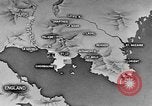
Film opens showing map of Normandy, France. Next, U.S. General Dwight D. Eisenhower is seen seated in a jeep, conversing with an officer, standing nearby, who makes notes in a pad. Lieutenant General Omar Bradley sits in the back of the jeep, and a Major General stands beside the jeep. Other officers stand around in the background. Eisenhower converses with the Major General. Scene shifts to closeup of Lieutenant General George Patton. U.S. B-24 Liberator bombers fly overhead, part of a two thousand plane bombarding the Saint-Lô area on July 25, 1944. Closeup of a B-24 dropping bombs and views of bombs exploding on the ground. American M4 Sherman tanks and infantrymen advancing after the bombardment. U.S. troops riding atop an M8 Greyhound armored cars and M4 tanks. Animated map shows the extent of U.S. advance from Saint-Lô encompassing the entire Breton Peninsula. Then, it shows American forces swinging North and around to the West, trapping German forces at Falaise. A German Tiger tank, camouflaged in shrubbery, moving along a road, followed by motorcycle, and trucks full of German soldiers retreating from the trap at Falaise. Brief closeups of German soldiers in some of the vehicles. A German FW-190 fighter-bomber seen flying very fast and low toward the camera. An explosion. View of British and Canadian soldiers coordinating in the field, further South of Caen, working to keep German armor surrounded in the area. A battery of British heavy artillery guns firing from camouflaged positions. An American 105 mm Howitzer Motor Carriage M7 (called M7 Priest by the British) firing from a wooded area. Shells exploding in the distance. German soldiers sheltering from the shelling. Fires burning. Allied jeep driving past knocked out German tanks. A field ambulance leads a long column of German prisoners of war. They march four abreast with hands clasped over their heads. A convoy of Allied heavy duty trucks bringing supplies from beachheads to the front lines. (World War 2; WW II; WW2)
CRITICALPAST.COM: About Us | Contact Us | FAQs - How to Order | License Agreement | My Account | My Lightboxes | Shopping Cart | Advanced Search | Featured Collections | Website Terms & Conditions | Privacy Policy ©2026 CriticalPast LLC.
License Agreement |
Terms & Conditions |
Privacy Policy
©2026 CriticalPast LLC.