


 Francais
 Deutsch
 Italiano
Refine Your Search
Rouen Normandy France 1944 stock footage and images
- Showing 5041 to 5046 of 9989 results more
more Hide
Hide
Nixon-Agnew election campaign states that Nixon will speak for United States and its citizens in the world.
Richard Nixon-Spiro Agnew election campaign for the Presidency in United States. United States citizens. A huge crowd gathered on the streets. Westminster skyline of London. Several boats in the Thames River. Champ Elysees, with Arc de Triomphe (Pl. Charles de Gaulle, 75008 Paris, France), at night. The Brandenburg Gate (Pariser Platz, 10117 Berlin, Germany) in Berlin, behind barbed wire. Lines of Russians on Red Square, in the snow. St. Basil's Cathedral in background. Leonid Ilyich Brezhnev and Soviet leaders. Chinese leader Mao Zedong and North Vietnamese leader Ho Chi Minh. Egyptian leader, Gamal Abdel Nasser. British Prime Minister Harold Wilson. Cuban President Fidel Castro. French leader, Charles de Gaulle. Hotline telephones on a table. Men seated with notepads in a press conference. Several microphones in view. Presidential Seal. Buildings and monuments in view. Washington Monument (2 15th St NW, Washington, DC 20024, United States) behind the White House. Nixon-Agnew Presidential election campaign states that Nixon will speak for United States and its citizens in the world.
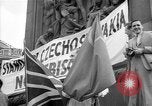
A procession moves on street during Peace Campaign Meeting in London, England.
International Peace Campaign Meeting at Trafalgar Square in London, England. People stand near a huge banner. The banner reads 'Stand By Czechoslovakia, No Plebiscite.' The British and Russian flags in view. Huge crowd of spectators. Sea of faces. A procession moves on the street. Spectator on sidewalk holds an American flag. Another holds Communist Red flag. Several double deck buses are seen. Several banners are seen. One reads: Britain-France, Russia Can Stop War". Another reads: "UNITY OF ARTISTS, Artists International Organization for Peace and Democracy; for Cultural Development."
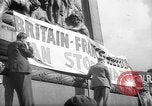
A speech by Lord Meston during Peace Campaign Meeting in London, England.
International Peace Campaign Meeting at Trafalgar Square in London, England. Men stand in front of a banner. The banner reads 'Britain, France, Russia, Can Stop War'. A huge crowd gathered at the Square. Speech by James Meston, 1st Baron Meston in Trafalgar Square (Trafalgar Sq, London WC2N 5DN, United Kingdom). Several people stand behind Lord Meston. He talks about peace in his speech. A sculpture of a huge lion in the background.
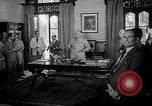
Plenipotentiary French Army General Beynet visits Levant States and calls a press conference.
French Army General Beynet in Beirut, Lebanon of Levant States near end of World War 2. Delegate General and Plenipotentiary Army General of France in Levant States. He receives local press and war correspondents. He addresses the correspondents and gives an account of events. Correspondents stand around his desk. The correspondents ask him questions.
German antiaircraft defenses fire at British attacking aircraft at night, during World War II. Wreckage of numerous downed British aircraft is seen.
Opening scene shows a German soldier using a sounding range and direction finder to locate British aircraft attacking German installations in France during World War 2. The next scene is during a foggy night. German searchlights are seen trying to locate attacking British aircraft. A flare is seen falling toward the ground. German antiaircraft guns fire. Engine sounds of aircraft are heard. View of German gunners firing tracer bullets and heavier antiaircraft guns skyward. A ball of fire in the air marks a struck British airplane. Closeup of burning British aircraft wreckage. Next, a ledger of British aircraft downed by a German antiaircraft battery is seen. It shows a list of British aircraft shot down in July and August, including: Bristol Blenheim light bomber; Short Stirling bomber, numerous Spitfires; and other aircraft. Workers are seen walking through a yard filled with the wreckage of British aircraft in a junk yard, where a powered crane is seen raising wings, and engines of the aircraft and loading them onto rail cars. The Narrator states that by November, the German defenses had downed 923 British aircraft. View of a loaded open rail car and a locomotive pulling loaded rail cars.

The Battle of Britain. German bombers strike London during the Blitz in World War II
View from cockpit of German Dornier Do 17 bomber, of many parked on an airfield in German occupied France during World War 2. Camera pans across the cockpit. View shifts view from under the wing of one plane as an aircrew member heads toward it. Next, the bomber with engines running taxis out for takeoff. Scene changes to show head-on approach of a Heinkel He 111 bomber aircraft taking off toward the camera. Then a formation of He 111 aircraft is seen in flight. Extreme closeup of He 111 in flight, with crew member visible in the aircraft. View from cockpit of a Dornier Do 17 bomber in formation flight. (Shaky camera makes them look like bi-wing aircraft in some brief scenes.) Camera pans across cockpit showing the Do 17 in formation above. View from instrument panel, of pilot and copilot at controls in a bomber. More views of the bombers in formation. The bombers arrive over London in the dark and are subject to British anti-aircraft fire with shells bursting all around them. Glimpse inside the cabin of one bomber. More flak explosions all around. The German planes release their bombs, which are seen exploding on London, England, below.
CRITICALPAST.COM: About Us | Contact Us | FAQs - How to Order | License Agreement | My Account | My Lightboxes | Shopping Cart | Advanced Search | Featured Collections | Website Terms & Conditions | Privacy Policy ©2026 CriticalPast LLC.
License Agreement |
Terms & Conditions |
Privacy Policy
©2026 CriticalPast LLC.