


 Francais
 Deutsch
 Italiano
Refine Your Search
Rouen Normandy France 1944 stock footage and images
- Showing 529 to 534 of 9958 results more
more Hide
Hide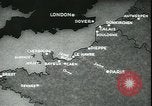
German forces fire at Allied vessels. Battle of Villers-Bocage in World War II
German soldiers in France during the Battle of Villers-Bocage of World War 2. A pictorial map showing cities along French coastline. A German soldier looking through binoculars. Allied ships at sea. German soldiers prepare artillery and fire. Smoke rising from explosions. German soldiers beside artillery. Smoke rising from Allied vessels at sea. Explosions on land and smoke rising. Two German soldiers talking. A wrecked landing craft at a beach. Debris of wreckage spread on the beach. A bomb wrecked U.S. LST (Landing Ship, Tank) on the beach and armored vehicles aboard the ship. Vehicles moving along a road. recked British Cromwell tanks and M3 Halftracks along the side of a road. A German soldier beside a damaged tank. Wide shot of a Stuart light tank. A damaged signboard which reads 'Villers Bocage'. Damaged buildings on the street of Villers-Bocage and a wrecked Tiger tank beside the buildings. Debris strewn on the ground and a damaged tank among the debris. A damaged tank with its front part into a building. A British helmet in the debris on a Cromwell tank. (Note: During this battle, On June 13th, 1944, German tank commander, Michael Wittmann, in a single Panzerkampfwagen VI Tiger tank reportedly destroyed up to 14 tanks and 15 personnel carriers along with 2 anti-tank guns. Many were of the British 22nd Armored Brigade of the 7th Armored Division, AKA the 'Desert Rats'.)

German film giving their perspective on Allied invasion of Europe in World War II
Film opens with slate showing date: 6 June 1944, in World War 2. German newspapers report that combined forces of Britain, and the Soviet Union finally decided to launch their invasion of Europe. Headlines say "Invasion launched at Moscow's orders." A map highlights cities along the coast of France. Formations of Allied warplanes shown in flight overhead. Light signals seen in the dark as German forces send information about the attacks. Closeups of German military men communicating by radio and telegraph. Defense forces are called to battle stations by alarms and announcements. Responding soldiers grab rifles from a rack and rush through tunnels in their fortifications. They climb to man weapons atop their bunkers. Artillery shells being raised by hoists to them from bunkers below. Searchlights scan the dark sky for Allied aircraft, and anti-aircraft guns fire in the night, including a 2 cm Flakvierling 38, four-barreled gun. German forces firing on Allied paratroopers. German sailors aboard destroyers and fast attack "E" boats fire at Allied warships. Daylight scenes of Allied ships and German shore batteries firing at them. U.S. Porter-Class, and Benham-class destroyers firing at land targets in France. German soldiers loading and firing Atlantic Wall coastal defense guns. An allied ship explodes off the coast. More views of German coastal guns firing and another Allied ship hit and exploding. More coastal gunfire.

General Eisenhower visits a camp and talks to officers in Cherbourg, France during World War II.
Supreme Commander of the Allied Forces in Europe General Dwight D. Eisenhower in Normandy, France during World War II. General Eisenhower with officers as he tours a rugged U.S. Army tent camp. He walks along a path between tents. (The path has deep side ditches for water runoff.) General Eisenhower near a car. Close behind him stands Major General Henry Aurand. General Eisenhower talks with a Colonel. Eisenhower in another area, talks with a very tall soldier, holding a mess kit. Major General Aurand, is in the group of officers behind Eisenhower, as he converses with soldiers eating from their mess kits. General Eisenhower proceeds to his car.

Free French vehicles moving, damaged buildings, a WW1 Memorial in La Haye Du Puits (WW2)
French troops passing through La Haye Du Puits, Normandy during World War 2. M3 half-tracks pass by ruins of buildings. Army trucks park near a World War 1 memorial used as a motor pool. Two tricolor Free France flags in the World War 1 memorial. An M3 half-track driving, with the Église Saint-Jean showing its damage (Place Patton, 50250 La Haye, France) in the background. French soldiers in trucks pass by a street with shops with signs “CITROEN”, “E. DE SAINT-GERMAIN” and “X GRANDES MARQUES”. Storefronts are damaged from bombing. Tricolor French flags in the street. A close view of a World War 1 Memorial with inscriptions “LA-HAYE-DU-PUITS A SES GLOREAUX MORTS 1914-1918” (“LA-HAYE-DU-PUITS TO ITS GLORIOUS DEAD 1914-1918” in English).
U.S. shuttle-bombing of German positions and military installations under Operation Frantic during World War II.
Film title slate indicates "Operation Titanic" but it, in fact, depicts "Operation Frantic" with U.S. shuttle bombing operations over Germany from bases in Great Britain, Italy and Russia during World War II. United States Army Air Force B-17 Flying Fortresses in flight. Aerial view of bombers in flight with several aircraft flying in formation leaving behind contrails. View inside bomber aircraft with bombardier preparing to drop bombs. View of bomb bay door opening and closeup of hand near bomb drop switch. Bombs awawy view as bombs are dropped from American aircraft. German defenses are bombed along the invasion coast of France (just prior to D-Day) on June 2, 1944. Aerial views of B-24 and B-17 bombers also in flight bombing German military installations in German-occupied northwestern Europe. Aerial view of a target area. Smoke rising up from bombardment. Two different U.S. Army Air Force B-17 Liberator aircraft are seen falling from the sky toward crashes after being hit by German enemy fire. One of them has smoke trailing from it, and the other is in a free fall. Railroad and marshaling yards are also bombed over Debrecen, Hungary on June 2, 1944, with aircraft continuing on (shuttle bombing) rather than returning to base. United States Army Air Forces B-24 Liberator flying in formation on June 21, 1944. Aerial view as they bomb the Focke-Wulf Fw 190 engine aircraft factory near Basdorf, Germany. German factories are bombed. B-17 aircraft on the same date are seeing in formation and bomb railway stations, freight yards, and factory targets, along with the Nazi German Ministry of War, Ministry of Propaganda, and Gestapo headquarters in Berlin, Germany. Heavy flak bursts seen in the air near the aircraft. Dogfight scenes as several German airplanes are shot down. Machine gunners aboard U.S. bomber aircraft firing at German fighter aircraft and shooting down 43 of them, according to narrator. Aerial view of ball turret rotating below bomber and firing guns at German fighter aircraft. The B-17s and B-24s bombing the targets. Synthetic oil plants and refineries are bombed at Ruhland Germany, east of Leipzig. Planning for the operation was done on December 7, 1943. A document about the operation is typed. Animated map shows Nazi positions and method of shuttle-bombing, allowing American aircraft to bomb from Soviet bases, and allies broadly to bomb German targets from bases in the United Kingdom, Italy, and Soviet Ukraine.
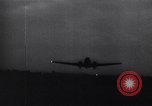
U.S. Army Paratroopers of the 101st Airborne Division load and depart to parachute into France the night before D-day
Paratroopers of the 101st Airborne Division (Screaming Eagles) prepare their equipment and prepare to drop behind enemy lines in France, the night before D-Day. They assemble in "sticks" and board C-47 transports painted in large white stripes to assure they will be recognized and not shot down by U.S. Navy ships, or other friendly fire. They are bid farewell by a three-star General. The aircraft take off one after another bound for the Normandy coast. (World War II period).
CRITICALPAST.COM: About Us | Contact Us | FAQs - How to Order | License Agreement | My Account | My Lightboxes | Shopping Cart | Advanced Search | Featured Collections | Website Terms & Conditions | Privacy Policy ©2026 CriticalPast LLC.
License Agreement |
Terms & Conditions |
Privacy Policy
©2026 CriticalPast LLC.