


 Francais
 Deutsch
 Italiano
Refine Your Search
Russia 1953 stock footage and images
- Showing 733 to 738 of 1877 results more
more Hide
Hide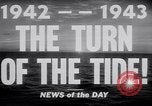
A 1942-1943 film report to the American public about the progress of World War II in Europe and the Pacific.
Opening slate at start of film reads: "1942--1943 The Turn of the Tide." A column of British armor enters Bengazi, Libya, led by several troops in tankettes. Next seen are a Lee Medium Tank, M3 followed by an infantry tank, a jeep, another infantry tank and another Lee M3 Medium tank. Closeup of local people greeting the troops with upraised hands giving the "V" for victory sign. Another Lee M3 tank passes close by the camera. Black smoke is rising in the background. Scene changes to a half sunken ship near another burning in the harbor. Another view of this from further away above port buildings. Closeup of three smiling British soldiers leaning over a cartoon on a tank, of Winston Churchill (As a bulldog smoking a cigar and wearing a cap with the word "Victory" written on it). A crumpled captured flag with swastika on it. British Field Marshal Bernard Montgomery stands atop a vehicle (unseen) and looks through binoculars. Below, a column of British supply vehicles is making its way along a path in the desert. Two tanks coming toward the camera through sand. Animated map shows Nazi territory being threatened by the Allies from the Mediterranean, the USSR, and the English Channel. Views of Soviet infantry advancing against German forces in the snow of winter on the eastern front. Soviet troops firing updated 76-mm divisional gun model 1902 hidden in woods. Shells exploding in snow-covered field as Soviet BT series tanks advance. Various Soviet artillery firing from fixed gun batteries and from woods. A shell striking in distance. Fallen German soldiers lying on snowy field. Makeshift battlefield crosses marking graves of fallen German soldiers. German steel helmets lined up in the snow. A sign, posted on a birch tree, lists the names and birth dates of 16 German soldiers from the 3rd Panzer Division (3Pz-Pi-BH.39) buried at this site on November 28, 1941. Scene shifts to Joseph Stalin addressing Soviet troops in Red Square, Moscow, Russia. All the soldiers in formation seem to be singing (unheard). Film switches to animated map again. This time delineating the Eastern front being pressed by the USSR, and showing area of the 2nd Soviet winter offensive in 1943. Change of scene from Europe to the War in Asia, against Japan, shows General Douglas MacArthur after arriving by a B-17 bomber at a Pacific island American base. He ascends a steep hill in a jungle area, accompanied by other officers. Closeup of MacArthur. American infantry moving in single file in New Guinea, as a field piece fires a round in the direction they are headed. U.S. artillerymen load shells into a 105mm howitzer gun. A fire burns as mop-up operations begin on New Guinea. An Australian soldier is seen firing a Bren gun in jungles. Other Australian soldiers fire a mortar that explodes, raising earth and dust. More views of shells exploding near Allied soldier advancing. A soldier with fixed bayonet makes a fake charge toward the camera. Views of Japanese prisoners of war guarded in an outdoor compound. Japanese dead soldiers on Guadalcanal. An animated map shows new battle lines in the Pacific, closing in on Japan, with pressure from China, the USSR, and the Pacific islands being captured by the U.S. Arrows are added showing new pressure from American naval fleets and from British and American bombers out of Australia and captured islands.
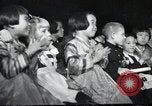
Korean and Russian children play together in North Korea.
Shows Russian and Korean children performing dance in a school function. A group of Russian and Korean children gather in circle in an open space of a village,dance and play a game of Blind Man's Bluff. Russian officials along with native villagers enjoy a friendly bout between Russia and Korea. Shows a Korean family going through lush farms in a horse cart. Farms scattered across the plain can be seen. Approximately 1948.
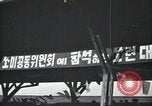
Events pertaining to withdrawal of USSR and USA from North Korea.
Events pertaining to withdrawal of USSR and USA from North Korea. Colonel General Trenty Shtikov and Kim II sung speaks at a joint assembly in Seoul. Flags of Korea USA and USSR seen in background. North Korean Flags being hosted over buildings. A scene from the People's Assembly in Pyongyang. Assembly members ask for withdrawal of USA and USA troops. North Korean flags on the walls of assembly hall. Assembly members cheer at the news of Russia's withdrawal from Korea in a later meeting. Shows a letter of thanks to Soviet Union by Koreans. Korean men,women and children collectively sign a petition. March 1946.
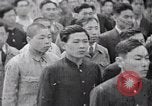
May Day Celebrations in Pyongyang,North Korea.
Thousands of people parade on the streets of Pyongyang to celebrate May Day. People carry several banners,pictures and signs. Flags of South Korea and Russia can be seen in parade. Shows a band playing in parade with a picture of Stalin in middle. Children do exercises in chorus. Prime Minister Kim II Sung, Russian Officials and other dignitaries watch and applaud the parade from a high-ground. Approximately 1947-48.

A Communist parade in Paris, France.
Anti-communist propaganda piece in the 1950s: A Communist parade in Paris, France. Communist demonstrators chant slogans like 'Stop the War in Indo-China', Down with warfare',' Unite with Russia for world peace'. People carry signs and banners reading 'France', 'US Go Home' and many more. A mock attack by a boy on another boy dressed up as an American Military Police. A union of French women with banners reading phony title for a communist front organization. Big replica of Stalin's party line novel. Main body of procession includes parade by Communist-led trade unions. A parade of French military might in an other part of Paris. Thousands of French soldiers armed with rifles march on a tree-lined street. People gather in great numbers to witness the parade. A parade of French military trucks, artillery, and tanks.

President Dwight D. Eisenhower speaks to the nation at his White House press conference.
President Dwight D. Eisenhower at his White House press conference addresses the nation. He states that Russia's success with the first earth satellite (Sputnik) during the Space Race doesn't indicate a lag in American satellite and ballistic missile research. President Eisenhower further adds that the Vanguard satellite program had not received the same amount of attention as American ballistic missile work, and that speed of progress in satellites cannot be interpreted as a measure of progress in ballistic missile work. He says that American satellite work has never been part of a race with any other nation, and rather has been scheduled as part of the IGY's (International Geophysical Year) scientific work. He praises the American satellite program for being well designed and properly scheduled to achieve the scientific purposes for which it was initiated.