


 Francais
 Deutsch
 Italiano
Refine Your Search
Russia 1953 stock footage and images
- Showing 847 to 852 of 1877 results more
more Hide
Hide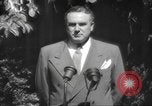
United States Senator Brien McMahon speaking about the first atomic bomb test explosion conducted by the Soviet Union.
United States Senator Brien McMahon, chairman of the Joint Commission on Atomic Energy, addressing the nation in the United States. Senator McMahon standing at the microphones speaks about the first atomic bomb test conducted by Soviet Russia (called RDS-1, First Lightning, or Joe 1) on August 29, 1949. The Senator talks about the President's announcement that the Soviet Union has exploded its first atomic bomb. He speaks about the atomic energy project and the necessity for U.S. President Truman to talk to the Russians. He says that the whole world has to be alerted about the atomic bomb explosion and interference of the United Nations is necessary in the matter.
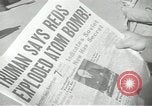
Men standing on a street in the United States read newspapers about the Russians exploding an atomic bomb.
Men reading various newspapers (mostly from New York) in the United States. Views of several newspaper headlines such as 'Truman says Russia set of Atomic blast' after President Truman revealed to the American public that the Soviet Union had successfully detonated an atomic bomb in a weapons test. Traffic on a road. Man in 1940's suit and hat standing on a street reading a newspaper. (World War II period).
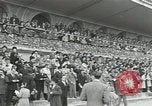
Scenes from German occupied Paris France; French collaborator Ferdinand De Brinon gives a speech to German officers (WW2)
Scenes shot in 1942 and 1943 from inside German occupied Paris, France during World War II. German officers and civilians at the Longchamps racetrack in Paris, France. Horses run on a dirt track. German troops at the Eternal Light for the Tomb of the Unknown Warrior at the Arc de Triomphe. A German Panther tank captured by the FFI (French Forces of the Interior) in 1944. French collaborator Ferdinand De Brinon speaks into a microphone. German officers listen carefully. Collaborators Marcel Deat, and Laval's son in law, Comte Rene de Chambrun also seen. French Regimental flag held by French collaborator militia. A crowd outside Notre Dame Cathedral. French Marshal Philippe Petain arrives in a car. French collaborationist troops stand at attention. Ceremony for the Legion against the Soviet Russia shows assemblage and German Swastikas on a wall.
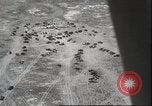
Three Russian airmen land in San Jacinto, California, after flight from Moscow, Russian, over the North Pole
Aerial view from airplane flying low over a dairy pasture outside San Jacinto, California, shows cars and people below, gathered around a parked Soviet Tupolev ANT-25 aircraft that landed there on July 14, 1937, after a nonstop flight over the North Pole, from Moscow, Russia. Closeup of local people standing in roped off area, looking at the airplane. Scene changes to Soviet pilot, Mikhail Gromov; Co-pilot, Sergei Danilin, and Navigator, Andrei Yumashev, meeting the Press, 20 miles away, on veranda at March Army Air Field Officers Club. Back at the landing site, local people walk under the aircraft wings and examine it closely. Letters "25ND25" are stenciled under the left wing. Back at March Field, American Air Corps officers shake hands with the Soviet flyers.
Images pertaining to advance of communism during 20th century, especially in East Germany
Statue of Karl Marx on his grave stone in Highgate Cemetery, London. A picture of Karl Marx. Scenes in Russia around the time of the Russian Revolution circa 1917 and creation of the Soviet Union. Soviet soldiers walking slowly in loose formation. Bolsheviks standing with a large banner. Images spanning many years thereafter: Damaged shops on a street. "One way" street signs in several languages. Large gathering of people carrying signs reading: "Frieden" (Peace, in German). A sign reading: "HALT, Landesgrenze" marking a German provincial boundary. A sign in German, designating the customs border at Furth im Wald, Bavaria ("Zollgrenz-Bezirk, Furth i.Wald"). East German border guards setting obstacles and sentry paths at barbed wire barriers (constituting the Berlin Wall, early on). Picture of Günter Litfin, a twenty-four-year-old tailor, who swam across the Spree Canal to West Germany on 24 August 1961. View of him being fatally shot from across the border, by East German guards, as he is being pulled into West Germany (the first such fatality at the East West German border). Animated map of the world with label references to Berlin,1961; Havana, 1959; Budapest, 1956; Coyoacan, 1940; and Kronstadt, 1921.
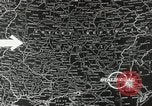
Post-World War II scenes in Communist occupied areas of Europe and Asia
Animated map shows thrust of German forces during invasion of Soviet Russia in World War 2. Stalingrad is highlighted as a turning point. Another animated map shows Soviet territorial gains at the end of the war, as narrator discusses the disposition of those places and their respective populations, as in Latvia, Lithuania, and Estonia. He also discusses Soviet zones of occupation. Animated map shows "Iron Curtain." Soviet troops on parade. Soviet ZSU-57-2 self-propelled anti-aircraft guns (SPAAG) on display during a parade in 1945. A stadium filled with people in Soviet-occupied East Germany, in 1949. Friedrich Wilhelm Reinhold Pieck, the first President of the German Democratic Republic, is seen in the stands. Young East German women parade in traditional costumes, clapping their hands, in the stadium. Waterfront scenes show Soviet trade activities with post-war occupied entities. Scenes of conflict as Chinese communist forces expel Chiang Kai-shek's Nationalist Chinese forces (ROC) from mainland China to Formosa (Taiwan), in 1949. A litter-borne casualty and a refugee mother and small girl are seen as they evacuate.