


 Francais
 Deutsch
 Italiano
Refine Your Search
Russia 1953 stock footage and images
- Showing 853 to 858 of 1877 results more
more Hide
Hide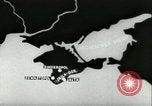
German troops load artillery and fire it at enemy positions on Eastern Front during World War II.
German soldiers battle against Russian troops on Eastern Front during World War II. A map shows the German campaign in South Russia. Captured Renault UE tankettes lead German advance in Crimea. Soldiers load and fire heavy artillery at enemy positions from atop a hill.
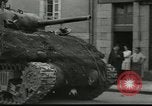
Military tanks and infantry advance and French civilians cheer and tear down German posters in France.
U.S. tanks and infantry advance in France during World War II. The tanks enter Laval. Military cars drive past along the tanks. Civilians cheer and wave to the troops on the tanks. Soldiers eat while they move along a road on military tanks. The civilians give water to the soldiers. The civilians tear down German posters. Officials fly a flag of the United States, France and Russia from a balcony. Civilians on cycles watch the troops on trucks as they advance. A pet dog with the soldiers on a tank. Military trucks with soldiers advance through Rennes. The soldiers move across a Bailey bridge on a river in Laval.
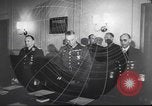
German surrender, UN founding, and Chiefs of Counsel meet before conducting Nuremberg and other trials after World War 2.
A film on preparations that are made for prosecution of axis war criminals following World War 2. Ratification of the surrender documents (from surrender two days earlier at Reims) held at Soviet headquarters in Karlshorst, Berlin, on May 9, 1945. German officers Colonel-General Hans-Jürgen Stumpff as the representative of the Luftwaffe, Field Marshal Wilhelm Keitel as Chief of Staff of OKW, and Admiral Hans-Georg von Friedeburg as Commander-in-Chief of the Kriegsmarine enter room and are seated. View of Keitel signing the surrender document. Scene change to Hall of the United Nations Conference, held in San Francisco from April 25 to June 26, 1945, with delegates from 50 Allied nations creating the United Nations. This was officially the United Nations Conference on International Organization (UNCIO). Leaders of various United Nations countries address delegates present in the War Memorial Opera House of San Francisco, including Edward Stettinius Jr of the United States. Next: A meeting of the military tribunal Chiefs of Counsel of many nations, including France, Russia, Great Britain and the United States, held in London, England, United Kingdom. They sign the International Military Tribunal Charter governing how the major war criminals from World War 2 would be tried.
The Soviet Army prepares to fight against the Germans in the Soviet Union during world War II.
A film titled 'Why we fight : Battle of Russia' about German aggression in the Soviet Union during World War II. A dramatization depicts Soviet troops as they defend their land against foreign invaders over the years. A map of the Soviet Union depicts the advance of German forces up to Moscow. Red Army troops march. A picture of an ancient Russian warrior. Snow covered surroundings with the onset of winters. St. Basil's Cathedral in Moscow. People pray in a church. A bishop conducts a service. Soviet soldiers listen to an order read out to them. Aircraft parked on a field. Soviet paratroopers, infantrymen and cavalry units. Artillery being fired at an enemy position.
Soviet-German non-aggression pact is signed in Moscow and the Germans and the Red Army invade Poland in the European Theater.
German aggression during World War II. German troops marching in formation. A large crowd on either side of a road watches the troops. German Chancellor Adolf Hitler delivering a speech in Germany. Troops standing in formation listen to Hitler. On August 23, 1939 : People holding banners that read 'Down with War and Racism' and 'Aid the Allies'. New York Times headline reads: 'Reich and Soviet Join for Peace -- or War; No Buffer State; New Pact Warns Allies; Estonia Gives Moscow Sea and Air Bases'. Soviet politician Vyacheslav Molotov, Soviet Union leader Joseph Stalin and German Foreign Minister Friedrich Wilhelm Ribbentrop with other officers during the signing of Soviet German non-aggression pact (also called Molotov–Ribbentrop Pact) in Moscow, Russia in August, 1939. German Stuka dive bombers in action, when Germany invades Poland in a "blitzkrieg.".German Heinkel He-111 bombers in action. Buildings being totally destroyed by bombs. Red Army tanks and troops moving in snow. Victorious German troops marching in occupation. German heavy artillery batteries firing.
Animation and footage depict American strategies to attack the Nazis in the European Theater during World War II.
A film about U.S. response to the activities of the Axis powers Italy, Germany and Japan during World War II. U.S. Army Chief of Staff George Marshall praises the United States Military offensives in Europe and Africa. George Marshall narrates rest of the clip. Animation of a globe depicts the Allied forces in the middle east planning to isolate China and Russia. The animation depicts the German Forces crossing the British allies, joining Japan and then attacking America. It depicts U.S. plans to stop the collaboration of Germany and Japan. Scenes of American shipyards are shown, with workers building new war ships. Some workers welding. A sign reads, "Work must continue during launching. Positively." The animation depicts the shorter routes to the European Theater. Aerial footage of a large fleet of U.S. Navy Ships at sea, underway during World War 2. Next scenes shows smoke pouring from ships at Pearl Harbor in Hawaii following attack by Japan. View of Soviet Russian horse cavalry forces charging toward enemy German positions during a battle in World War 2. Scenes of Allied artillery being fired at night in North Africa. Animation depicts the need to establish American air bases closer to Japan before launching successful air attacks. Footage of U.S. soldiers running out of landing crafts and coming ashore at a beach head during World War 2. Animation depicts U.S. plan to defeat Japan. Animation depicts strong German Army. Animation depicts U.S. plan to defeat the Nazi and the Fascist power in Europe.