


 Francais
 Deutsch
 Italiano
Refine Your Search
Russia 1953 stock footage and images
- Showing 871 to 876 of 1877 results more
more Hide
Hide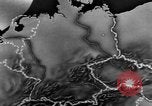
The Soviet Union walls off East Germany from the rest of the world post WW2.
Animated map shows the four different zones of Germany after World War II.: British, Soviet, French and American Zone. Animated map focuses on the Soviet zone and shows the Iron Curtain rising along the Soviet Border. Russian troops march through streets in Berlin. Civilians board trains on streets. Russian woman directs traffic. Damaged buildings in the background. Russian officers enter and leave Headquarter in Berlin. East German men and women workers on farms. Russian soldiers and East German civilians pull heavy machinery for shipment to Russia. Interior of the Dresden China Works. Civilians mold and paint china articles.
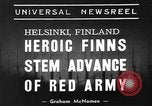
Red Army attacks Finland on Nov 30, 1939 by bombing Helsinki. The Winter War begins. Views of a Moscow parade and of Helsinki.
View of Red Army parading in Moscow, Russia. General Secretary of the Communist Party of the Soviet Union Joseph Stalin waves at the marching troops. Map of Finland. Finland during the early days of the Winter War of 1939-40. President Kyösti Kallio of Finland seated at table during a conference. He bangs a gavel. View of Helsinki Central Station (Helsingin päärautatieasema, Kaivokatu 1, 00100 Helsinki, Finland). Traffic moves through the streets of Helsinki. Finnish civilians fleeing Helsinki at Helsinki Central Station. Finnish civilian men mobilizing. Aircraft in flight. Paratroopers descend and advance on ground. Tanks move on a field. Soldiers riding horse carts beside a railroad track. They fire artillery. Soldiers advance through snow covered terrain in Finland wearing skis.

President Eisenhower addresses the nation and lights a spruce during the Annual Christmas Tree Lighting Ceremony in the U.S.
The Annual Christmas Tree Lighting Ceremony in the United States. The President of the United States Dwight D. Eisenhower and his wife Mamie Eisenhower arrive for the ceremony. An officer greets and receives them. The Vice President of the United States Richard Nixon and his wife Pat Nixon also arrive for the ceremony. The President addresses the nation that world peace is up to Russia. He lights a 60-foot spruce which is a symbol of world's hope for peace.
Kremlin leaders review a massive military parade in Moscow. U.S. Army recruiting and training soldiers in the United States.
Opening scene shows massive military parades in Red Square, Moscow, Russia, Soviet Union. Huge formations of Sailors and soldiers pass in review before Soviet leaders watching from a Kremlin reviewing stand. Among those seen are Party Chairman, and leader, Nikita Khrushchev, in light suit and hat and at his right side, Defense Minister Georgy Zhukov (in General's uniform). Next a formation of Tupolev Tu-16 (Badger) bombers flies over St. Basil's Cathedral and the square. View from high in Kremlin of towed artillery pieces. Closeup of Russian soldiers standing in the open back of a large artillery tractor pulling a large field piece. Other field pieces in tow. Scene shifts to the United States. Glimpse of an American Army recruiting poster and views of U.S. army recruits. U.S. soldiers on parade and in field training live fire exercises. Soldiers firing rifles in prone position, and then advancing across a field. Army gun crew with an 8-inch howitzer. M75 Armored Personnel Carriers driving across a field. Soldiers on maneuvers wearing personal camouflage and firing heavy weapons from a tree line.
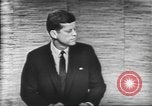
During a presidential election debate in Washington DC, Kennedy comments that its proper to express regrets to nations.
The second Kennedy-Nixon Presidential Debate in Washington DC, United States . Edward P. Morgan of ABC News asks Democratic candidate Senator John F Kennedy about sending apologies or regrets to General Secretary of the Communist Party of the Soviet Union Nikita S Khrushchev over the U-2 reconnaissance aircraft incident. Kennedy answers that if it could save the summit conference it would have been proper to express regrets. He speaks that the U-2 flights were proper from the point of view of protecting their security. But they were not in accordance with the international law. He speaks about the regrets expressed to Castro, to Southern Russia and to Eastern Germany under the Eisenhower Administration during the past years. He mentions the regrets expressed by the Soviet Union and the Chinese Communists to the U.S. over incidents. He states about they should have a stronger military force and should increase their strength all over the world. Republican candidate U.S. Vice President Richard M. Nixon presents his views and states that Senator Kennedy is wrong in thinking that Khrushchev might have continued with the summit conference if the U.S. had expressed regrets. He disagrees with Kennedy's analogies that the U.S. is a strong country and can express regrets for any wrong doings. He also disagrees in expressing regrets to anybody for doing things which has the support of the Congress and which is right from point of view to protect the security of the U.S. (This 4 part debate is sometimes called the Great Debate)
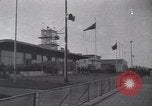
Czech Prime Minister Gottwald shakes hands with Valerian Zorin and boards an aircraft for Moscow in Prague, Czechoslovakia.
Czech Prime Minister Klement Gottwald at an airfield in Prague, Czechoslovakia. Prime Minister Klement followed by military officials walks on the airfield. Prime Minister Gottwald shakes hands with Russian Ambassador to Czechoslovakia Valerian Zorin. Gottwald boards an aircraft for Moscow. Russia. The aircraft takes off.