


 Francais
 Deutsch
 Italiano
Refine Your Search
Russia 1953 stock footage and images
- Showing 877 to 882 of 1877 results more
more Hide
Hide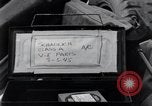
Wounded American soldiers and nurses at U.S. 48th General Hospital during Victory Day celebrations in Paris after World War II (WW2)
Victory Day celebrations in Paris, France after World War II. Entrance of U.S. 48th General Hospital in Paris. Wounded American soldiers with nurses in a hospital compound. Soldiers reading news of Germany's surrender. A soldier shows newspaper with headline 'Nazis Reveal Surrender To Western Allies, Russia'.
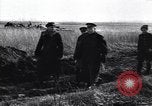
Soviet forces advance westward towards Berlin during World War II
Opening scene shows Soviet Marshal Georgy Zhukov and officers of his staff walking across a field in Russia, during World War 2. Soviet SU-100 (Samokhodnaya Ustanovka 100) tank destroyers armed with a 100 mm anti-tank guns, rush past the camera. Next, Marshal Zhukov is seen surrounded by senior Soviet officers as he speaks on a field telephone. A formation of Soviet warplanes flies over the advancing tank destroyers. Marshal Zhukov and staff observe field operations from an established trench covered by a camouflage netting. Closeup of Zhukov examining a map. Soviet armor moving under fire from German shells exploding near them. Glimpse of Zhukov and staff in another observation point. Soviet armor and infantry enduring explosions from German gunfire and moving forward in smoke. Animated map shows gradual Soviet advances beginning at the River Oder and pressing toward and beginning to encircle Berlin.
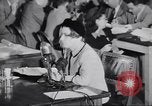
Russian-American novelist Ayn Rand testifies against communism at hearings of House Committee on Un-American Activities.
Russian-American novelist Ayn Rand at hearings of House Committee on Un-American Activities (HUAC) in the United States. The Russian-American novelist Ayn Rand testifies against communism and speaks what she feels about communist propaganda. The novelist mentions the movie 'Song of Russia' and further says that it's impossible to convey to free people what it's like to live in a totalitarian dictatorship.
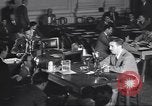
Walt Disney Studios owner Walt Disney testifies against communism at hearings of House Committee on Un-American Activities.
Owner of Walt Disney Studios Walt Elias Disney at hearings of House Committee on Un-American Activities (HUAC) in the United States. Walt Disney owner Walt Elias Disney speaks about Walt Disney pictures distribution in Russia. He further states that pictures were bought by Russians but they turned them back saying they did not want them as they did not suit their purposes. Walt Disney also speaks about organizer and leader Herbert Sorrell when he called for a strike against Disney Studios in 1941 and his connection with Communist Party.
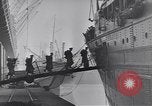
U.S. Army Service Forces transporting troops and supplies worldwide during World War II.
U.S. troops board a large troop transport ship via a gangplank. Troops on an intermediate deck of the ship. Some are sprawled out relaxing. View from above of more troops boarding a ship. Men and equipment on the pier below. American forces at various far flung places where the U.S. Army Services Forces facilitated their transport and logistic support. Fleeting glimpses of troops in: Ireland; Alaska; Trinidad; and South America. Troops jam the upper deck of a transport ship. Army Service Forces officers in a planning meeting. Naval officers on deck of a ship look through binoculars as U.S. Naval ships bombard the coast of Solomon Islands and landing craft carry marines in an amphibious assault. Next, a man is seen annotating a map of North Africa. Secret maps pertaining to Allied landings in Tunisia and Algeria. Animated map illustrates amphibious landings on North African coast, highlighting Casablanca, Oran, and Algeria. Landing craft carry troops and supplies that are piled up in the sand beach. Soldiers moving military supplies ashore, in fire brigade fashion. Soldiers working at desks in Offices of the Army Service Forces. Filing cabinet in background. Trucks on the move in remote locations. Supply ship being loaded at a terminal. Fuel drums and army vehicles a being loaded aboard ships. Officers seated at a conference table. Ordinary American enlisted soldiers in a griping session at an Army post in the United States. Camera pans over large formation of soldiers. Animated chart shows more than half of servicemen who are part of Army Service Forces (ASF), are unaware of that. Troops marching in review at a tropical location, where reviewing officers wear pith helmets. Chart illustrates lack of unit pride in ASF. Images of various ASF logos. Chart shows results of polling data from soldiers and service members. Signal Corps and Engineers elements of ASF have the greatest unit pride. But most think better of other branches of the Army. More troops marching, in steel helmets and carrying rifles with bayonets affixed. Troops marching overlaid by "50%" indicating that half don't believe their contributions to the war effort are significant. Troops lined up (for pay?). More charts expressing concern about low morale. A heavy gun firing. German paratroopers jumping from a formation of Junkers Ju 52 aircraft. Charts expressing prevailing U.S. troops view that Germany wouldn't be too hard to defeat. Chart showing lack of understanding about why the U.S. is fighting Germany. Image of President Franklin D. Roosevelt and Prime Minister Churchill seated in front of their key military officers at Casablanca Conference in World War 2. Chart shows U.S. soldiers believe that the greatest war effort is expended by the U.S. followed by Russia, with China and Britain providing little. Chart illustrates that only half U.S. troops want to get overseas and fight. Chart shows U.S. War Department films can correct this problem.
U.S. shuttle-bombing of German positions and military installations under Operation Frantic during World War II.
Film title slate indicates "Operation Titanic" but it, in fact, depicts "Operation Frantic" with U.S. shuttle bombing operations over Germany from bases in Great Britain, Italy and Russia during World War II. United States Army Air Force B-17 Flying Fortresses in flight. Aerial view of bombers in flight with several aircraft flying in formation leaving behind contrails. View inside bomber aircraft with bombardier preparing to drop bombs. View of bomb bay door opening and closeup of hand near bomb drop switch. Bombs awawy view as bombs are dropped from American aircraft. German defenses are bombed along the invasion coast of France (just prior to D-Day) on June 2, 1944. Aerial views of B-24 and B-17 bombers also in flight bombing German military installations in German-occupied northwestern Europe. Aerial view of a target area. Smoke rising up from bombardment. Two different U.S. Army Air Force B-17 Liberator aircraft are seen falling from the sky toward crashes after being hit by German enemy fire. One of them has smoke trailing from it, and the other is in a free fall. Railroad and marshaling yards are also bombed over Debrecen, Hungary on June 2, 1944, with aircraft continuing on (shuttle bombing) rather than returning to base. United States Army Air Forces B-24 Liberator flying in formation on June 21, 1944. Aerial view as they bomb the Focke-Wulf Fw 190 engine aircraft factory near Basdorf, Germany. German factories are bombed. B-17 aircraft on the same date are seeing in formation and bomb railway stations, freight yards, and factory targets, along with the Nazi German Ministry of War, Ministry of Propaganda, and Gestapo headquarters in Berlin, Germany. Heavy flak bursts seen in the air near the aircraft. Dogfight scenes as several German airplanes are shot down. Machine gunners aboard U.S. bomber aircraft firing at German fighter aircraft and shooting down 43 of them, according to narrator. Aerial view of ball turret rotating below bomber and firing guns at German fighter aircraft. The B-17s and B-24s bombing the targets. Synthetic oil plants and refineries are bombed at Ruhland Germany, east of Leipzig. Planning for the operation was done on December 7, 1943. A document about the operation is typed. Animated map shows Nazi positions and method of shuttle-bombing, allowing American aircraft to bomb from Soviet bases, and allies broadly to bomb German targets from bases in the United Kingdom, Italy, and Soviet Ukraine.