


 Francais
 Deutsch
 Italiano
Refine Your Search
Saigon Vietnam 1939 stock footage and images
- Showing 469 to 474 of 5026 results more
more Hide
Hide
J.Edgar Hoover describes the problem of enemy agents and Nazi sympathizers in the United States in 1940.
Director of the U.S Federal Bureau of Investigation (FBI), J.Edgar Hoover, addresses Americans in military service in 1940. He speaks about enemy agents sent to the United States to undermine the war effort. Scene shifts to a 1940 nighttime view of New York City with lights on in its buildings. Sound of Benny Goodman's orchestra in background. Glimpse of water displays at the New York World's Fair. Brooklyn Dodgers Baseball team playing a game at Ebbets Field. A large field of wheat being harvested by a mechanical reaper, in an American western state. American soldiers putting on civilian clothes for weekend passes. Views of various American cities and towns with cars driving on parkways, shoppers and pedestrians walking in business districts. Closeup of a German agent, ostensibly being apprehended while beaming information to Germany via shortwave radio. German documents are on his desk. A submarine periscope tracks across surface of water. A torpedo races through the water leaving a trail of bubbles. An American ship, ostensibly being torpedoed in the Caribbean. Letters being mailed to so-called "mail drops" in Spain and South America. An intercepted letter with military information being highlighted. A brick house, outside Los Angeles, where an unidentified man is seen, whom narrator (J.Edgar Hoover) describes as " This self-appointed Dictator, who set himself up in the business of promoting Nazism." A picture of Adolf Hitler is seen on his wall. Near Chicago, a wooden sign reads, "Camp Hindenburg., Two miles." American Nazi youth are seen parading there. A newspaper shows a picture of Nazi youth at Camp Nordland, in New Jersey where young American Nazi girls are seen parading. In Yaphank, on long Island, New York, American Nazis are seen parading. The head of the German-American Bund, Fritz Kuhn, is seen at an outdoor podium giving a speech, while surrounded and guarded by uniformed Bund members. He is enthusiastically applauded by members of the audience. Several women with babies in carriages, cross at a corner in New York City. Some receive notices being passed out by a young man, announcing a "Mass Demonstration for true Americans" (to be held at Madison Square Garden). A swastika appears on each notice. View from a high point overlooking a crowd of 22 thousand American Nazis gathered in Madison Square Garden, on Feb. 20, 1939. An honor guard parades as drummers play from the stage. A mass of men holding American flags, and one holding a banner showing a swastika and words in German. Audience members all render the Nazi salute and shout "Heil." Files in the FBI offices labeled "German Agents." The file of Walter Kappe, one of the leaders of the Chicago Free Society of Teutonia and German American Bund is shown. Narrator, Hoover, says, " he was a Lieutenant in the German Army and the Leader of German sabotage in the United States." View of a vast array of desks and files in the FBI where men and women work on fingerprints. A man projects fingerprints on a screen, as Hoover speaks of the files revealing that "innocent appearing persons, applying for work in United States war plants, had been convicted of espionage in the last world war."Two men look over an FBI chart showing the location of every key spy and mail drop in North and South America
Post World War II trials of German and Japanese Leaders for war crimes
Film opens with exterior view of Nuremberg cell prison, just north of the Palace of Justice, holding war criminals for the Nuremberg Trials. Interior view showing cell bloick area and guards patrol the halls. Cell door with name Karl Doenitz on it. Views of German Admiral Doenitz and Admiral Erich Raeder, looking over war planning charts. Ships burning at sea in nighttime. Glimpse of German U Boat Captain observing through periscope. Back at Nuremberg Prison, an American soldier checks cell of Joachim von Ribbentrop. German Foreign Minister von Ribbentrop seen on steps of an airplane. Scene shifts to Nazi–sponsored so-called American Rally in Madison Square Garden, New York City, on February 20, 1939. A huge picture of George Washington dominates the stage where drummers play while flag-bearing marchers fill the stage. View of audience of 20 thousand persons, rendering Nazi salutes. Someone trying to interfere with the activity is quickly subdued on stage by men in military style uniforms. Scene shifts back to Nuremberg prison, where a soldier guard passes food through cell door to Julius Streicher (unseen). Closeup of Streicher speaking to crowd of people in Germany. Views of German Paramilitary Brown shirts (Storm troopers, or Sturmabteilung) during boycott preventing people from patronizing Jewish merchants. Next, victims liberated from Nazi concentration camp are seen being sprayed in delousing powder by American soldiers. Back at Nuremberg prison, a soldier stands outside the cell of Hermann Goering. Next, Goering is shwon in a scene eating at an outdoor table with other men, at a Nazi-sponsored public feeding event before World War 2. Brief view of German Chancellor, Heinrich Bruening, who fled Germany in 1934 as the Nazis were coming to power. A Graf Zeppelin airship, bearing Nazi Swastika insignia, is seen in flight over New York City. Crew member inside the Zeppelin, looking out a window as he plots a position on a chart. The Zeppelin casts a shadow over an ocean liner at sea, as it passes overhead. Back at Nuremberg cell prison, a guard opens a door with a key. Next seen shows several prisoners walking into a prison yard at an unidentified prison. A firing squad (unseen) is heard marching into position and firing their guns. Scene shifts to Japan, where a Japanese twin engine passenger plane is seen overhead, coming in for a landing. Official buildings are seen in Tokyo and jurists who will participate in war crimes trials. Scene shifts to war crimes trials authorized in Manila, by General Douglas MacArthur. Seen are Japanese General Tomoyuki Yamashita and another Japanese officer on trial at the High Commissioners Residence in Manila, in 1945. Views of ordinary Japanese soldiers. A court convening.
World War II war crimes trials; flashback views during World War 2; Nazi prison cells in Nuremberg; Japanese war criminals
Prison at Nuremberg, north of the Palace of Justice, where Nazi prisoners are held during Nuremberg trials in 1946. Cell of Nazi Admiral Doenitz is seen, with his name over the prison cell door. Nazi Admirals, Karl Doenitz and Erich Raeder, during the war. Views of war crimes at sea, with burning ships in flames at night. American soldier looks into prison cell of Joachim von Ribbentrop. Von Ribbentrop boarding an airplane, during the war. A German American Bund rally in the United States at Madison Square Garden in 1939, with Patriotic image of George Washington and massed American flags. Americans giving Nazi salute as Fritz Kuhn speaks. Fight or scuffle on the stage of the meeting. American military guard places food into cell of Nazi Julius Streicher. View of Julius Streicher giving a speech. Street scenes of Jewish shops being vandalized and boycotted in Germany. Boycott of Jewish-owned stores in Germany including posters and paint labeling Jewish businesses, and a poster that says, "Die juden sind unser unglück" (which means "The Jews are our misfortune"). Emaciated and thin liberated Concentration camp inmates being deloused. American soldier looks into prison cell of Hermann Goering. View of Goering in civilian clothes, sitting with companions, before the war. The Graf Zeppelin airship in flight over New York City. Officer on board Zeppelin shown plotting a course from the bridge. Shadow of the zeppelin air ship cast over an ocean liner at sea. Prison guard opens a door and goes in. Prisoners file out of the building, ostensibly to face firing squad. Airplane landing at Japanese airfield and scenes of military staff and military gathering of Imperial Japanese forces in Tokyo Japan during World War 2. Japanese General staff in a meeting. A Japanese military leader during a surrender meeting in World War II.
British prosecutor Shawcross presents crimes by Nazi leaders during Nuremberg Trials; scenes from Molotov-Ribbentrop Pact signing
Trial of Nazi leaders for war crimes in Nuremberg, Germany soon after the end of World War 2. British Chief Prosecutor Hartly W Shawcross presents count no 2, crimes against peace involving wars of aggression in violation of international treaties and agreements. A document reveals Adolf Hitler's plans to occupy Poland. Footage showing Soviet Leader Joseph Stalin and Germany's Joachim Von Ribbentrop as they sign non-aggression pact between Russia and Germany on August 23, 1939 (also called the Molotov-Ribbentrop Pact). Germany prepares to occupy Poland as Pope Pius XII and President Franklin D Roosevelt appeal for peace just before start of World War II.
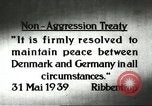
German invasion of Denmark on April 9, 1940, in World War II
In spite of Non Aggression treaty with Denmark, signed by Germany, May 31, 1939, German ships carrying army troops dock in Copenhagen and offload troops, tanks and equipment in the midst of local citizens, as part of surprise invasion of Denmark, on April 9, 1940, in World War 2. Some local citizens running away from the dock area. View of German troops marching along a street in Copenhagen, as local people line the sidewalks, watching.
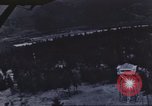
Firefighters parachute into forests from Ford trimotor airplane. Parachute training in Missoula, Montana
Aerial view of a lookout tower in a forest in United States . A Ford trimotor airplane takes off on a grass field. The airplane in flight and dropping supplies to firefighters, by parachute. Scenes of 1939 experimental tests with firefighters parachuting from a Ford trimotor, near Winthrop, Washington. They can be seen leaving the aircraft, chutes opening, and firefighters descending. Scenes from first operational use of parachuting firefighters, on July 12, 1940, when Smoke Jumpers, Rufus Johnson and Earl Cooley parachuted into the Nez Perce forest , in Idaho, where they successfully extinguished a small fire. Rufus Johnson was the first to jump from the airplane, followed immediately by Earl Cooley. Fire fighters being trained at a parachute training center in Missoula, Montana. Men learn to jump and run over wooden planks. An instructor gives directions to trainees on a loudspeaker. (World War II period).