


 Francais
 Deutsch
 Italiano

Refine Your Search
Saigon Vietnam 1939 stock footage and images
- Showing 481 to 486 of 5030 results more
 Hide
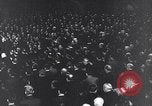
Isolationist versus interventionist sentiments of people in the United States regarding America entering World War 2
Americans express their views about United States entering into World War II after the Pearl Harbor attack. Anti-war isolationist and interventionist views are presented. Senator Gerald P. Nye advocates in favor of an arms embargo. Urging against American involvement in war, Senator Burton K. Wheeler cautions that war mongers and interventioners or intervention advocates control most of the avenues of propaganda. Wendell Willkie speaks advocating unity of purpose in America and importance of assisting the threatened democracies of Europe with war materiel and supplies. Next, Senator Joshua B. Lee of Oklahoma strongly urges support for lend-lease and "setting in motion an industrial blitzkrieg (of war materiel) that will make it possible for England to blast Hitlarism from the face of the earth." View of Congress meeting in the U.S. Capitol chamber. Anti-war college aged students protests against involvement in war and picket at the White House in Washington D.C.,United States. Adjacent to them are other protestors picketing against the peace advocates, with signs like "Americans are against subversive organizations picketing the White House" and "We Americans protest Communists picketing the White House. A women's organization advocating peace or protectionism or isolationism is seen wearing all black. They pull down black veils over their faces in a show of unity against war and the possible loss of American boys to war. An outdoor rally of a fascist organization meeting in America. Also scenes from a German American Bund meeting in 1939 at Madison Square Garden in New York City. Speaker at the meeting is Fritz Julius Kuhn who watches as a protestor leaps on the stage and is subdued by guards. Scenes shown from various other protests in the United States during the same era, including labor strikes and lockouts, and a group holding a rally in favor of equal rights or civil rights, with a woman holding a sign "Did Lincoln Free the Slaves?"

Soviet military forces and equipment employed to defend against German invasion in World War 2
Film opens with exploding shells and bombs at a steel bridge and along a waterfront, during World War II. g. Soviet troops march in the street of a city. An open truck filled with soldiers passes the camera. Smoke rises from chimneys over an industrial complex. A formation of Soviet Polikarpov I-16 aircraft in flight overhead. A formation of Soviet Ilyushin Il-4 bombers in flight overhead. Closeup of a Soviet BT-7 Tank. A formation of BT-7 tanks moving across a field. Soviet soldiers with captured Nazi Swastika flags. A Soviet BT-5 tank plowing through snow. Cossack cavalry charging across a frozen lake. A Russian artillery piece Extreme closeup of a Soviet Petlyakov Pe-2 bomber in flight. A tank climbing out of a deep hole. A Soviet Lavochkin La-5 fighter plane coming in to land, with flaps extended. Closeup of a Soviet BT-7 tank. Battery of Soviet 85 mm M1939 (52-K) anti-aircraft guns. Soviet tank commander standing atop his tank, looking through binoculars. A Russian battlecruiser firing her guns. Formation of Russian warships cruising at high speed. Triple gun turret on a Russian warship. Large formation of Soviet soldiers marching while holding rifles with fixed bayonets in front of them. Closeup of Soviet troops marching with shouldered arms. British union jack flag superimposed over British soldiers marching. American flag superimposed over U.S. troops marching. A giant formation of warplanes in flight overhead. A Soviet soldier (sentry) standing next to the Red flag, with formation of airplanes aloft in background.
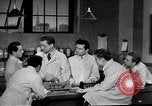
U.S. Anti-Fascist propaganda film during World War 2 depicts Axis leaders and Allied forces fighting in both World War 1 and World War 2.
Mix of actual footage and scenes with actors. Professor in laboratory extolling virtues of international research and researchers, in science and medicine. Voice-over with German accent speaks about inferior peoples and the scenes darken. Images of Nazi, Fascist, Japanese leaders and their followers including Fuhrer Adolf Hitler, Pierre Laval, Oswald Moseley, Fritz Kuhn, Japanese Emperor Hirohito, Rudolf Hess (or Heß), Julius Streicher, Joseph Goebbels, Heinrich Himmler and Benito Mussolini. Footage from World War I era shows rubble from bombing in French cities and towns, and French citizen refugees leaving homes with hand pulled wagon carts. German Kaiser Wilhelm II descends steps and reviews cheering German Army forces in 1914. French poster calls for military mobilization. Mobilized French soldiers march in France as citizens cheer them off to war. Explosions of shells on World War 1 battlefield. French "taxicab army" of French military vehicle line leaving Paris. Battles of Verdun and Chemin des Dames showing French artillery and French soldiers. David Lloyd George confers with Clemenceau. Close ups of General Foch and then of General Joffre. Armament factory in France manufacturing arms in World War 1. British battle scenes at Passchendale and Ypres. Scenes of U.S. battles at Chateau Thierry, the Argonne. U.S. Marines battling at Balleau Wood and Cantigny. Lloyd George greets citizens in England. Close up of British General Haig. American General John J Pershing greets French Generals in World War I. U.S. President Woodrow Wilson is shown. World War II era events: Adolf Hitler addressing a crowd. Brownshirt SA soldiers and other German Army soldiers march and goosestep. Remilitarized Germany invades Poland in 1939, and then France in 1940. Hermann Goering reviews marching troops. Elevated, overhead view of German troops marching with hands raised in Nazi salute, and shadows of their salutes are cast on the ground in front of them as they march. Close up side view of Hitler giving Nazi salute to cheering troops. German artillery and railroad guns fired and tanks advance during invasion of France. French Army soldiers fighting the invading German soldiers; French soldiers fire artillery. French civilian women and children refugees flee in carts as Luftwaffe aircraft fire guns and strafe their path.

Franklin D. Roosevelt relaxing at Hyde Park, New York, after his election to a second term as U.S. President
President Franklin D.Roosevelt (FDR) sitting at a desk, reading congratulatory letters and telegrams from supporters. He is surrounded by grandchildren: Curtis Dall,Jr.; Sara Roosevelt; and Anna Eleanor Dall. Next is a closeup of FDR signing a letter thanking Dan V. Stephens for his telegram. (Stephens was Democratic Congressman from Nebraska's 3rd District, 1911-1919. He died in January, 1939.) Scene changes to the lawn at "Springwood," the Roosevelt family estate in Hyde Park, New York, where President and Mrs. Eleanor Roosevelt are sitting in wicker lawn chairs. She is knitting, and FDR is paying attention to the grandchildren, Sara and Curtis, who are riding horses,and granddaughter, Sara, on a pony. He talks with Sara. Closeup of Sara. The President is next seen relaxing with his stamp collection. Finally, he is seen sitting by the fireplace, with his mother, Sara Ann Delano Roosevelt.
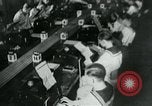
Mine warfare conducted by the German Navy's Northern Fleet during World War II.
Group of German Navy sailors in the communications center of the German headquarters of the Kriegsmarine Northern fleet, work at numerous teletype stations. Next, the Admiral (Generaladmiral) in command, Rolf Carls, is seen pouring over nautical charts and maps and discussing them with officers of his staff. Scene shifts to naval armory where marine mines are being prepared for deployment. They move through the processing lines and then transported by railroad train cars. At a port, a crane lifts a mine, on a wheeled dolly onto the minelayer ship, "Tannenberg," where crew members roll it along the deck. Sailors write on it with white chalk. The Tannenberg seen underway, and then with sailors rolling mines (on their dollys) off the stern of the ship in the Baltic Sea. Sailors moving mines along the deck to the stern for launching. View from another ship of the mines dropping from astern the Tannenberg. Next, officers on deck in cold weather gear, look through binoculars as they sight threat from Soviet aircraft. Interior of the ship as sailors manipulate controls for an anti-aircraft gun. The ship's gun and a machine gun being fired. Soviet bombers seen very high overhead. Camera pans about the deck showing sailors firing at aircraft. Something raises a plume of water astern (a near-miss?). Next, several German patrol boats are seen moving at high speed. Sailor on a speeding patrol boat, stands precariously atop it as he signals with semaphore flags. From a patrol boat, bombs (or mines) are seen exploding behind in its wake. (Note: The Tannenberg was a passenger and ferry built in 1935. On 2 September 1939 the German Navy had her converted to a minelayer. In August 1940 she served as flagship of the minelaying ships, in the North Fleet. She was sunk on 9 July, 1941, off Sweden.)
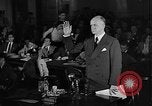
Hearings of House Un-American Activities Committee. Former Undersecretary of State, Sumner Welles testifies
House Committee on Un-American Activities hearings (HUAC) in Washington, DC, the United States. Former Undersecretary of State, Sumner Welles, is sworn in and sits during the hearings. Several men sit in the background. The defendant is asked questions about a note from Eleanor Roosevelt, on January 11, 1939,about the rejection of a U.S. visa for Mr. and Mrs. Hanns Eisler, by the U.S. Consul in Cuba, which was subsequently reviewed again. Defending against implications of negligence, Mr. Welles reminds the Committee of the context in which these decisions were being made. He talks about the atrocities committed in Germany.