


 Francais
 Deutsch
 Italiano
Refine Your Search
Saigon Vietnam 1939 stock footage and images
- Showing 487 to 492 of 5026 results more
more Hide
Hide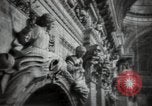
Soviet-sponsored reconstruction of buildings in Lithuanian Soviet Socialist Republic.
Achievements of Lithuania since the Soviet liberation in 1939. Exteriors of various buildings and a church. Small radio studio with technician and with a woman speaking over microphone. Woman opens windows of house from outside. Soviet-sponsored reconstruction of building after World War 2 shows workers at work rebuilding war torn area. Past events show a man hidden in the woods with a machine gun as a German supply railroad train approaches during the war. Demolition charges explode and train is derailed.
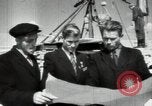
Stakhanovites work in factories to industrialize Lithuanian Soviet Socialist Republic under first 5-year plan.
Achievements of Lithuania since the Soviet liberation in 1939. Soviet engineers examine blue-prints of building. Soviet officials confer. Interiors of a factory shows work operating various machines. Gauges on a machine. Stakhanovites work in factory and operate various machines. Young stakhanovites work on machines.
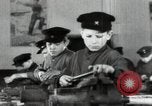
Stakhanovites work in factories of Lithuanian Soviet Socialist Republic.
Achievements of Lithuania since the Soviet liberation in 1939 and during World War II. Stakhanovites work in factory and operate various machines. Stakhanovites work to industrialize Lithuanian Soviet Socialist Republic under first 5-year plan. Young stakhanovites work on machines. Exteriors of a building. Interiors of a textile plant shows women worker operating weaving machines.
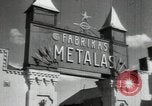
Workers leave a textile factory after work in Lithuanian Soviet Socialist Republic.
Achievements of Lithuania since the Soviet liberation in 1939 and during World War II. Sign reads 'Fabrikas Metalas'. Workers leave the textile factory after work. Female workers walk. A man pulls his bicycle as he walks with another man, who is smoking a cigarette, after work. A woman opens a window. Various building in Lithuanian Soviet Socialist Republic.
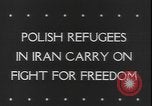
Polish refugees receive Red Cross aid as they reach Iran during World War II.
Polish refugees in Iran during World War II. The refugees walking in an area. People with their personal belongings loaded on carts walk on a street in Poland in 1939. They line up for food. A map locates the route traveled by the refugees. They reach Iran. They receive Red Cross aid. People receive clothes and shoes. They establish a village. People eat food. Children study in schools. Men and women work. They join and serve the U.S. Army.
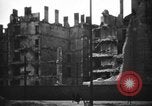
Polish citizens commemorate victims of Wawer Massacre, raise Adolf Hitler puppet in effigy during WW2
Destroyed city blocks and rubble in Warsaw ghetto during World War 2. A man writes “WAWER” on pavement as reference to the 1939 massacre of 107 Polish civilians by German forces in Wawer, near Warsaw. Women leave flowers on pavement to commemorate victims in Wawer. Pavement Polish graffiti with the symbol of the PW Polish Underground State. Polish men play with a cartoon Adolf Hitler paper marionette puppet hung on a wall. Polish men hoist cartoon Adolf Hitler puppet in effigy up a lamppost. Bottom of streetlamp with graffiti words written in German.
CRITICALPAST.COM: About Us | Contact Us | FAQs - How to Order | License Agreement | My Account | My Lightboxes | Shopping Cart | Advanced Search | Featured Collections | Website Terms & Conditions | Privacy Policy ©2026 CriticalPast LLC.
License Agreement |
Terms & Conditions |
Privacy Policy
©2026 CriticalPast LLC.