


 Francais
 Deutsch
 Italiano
Refine Your Search
Sattahip Thailand 1969 stock footage and images
- Showing 319 to 324 of 1159 results more
more Hide
Hide
United States Air Force munitions handlers move M117 General Purpose Bombs from trailer to mobile storage racks
U.S. Air Force munitions handlers unload M117 General Purpose Bombs from a flat bed truck trailer. They roll them by their tail fins and then strap them one by one onto an MJ-1A/B Aerial Stores Lift Truck (Jammer) which they then use to raise each bomb up into a slot in a multi-bomb storage rack. View from storage rack as the team of two handlers approaches transporting an M117 bomb to be placed in the rack. Another munitions handler helps secure the bomb into the rack. The team continues to move bombs into the rack. View of a fully loaded rack of bombs on its low mobile trailer, and then view of being pulled from the area by a tractor truck.
B-52 D bombers taking off from U-Tapao Royal Thai Air Force Base, during Vietnam War.
Distant views of three B-52 D planes taking off in succession, from U-Tapao Royal Thai Air Force Base during Vietnam war. Views are from camera at side of runway. Takeoffs are made toward the camera that tracks the aircraft as they pass overhead and climb out.
Realistic example: U.S. Army 1st Battalion 87th Infantry prepares for a night operation.
Night vision techniques and the use of metascope and starlight scope by the United States Army. Relaistic example of a night operation. Command post of the Alpha Company, 1st Battalion, 87th Infantry. Captain Wald briefs Sergeant King about a night mission to be conducted the same night. Soldier on the radio nearby. The two officers draw and mark the route on a map. Captain Wald salutes the Sergeant and gets on the radio. Animation shows the functioning of a starlight scope, a portable battery operated telescope. Includes the functions of illumination and magnification. A soldier prepares for the night mission. He walks up to a log and sits behind it. He mounts the starlight scope onto the rifle, selects a target, takes a comfortable position with support and then turns the power switch on. After that he takes aim, adjusts the eye piece focus and the range focal ring, and fires.
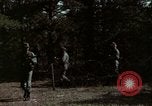
Realistic example: U.S. Army patrol reaches the Listening Post and scans the area for danger during a night operation.
Night vision techniques and the use of metascope and starlight scope by the United States Army. Relaistic example of a night operation. 2100 hours: 1st Battalion, 87th Infantry patrol clears the parameter. Sergeant King checks if the soldiers' eyes are adapted to darkness. Animation depicts parts and operation of camera, parts and functioning of human eye, comparison between the two, and functioning of rods and cones. Listening Post (LP): Sergeant King confirms the patrol's coordinates, the LP in turn alerts the headquarters that the patrol has passed his position. An illuminated object falls from the sky to the ground. The soldiers cover one eye to retain night vision in the same. They advance through the jungle. A soldier sights danger area and signals the patrol to halt. Soldiers sit on the ground and scan the area. Scanning includes short, abrupt, irregular movement of the eyes over and around the area every 4 to 20 seconds. A stream in the area.
U.S. Army soldiers employ night vision principles and night vision devices for a successful night operation.
Night vision techniques and the use of metascope and starlight scope by the United States Army. Relaistic example of a night operation. Sergeant King obtains a starlight scope to scan the opposite bank.. Point man receives instructions for crossing the danger area. Soldiers advance. Soldiers in prone position takes aim with both eyes open above the barrel, and fire. One soldier signals to the rest. Two soldiers by the road. They take out a starlight scope and look through it. Sergeant King decides to continue and the patrol moves across. A soldier signals with a torch. They move through the jungle. Sergeant King radios the Company Commander about their approach into the parameter. Point man scans the area with a starlight scope to locate the friendly patrol. Recognizing the patrol leader's signal, the guard signals him to move forward. The patrol moves ahead while the guard continues to scan. The patrol returns, mission accomplished. Soldiers employ the night vision principles of scanning and off center vision, as well as night vision devices for successful night operations.
President Nixon meets with former war correspondents before they travel to Europe for D-Day 25th anniversary
World War II war correspondents gather in Washington DC before returning to Europe for ceremonies commemorating the 25th anniversary of the Allied invasion of France. War correspondents walking on the streets of Washington DC. They pass a long painted mural wall depicting scenes from American life. They stop at guard station of a White House entrance gate and then enter gates at the White House grounds as a White House officer checks them in. President Richard Nixon meeting with the correspondents. The President and a correspondent hold a document and pose for a picture. The correspondents pose with President Nixon on the White House lawn. President Nixon poses with the document, as the correspondents stand near him. Nixon talks to the men and picks up and pets the White House dog named Pasha, who was Trish Nixon's Yorkshire terrier.