


 Francais
 Deutsch
 Italiano
Refine Your Search
Seoul Korea 1960 stock footage and images
- Showing 1243 to 1248 of 2020 results more
more Hide
Hide
Korean farmers in a funeral procession of an elder peasant.
Korean farmers in a funeral procession of an elder peasant Kim. Farmers carry square shaped umbrellas.Korean laborers carry wealthy men in wheel carts.Large stone statue of Lord Buddha over a hill side. Korean believe that buddha overlooks their village and crop.
Review of U.S. Army Combat Team operations during the Korean War
Operation of a U.S. Army Combat Team from the Eighth United States Army (EUSA) during the Korean War. Infantry soldiers walk through rocky mountains carrying guns. Soldiers look through binoculars at observation posts and relay targeting information to artillery. U.S. Army artillery firing on enemy positions. Infantry dug in on a trench line. U.S. Army grasshopper observation aircraft in the sky scouting out target sites. Views of artillery being loaded, aimed, and fired, including by a group of African American soldiers. Tanks and infantry on the move together as an Armored Infantry Unit. Narrator discusses relationship between infantry troops and tanks and how they work together as a team. Mortar units aiming and firing. At an airfield, weapons are loaded onto planes including P-51 Mustang aircraft and jets. Planes being fueled. 5 inch rockets and 50 caliber machine guns are loaded, along with Napalm and demolition bombs. View of pilots in combat briefing and then exiting briefing to fly mission. P-51 Mustangs taking off from airfield. Mustang fighters in the air and views of Mustangs firing on enemy positions with guns and bombs. Air-Ground Liaison Team shown in a jeep on the ground providing targeting information to planes via radio.
Activities of Regimental Unit in U.S. Army Combat Team during Korean War
Regimental Unit of Eighth United States Army during the Korean War. Trucks of a Regimental Unit passing along roads. Two officers looking field maps and conversing. Soldiers walk in line followed by army tanks on the road side. Tanks cross streams. Artillery and mortars seen firing on targets. Officers standing in front of maps and discussing tactics. View of General Matthew Ridgway consulting maps with other officers and then boarding a small airplane. Armored Task Force Team activities: One soldier technician stands near the radar at an army truck while others work inside the truck. Soldiers seen in a bunker, looking through a device that detects location of hostile fire. Soldiers place microphones in the ground, to detect enemy activity. They run cables away from the microphones. Two soldiers look at a paper and talk over radio, reporting information learned from the microphones. Soldiers release a hydrogen balloon carrying a radiosonde device for measuring atmospheric conditions, such as wind, humidity and pressure. Technician seated beside a radio receiving device recording weather readings.
U.S. Army 24th Division soldiers in combat during first 50 days of Korean War
Narrated feature describing first 50 days of U.S. Army troops fighting in the Korean War. U.S. Army soldiers from the 24th Division. Views of soldiers climbing mountains and looking through binoculars. Soldiers walk through rice paddy field and cover themselves and their weapons in natural camouflage. Soldiers dug in. Soldiers rest, splashing water from a pond, sleeping and resting on the ground. Soldier removes his shoes and massages his foot. Soldier sleeps on the ground and others dig foxholes. South Korean workers carrying ammunition and supplies for U.S. Army. South Korean refugees evacuating on foot. Army soldiers catch some North Korean communists among the refugees. Army soldier guarding North Korean prisoners with hands behind their heads. United Nations officer with UN armband examines prisoners.
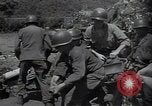
U.S. Army soldiers during the first 50 days of the Korean War
Narrated feature on experiences of U.S. Army soldiers from 24th Regiment during first 50 days of Korean War. Loading and firing heavy artillery. General Walters and General Dean in a planning meeting together. View of ship port with supplies being loaded for transport to the front, including tanks, jeeps. U.S. Army reinforcement soldiers gathered on vehicles awaiting loading. Loading and unloading ships, over temporary bridges and through shallow water. A Field Artillery Batallion stacking shells, loading shells, and firing heavy artillery. Soldiers communicating on radio from the front. Explosion of a bridge over the Kom River by U.S. Army forces after crossing it. Black smoke rising after explosion. Army truck on fire. Thick smoke in air. Wounded on stretchers being loaded into trucks, unloaded from trucks, and placed into waiting airplane with banner on tail reading "Pacific Division".
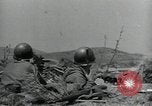
U.S. Army Medical Service at work during the Korean War.
The role of the American Army Medical Service during the Korean war. U.S. Army Captain Carl Zimmerman introduces Major General George E. Armstrong, Surgeon General of the U.S. Army who speaks from Washington, DC, about the work of the medical service. Scenes from the Korean War. U.S. troops rushed from japan, in July 1950 after a Chinese offensive at the 38th Parallel. Troops disembarking from ship and unloading artillery. Medical personnel offloading from assault boats, including doctors, medics, ambulances and drivers. A crane offloads medical equipment and supplies from a ship. Nurses with a mobile surgical hospital unit. Medics remove a casualty from an ambulance, on a stretcher. U.S. infantry slogging through difficult terrain. An ambulance driven on a mud road. Korean refugee families. Children sit and eat. People walk. An old Korean man is helped into a car. U.S. C-54 transport aircraft unloading supplies and evacuating wounded on stretchers. Medical supplies being unloaded from an aircraft and loaded into a truck. Surgeons in a tent hospital. A doctor treats a patient who is receiving blood plasma in an IV. Medics moving with tanks and infantry. Walking wounded being assisted. U.S. wounded lying on the ground, attended by medics. The U.S. medics treat injured soldiers during a tank battle. Soldiers on tanks. Thousands of paratroopers jumping from aircraft, their parachutes filling the skies. U.S. Army wounded being treated on stretchers around the Yalu River. Tenth Corps Troops in long winter withdrawal. U.S. Marine aircraft evacuating wounded. Troops withdrawing by sea in Landing Ships.