


 Francais
 Deutsch
 Italiano
Refine Your Search
Seoul Korea 1960 stock footage and images
- Showing 1951 to 1956 of 2020 results more
more Hide
Hide
During an interview in the US, Lt. Gen. Ira Eaker talks about the urgency and the efforts of European air forces to win.
An interview of United States Air Force Lieutenant General Ira Eaker conducted by Dr. Maurer in the United States. General Eaker talks about why had he said that the United States Army Air Force was inferior to certain European air forces in the beginning of World War II. He said that European air forces were in operation during the war. He says that very few people in the U.S. had visualized that the country would get involved in the war. European Air Forces were in urgent need of advanced air forces and further efforts to win against the enemy. U.S. was not in the same position. Their aircraft production was also limited.
During an interview in the US, Lt. Gen. Eaker talks about problems in commanding the 8th Bomber Command in England.
An interview of United States Air Force Lieutenant General Ira Eaker conducted by Dr. Maurer in the United States. General Eaker talks about major problems in organizing and commanding the 8th Bomber Command in 1942. They landed in England. Getting air bases , missiles, barracks, hospitals, runways and other equipment from the British was the basis for the organization. Different area commanders reported to them and kept no secrets from them. He talks about the development of defensive tactics against the enemy and modifying the equipment according to needs.
During an interview in the US, Lt. Gen. Eaker talks about becoming the Commander of the the Eighth Air Force in England.
An interview of United States Air Force Lieutenant General Ira Eaker conducted by Dr. Maurer in the United States. General Eaker talks about the time when he became the Commander of the the Eighth Air Force in England. He stressed on daylight precision bombing. Their targets were enemy ammunition factories. He was ordered home to make a presentation in front of the Combined Chiefs of Staff in the Pentagon. They were successful in many strategies. They damaged German airplanes. German supplies and lines of communication were also ruined.
During an interview in the US, Lt. Gen. Ira Eaker talks about daylight precision bombing and B-17 Flying Fortress aircraft.
An interview of United States Air Force Lieutenant General Ira Eaker conducted by Dr. Maurer in the United States. General Eaker talks about daylight precision bombing, British and U.S. night and daylight bombing. He says that a few United States Army Air Force B-17 Flying Fortresses Could survive against several German aircraft. He further states that if they reduced the number of these aircraft by razing factories, then they didn't have to worry about German bombers.
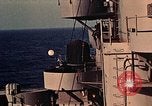
Sailors fire guns at balloons aboard a ship underway at sea in the United States.
A film on the life of U.S. Navy sailors aboard ships in the United States. The sailors undergo a training exercise where they are firing ships guns at balloon targets while at sea.The sailors aboard a ship. They aim ships guns at target ballon. The balloon is released. They fire at the balloon. Smoke rises. The sailors load and fire the guns. A man looks through binoculars.

Steel Strike of 1959 ends with announcement from Labor Secretary James P. Mitchell.
Wide shot of building in Washington, D.C., possibly the Department of Labor. Labor Secretary James P. Mitchell, steel industry chief negotiator R. Conrad Cooper, and Steelworkers Union leader David J. McDonald gathered at a table. James P. Mitchell announces settlement of the 116 day steel strike of 1959, which started on July 15, 1959 and ended with an October 21 court injunction which was upheld by the Supreme Court on November 7. Mitchell explains that a "recommendation for settlement" was made, but that his announcement was pending ratification. The three men shake hands after the announcement. The narrator explains that the pact has benefits "totaling some 39 cent an hour."