


 Francais
 Deutsch
 Italiano
Refine Your Search
South Vietnam 1969 stock footage and images
- Showing 1543 to 1548 of 6014 results more
more Hide
Hide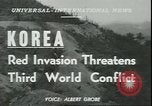
Consultant to the U.S. Secretary of State John Foster Dulles visits front areas in Korea with the start of the Korean War.
The beginning of the Korean War with the invasion of South Korea by North Korean troops. ROK (Republic of Korea) troops in trenches and at sandbagged positions on the 38th Parallel. John Foster Dulles, Consultant to the U.S. Secretary of State, visits the front areas and converses with an officer at a map. Dulles standing with ROK (Republic of Korea) troops. South Korean refugees fleeing. United Nations Security Council's meeting in progress. The empty chair of the delegate from the Soviet Union. Secretary General of the United Nations Trygve Lie speaks. The Security Council passes a resolution calling for cease fire.
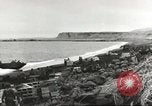
U.S. troops and supplies land at Attu Island in Aleutian Island, Alaska, during World War II
U.S. army troops and supplies being landed by Higgins boats at Massacre Bay, in preparation for battle to dislodge Japanese forces that invaded Attu Island in the Aleutians during World War 2. American forces landing at this Southern landing site included elements of the 17th and 32nd Infantry Regiments.. Troops and supplies are seen being brought to the shore by Higgins boats. Boxes of supplies are piled up and several Higgins boats are beached, including one from the Attack Transport Ship, USS Barnett (APA-5) and one from the USS Zeilin (APA-3). Weather is bleak and snow covers mountains in background. Most of the supplies are in wooden crates. Some building materials are also seen. There is no sign of Japanese resistance. The Higgins boats, aka Landing Craft, Vehicle, Personnel (LCVP) are shuttling back and forth from the attack transports seen anchored offshore. As the sequence progresses, more and more troops and supplies are seen on the beachhead. Troops form a chain to unload cargo from the landing craft. U.S. army troops and supplies being landed by Higgins boats at Massacre Bay, in preparation for battle to dislodge Japanese forces that invaded Attu Island in the Aleutians during World War 2. American forces landing at this Southern landing site included elements of the 17th and 32nd Infantry Regiments.. Troops and supplies are seen being brought to the shore by Higgins boats. Boxes of supplies are piled up and several Higgins boats are beached, including one from the Attack Transport Ship, USS Barnett (APA-5) and one from the USS Zeilin (APA-3). Weather is bleak and snow covers mountains in background. Most of the supplies are in wooden crates. Some building materials are also seen. There is no sign of Japanese resistance. The Higgins boats, aka Landing Craft, Vehicle, Personnel (LCVP) are shuttling back and forth from the attack transports seen anchored offshore. As the sequence progresses, more and more troops and supplies are seen on the beachhead. Troops form a chain to unload cargo from the landing craft.
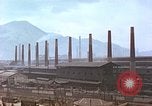
Burned out sections of Japan Iron and Steel Works at Kitakyushu, Kyushu, Japan
Iron and Steel Works at Yawata in Japan (Yawata Steel Works). A view at the end of the Japan Iron and Steel Works. Open hearth, rolling mills and coke ovens. Southern sections of the plant as seen from the roof of the Muwata Grade School. Burned out sections of Yawata as seen from the roof of the school. This area lies between a post office and the south end of the plant. It includes the areas Higaichi, Machi, Okadamachi and Hishimachi. This view shows the results of incendiary attack of August 8, 1945. The coke plant and by-products installations of Japan Iron and Steel Works. The southwest corner of the plant. Views of Tobata Power Plant. Aircraft revetments around the Japanese Naval Air Base in Omura. (World War II period).
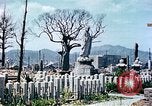
Damage inflicted on Kobe city, Japan by incendiary bombing during World War II.
A survey of the damage inflicted upon Kobe, Japan during World War II. A granite statue of Buddha which was damaged by the fire but survived. The south face of a three-story reinforced concrete building which was gutted by the fire and in which the windows have been replaced. Three story reinforced concrete Meishin Grade School Building which was gutted by the fire. Structures which were unaffected are on the north side of Matsubara Dorii which acted as a firebreak. Ruins of a former rubber factory. Rubble and machinery of the damaged factory. The south face of a single-story brick load bearing structure located west of the former rubber plant.
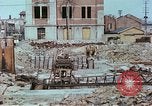
Effects of incendiary bomb attacks in Kobe, Japan during World War II shows two and three-story fire gutted brick buildings.
A survey of the damage inflicted upon Kobe, Japan during World War II. Small machines in the rubble. South of streetcar tracks in third square west of Hong Kong Shanghai Bank is a stone grotto in the rubble and destroyed brick buildings. The east face of a three-story concrete school in Eizawocho. The building shows the effects of fire on the concrete wall. The south face of a two-story building gutted by the fire. Front columns of a building heavily chipped by the fire. A two story building gutted by fire which affected a closed metal shutter.
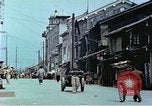
Effects of World War II bombings on various buildings in Kobe, Japan.
A survey of incendiary bomb damages inflicted upon Kobe, Japan during World War II. A Japanese man pulls a cart along Minato Cho Street. Slight effect of bombing on the buildings alongside the street. The south west face of a concrete theater whose roof has collapsed and a seven-story concrete building adjacent to it which shows very little surface damage. All these buildings are located west of Konunato Dorii. The south east face of a six-story concrete building gutted by fire and whose interior surface has been badly chipped. A five story modern concrete structure not visibly affected by fire. A two-story building that has been gutted by fire and whose walls have collapsed. A six-story concrete tile-faced building affected by fire.
CRITICALPAST.COM: About Us | Contact Us | FAQs - How to Order | License Agreement | My Account | My Lightboxes | Shopping Cart | Advanced Search | Featured Collections | Website Terms & Conditions | Privacy Policy ©2026 CriticalPast LLC.
License Agreement |
Terms & Conditions |
Privacy Policy
©2026 CriticalPast LLC.