


 Francais
 Deutsch
 Italiano
Refine Your Search
Stalingrad Russia Soviet Union 1943 stock footage and images
- Showing 811 to 816 of 5654 results more
more Hide
Hide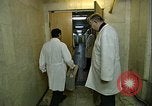
Interior views of Lenin tomb. Technicians, coffin,climate controls, mechanical apparatus
White-coated technicians work in basement of Lenin's Tomb, in Moscow, Soviet Union. A technician opens a door for another technician. They walk through a corridor. They enter a climate controlled space. Another technician opens a vault and slides out the coffin of Vladimir Llyich Lenin. View of Lenin as seen from visitor perspective. Switches and controls for climate and mechanical control.
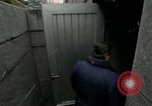
Mummy technicians pour a chemical in a glass box and haul a dignitary's body in a laboratory in Moscow, USSR.
A mummy technician enters Lenin's tomb through a side door. Technicians work in a laboratory in proximity to Lenin's tomb in Moscow, Soviet Union. Technicians haul a cart loaded with a clear liquid in a bottle. They pour the clear liquid into a glass box. They transport a patriarchs mummified body on a bier.
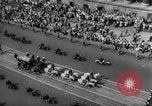
Funeral services for Franklin D. Roosevelt in Washington DC and at Hyde Park, New York (WW2)
Funeral procession of President Franklin D. Roosevelt on the streets of Washington DC. Horse drawn carriage with casket escorted by men on motorcycles. Crowd lined up on sidewalks. Various U.S. military units march. Funeral procession arrives at White House. Casket is carried into building. Casket is placed in East Room, lying in state. Scene change to funeral services for FDR at Hyde Park, New York. President Truman and Franklin D Roosevelt's wife among the mourners. A volley is fired over the president's grave. Symphonic music track in background is interspersed with audio quotations from Roosevelt, including, from his State of the Union on January 7, 1943: "Therefore, let us all have confidence, let us redouble our efforts. A tremendous, costly, long-enduring task in peace as well as in war is still ahead of us. But, as we face that continuing task, we may know that the state of this Nation is good--the heart of this Nation is sound--the spirit of this Nation is strong--the faith of this Nation is eternal." Also heard at the beginning of the clip is Roosevelt saying, "American fighting men looked to the statesmen of the world to finish the work of peace for which they fought and suffered. We failed them then. We cannot fail them again, and expect the world again to survive," from his address to Congress on Yalta, March 1, 1945 (World War II).
United States and Russian troops in Germany after World war 2; division of West Germany and East Germany
Bomb damaged and ruined buildings of Nazi Germany in 1945, including the Reichstag. Nazi Eagle symbol of Third Reich pulled down from building and crashes to the ground at end of World War 2. United States Army of occupation marches into city as German population lines sidewalks and watches them parade. Sign on a shop reads "Gaststatte Schosser." Many buildings in view are damaged or destroyed from bomb attacks during World War 2. American soldiers occupying German give candy to German children who at first hide from them. Nazi leaders including Hermann Göring, Rudolf Hess, Joachim von Ribbentrop, and Wilhelm Keitel, seen on trial in the Nuremberg war crimes trials. German people struggling to rebuild. women and children trying to gather wood from stumps of trees for fuel. A woman sawing a log. Women and children scraping food from inside trash cans and refuse bins, to stay alive during scarcity and shortages after the war. Americans providing food assistance and feeding German children in relief lines. Close up of a smiling boy as he receives food or drink. Soviet Russian Army soldiers occupying East Berlin and marching in formation. Russians removing an industrial lathe and other machinery and tools from Germany as the Soviet Union continues to strip Germany of resources after the war. A map of Germany and Berlin seen with divided regions as American, British, French and Soviet zones. Views of empty streets and heavily damaged buildings of Berlin after the end of the war. Children play amidst the desolation and destruction in East Berlin. View of Kammergericht, Headquarters of the Allied Control Council. Leaders seen meeting inside include American General Joseph T. McNarney, French General Marie Pierre Kœnig (Marie-Pierre Koenig), Soviet General Georgy Konstantinovich Zhukov,. British Field Marshal Bernard Law Montgomery. View of Spandau Prison guarded by troops of occupying powers. Soviet and American troops drill and march on the grounds of Spandau Prison. An American soldier relieves a Soviet soldier at a watch post. Soviet blockade of West Berlin begins in June 1948. View of a man shutting down power in a power plant and lights going dark in Berlin. Blackout conditions in Berlin during the blockade. Germans plant vegetables in city to survive. Germans exchange goods in black market setting. A man plants vegetables in view of the Brandenburg Gate. The Berlin Airlift operations underway. U.S. Air Force C-54 aircraft flying low and arriving in Berlin, bringing supplies to West Berlin. C-97 landing. U.S. military forces unloading relief supplies and food from airlift aircraft. American C-47s and C-54s in the Berlin Airlift. Soap and milk being unloaded from airplanes. German children gather on a hill and watch low-flying American airlift planes as they approach to land at Tempelhof Aerodrome in Berlin. An Air Force airman throws a package out of the aircraft. It is a very small parachute with candy that drops from the American airplane to the waiting children. Children run to retrieve it and they share and eat the candy. Blockade is lifted in 1949 and rebuilding of West Berlin resumes. View of railroad tracks being re-linked, a locomotive running on tracks, and trains cross between East and West Berlin. Ships loading goods onto trains for Berlin. A coal processing factory running again in Germany. German workers producing industrial parts and goods again in production factories. West German construction workers rebuilding structures in West Germany. German people cast votes, establishing Federated German Republic (West Germany). Figures seen include U.S. General Alfred B. Gruenther with Konrad Adenauer, President of the new German Republic, together in Bonn, Germany. Soviet Russian troops marching on parade in East Germany. East German workers rioting in 1953, in protest of increased production quotas in Communist controlled East Germany. Soviet forces in armored vehicles patrol the streets and disperse the crowd. A large electronic billboard banner flashes West German messages and propaganda to those who can view it in East Berlin. Citizen refugees from East Germany arriving in a processing center in West Germany, carrying bags and luggage. East German refugees laying on the ground on blankets in a crowded immigration processing center of West Germany. A woman irons clothes in the immigration center, while a child plays with dolls.
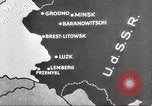
German forces move East to Luzk and Lemberg in Belarus, during Operation Barbarossa in World War II
Animated map shows movements of German forces Eastward toward Luzk and Lemberg in Belarus during the Operation Barbarossa invasion of the Soviet Union in World War 2. German soldiers work with shovels and wheelbarrow on muddy bank of a river.preparing to construct a pontoon bridge. Two small boats convey some soldiers across the river. German Army Engineers prepare for construction on both banks of the river. A road bed of wooden planks is being laid at one foot of the bridge Engineers crank cables to level the bridge bed. German soldiers stand guard over the construction site. An MG 34 machine gun sits on a tell tripod with a belt of ammunition ready for use if needed. On the river bank, soldiers carry timber planks to the construction site. View from the river of the bridge under construction. The workers and bridge are silhouetted against the light sky. A soldier wades below the bridge showing water only up to his knees. Next, a large shallow draft barge is seen bringing troops a\cross the river. A 5-wheel army truck, camouflaged with foliage and logs, climbs the river bank as it leaves the bridge. Scene shifts to German motorcycles and utility vehicle driving along a well established highway on their way to Lemberg, followed by armor. Closeup of a German Panzer III Ausf. N; with short barrel gun passing into the town of Luzk. It continues moving into the town away from the camera. Civilian refugees walking alongside the roadway as German army vehicles pass them. A destroyed building with a knocked out 1930s vintage Soviet BA-10 armored car in front of it. Hulk of a completely destroyed Soviet tank and a knocked out Soviet BT-7 tank nearby. German army trucks and other vehicles moving along a rutted dirt road. A German medium half track SdKfz 6/1 filled with troops. It displays a large white "K" identifying it as belonging to Panzergruppe Kleist. Some Panzer I Ausf A tanks armed with two 7.92 mm machine guns are seen moving along a dusty dirt road. Closeup of one passing near in cloud of dust. A group of German soldiers rest under a large tree. destroyed weapons litter the ground. Closeup of destroyed Soviet tank. Closeup of shell hole in a knocked out Soviet tank. A smoldering Soviet T-34 tank with dead Soviet soldier lying on ground in front of it. German soldier examines a Soviet tank turned on its side
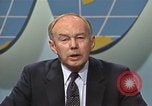
Senator Jim Sasser and Arnold L Raphel are interviewed regarding Afghanistan.
Interview at Woldnet studio hosted by Harry Ellis, with reporter from The Hague joining via telephone. Guest Arnold L Raphel, Deputy Assistant Secretary of State for the Bureau of Near Eastern an South Asian Affairs. He states that Soviet Union is committed to negotiating an agreement on the Afghanistan situation. He further says that there has been gradual ability of Mujahideen (Muslim Fundamentalists) to stand up to Soviet Union.
CRITICALPAST.COM: About Us | Contact Us | FAQs - How to Order | License Agreement | My Account | My Lightboxes | Shopping Cart | Advanced Search | Featured Collections | Website Terms & Conditions | Privacy Policy ©2026 CriticalPast LLC.
License Agreement |
Terms & Conditions |
Privacy Policy
©2026 CriticalPast LLC.