


 Francais
 Deutsch
 Italiano

Refine Your Search
Stalingrad Russia Soviet Union 1943 stock footage and images
- Showing 805 to 810 of 4682 results more
 Hide
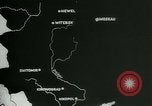
German soldiers transported across the Dnieper river in Russia, then setting landmines, razor wire, and artillery emplacement
German soldiers at Dnieper river, Russia. A map of Russia shows the course of Dnieper river. Low aerial view of ice melting on the Dnieper River in Russia. German ski troops along with equipment cross a bridge on a truck. A small white dog under a blanket on a horse sled. German soldiers stand near horses. They walk past dead horses on the roadside. German soldiers march in a single horizontal line across a battlefield, laying razor wire and setting land mines into position under the snow. A snow covered and camouflaged German artillery emplacement and a German soldier uses sighting equipment to establish range to Soviet target. (World War II period).
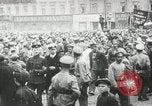
Post-World War 1 events in Russia
Crowd milling about in Kronstadt, West of Saint Petersburg,Russia, as group of Russian sailors, soldiers and civilians, marches in their midst carrying a Sign reading "Peace, Freedom, and Bread." On March 7, 1921, The Bolshevik government sends 60,000 troops under command of Mikhail Tukhachevsky to quell the disturbance. They are seen marching in the streets. Next scene shows women looking amongst the fallen for their relatives. View of Leon Trotsky (Commander of the Red Army) walking with some of his staff. View of human remains. Brief view of Lenin. Trotsky writing at his desk. Narrator mentions the State Security Agency called "Cheka," being replaced by the Joint State Political Directorate (AKA OGPU). Narrator calls it the Political Police. Vyacheslav Mikhailovich Molotov is seen walking with a group of Soviet workers and politicians ostensibly charged with overseeing the OGPU. Another scene shows Molotov conversing with Joseph Stalin (Iosif Vissarionovich Stalin). Mikhail Ivanovich Kalinin stands to Stalin's left. views of Stalin. Lev Kamenev, a leader in Moscow City politics. Russian families on a train platform preparing to travel in box cars (to Siberia?). farmers harvesting grain in Russia. A woman shopkeeper cuts a loaf of bread in pieces and weighs them on a scale for sale to a customer. American foodstuffs provided as aid to Russia. Some of the American food being unloaded at a pier. American Relief Administration Chief, Herbert Hoover, standing at a port. Food being distributed to Russian citizens, and to children. Newspaper of March 14, 1923, announces the Lenin suffers a stroke. In January, 1924, a newspaper headline announces that "Lenin is dead." Lenin seen in coffin. Funeral cortege, including principal Soviet leaders, carries the coffin outdoors in falling snow. Spectators watch and others follow in the solemn funeral march. Narrator states that "Stalin,Zinoviev, and Kamenev force Trotsky into exile." Soviet citizens are seen at hard labor under new "Five year plans."
Russian Revolution occurring during World War I. Scenes from first world war and from protests in streets of Russia.
The Russian Revolution of 1917. Scenes of trench warfare on the Western Front during World War I. German soldiers firing at enemy positions. Ill-equipped Russian troops in the field, and suffering from pestilence and disease. A Russian soldier wearing no shirt and with no equipment is seen scratching at itches on his own body. Starving, sad Russian children are shown back in Russia. Scenes of St Petersburg, Russia in March 1917, during demonstrations for increased bread rations. Responding Russian troops defect and join demands for the transfer of power from the Czar to an elected parliament. A military vehicle loaded with troops is seen rallying and celebrating with Russian people. Minister of Justice in the Provisional Government Alexander Kerensky speaks to a large crowd. Czar Nicholas II, who has abdicated, sitting on a stump, with a few guards behind him. Political prisoners are freed from prisons. Leon Trotsky, speaking from a train platform, upon his return from exile in Canada. Summer, 1917, and Alexander Kerensky becomes Head of the Russian Provisional Government. Kerensky, standing in the balcony of a building, proclaims Russia a republic. A large crowd gathered outside the building. Vladimir Lenin speaking to a large crowd on the Kerensky Republic. View of Farmer workers with shovels in a field. Lenin and Trotsky call for the members of the Farmer Worker Army Union Soviet to work against the Kerensky Republic. View of Lenin speaking against the Republic and for class warfare. Lenin's Bolsheviks riot and seize the railroad stations, telegraph lines, and government offices. A tower column of the Russian monarchy is seen falling to the ground. Events on November 25 after the Russian Revolution: A number of people on a street during elections called for by Kerensky. View of Lenin talking to people in the streets. Lenin's Bolshevik group loses to the SR party. People in the streets near the time of the election. The elected assembly of the Socialist Revolutionary Party is seen meeting under the protection of Trotsky's Red Army which is seen marching near a crowd. Catherine Breshkovsky is seen standing and speaking at the assembly meeting. The elected assembly in session. The assembly refuses to turn power over to the Lenin Soviet. The members of the elected assembly are seen finally giving in to the Bolsheviks and the factions of the SR that have split to support the Bolsheviks. The leaders of the defeated faction of the Socialist Revolutionary Party (SR) are seen leaving the grounds of the assembly. In the next scene, a crowd protests against the dismissal of the elected assembly, to no avail.. Lenin speaking to a large crowd. He speaks about the power won and maintained by violence. Views of the demonstrating crowd.
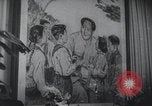
Implementation of the Mao Zedong led economic and social plan titled the 'Great Leap Forward' in Red China.
Postwar living conditions in the People’s Republic of China under the Communist regime of Mao Zedong (Mao Tse-Tung) photographed by Indians visiting the country. The film highlights China's problems of industry, agriculture, and excess population. Advertisements and posters for the Mao Zedong led economic and social plan titled the 'Great Leap Forward' in 1958. Objectives of the plan. Agriculture, industry, and education in China, including brief shot of men, women, and children in classroom, possibly for re-education. Men and women work in factories and plants. A Russian sign reads 'Made in the Soviet Union'. Workers inside a huge automatic automotive plant set up and supplies by the Soviet Union (SU). A steel and iron company rebuilt and enlarged with the aid of Soviet Union. A seamless steel tube mill supplied and erected by the SU. A plant designed, equipped, and built by SU technicians. A bridge over a river. Women work in a high voltage testing laboratory equipped by the East German government. A fully automatic petroleum refinery built by the Japanese. A heavy gilding machine plant started by the Japanese in 1937. Various factories, plants, and industries in China. Rural farmland and irrigation. People work in backyard furnaces, factories, presses, rolling mills and automotive factories. Deserted city streets with few cars. Workers inside an automotive plant. Communist Party of China Chairman Mao Zedong signs a pact with the Premier of the Soviet Union Nikita Khrushchev. Newspaper headlines regarding the disagreements leading to rifts in the China-Soviet relations in 1960. The Soviet Union withdraws technicians and support from China resulting in closure of industries. Statistics highlight China's dropping industrial production in steel, coal, electricity, and petroleum compared to that of USA, Soviet Union, and United Kingdom.
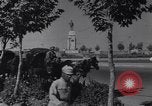
Views of Tehran, when Iran was the "Persian Corridor" for American Lend-Lease aid to the Soviet Union in World War II
Opening scene is of ordinary day in teheran, Iran, during World War 2. A horse and wagon sits quietly in shade at edge of a traffic circle centered on monument topped with a statue of Reza Shah Pahlavi . A U.S. Army truck, displaying a white star, and a jeep, drive by on the nearby roadway. A horse-drawn wagon passes at edge of toad. A military truck drives around the road closest to the statue of Reza Shah Pahlavi . Closeups of the statue. Change of scene shows an official-looking modern building, with a guard at its open gate. A sculpture above the gate depicts a crown flanked by two lions. Several pedestrians pass by casually on the road and sidewalk. The pedestrian women include some in Western dress and ant least one with head modestly covered. View through the open gate shows a circular drive around a garden and a large building behind it. Two military officers walk out the gate. One wears a steel helmet. They pass the guard standing by his booth. Street scenes showing a modern building and light traffic, including another American jeep, a horse-drawn wagon, a car and a bus. Several multistory apartment buildings. View looking down on a horse-drawn cart moving along a tree-lined city street.
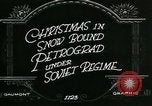
Russian civilians collect wood and clean roads at Christmas in Petrograd (Saint Petersburg), Soviet Russia.
Christmas preparation in Petrograd (Saint Petersburg), very soon after the Russian Revolution (or "October Revolution") brought Lenin, the Bolsheviks, and Soviets regime in control in Russia. People move goods on the snow covered streets using sleds. Facing shortages of fuel, people collect and carry wood to burn from a dock. Citizens stacking and carrying timbers for fuel. With men involved in revolution and in World War I, women workers clean roads of city, working together in a group with brooms.