


 Francais
 Deutsch
 Italiano

Refine Your Search
Stalingrad Russia Soviet Union 1943 stock footage and images
- Showing 1381 to 1386 of 4682 results more
 Hide
Color Sound

U.S. world aid, African dancers perform at Carnegie Hall 1959
The narrator and host of the film is seen sitting on an armchair. He speaks about United States’ lack of desire to establish a global hegemony. “We have constantly reiterated by word, by deed, that we have no desire to establish a colonial empire” the host said. Wilson Line SS Ariosto ship unloads a tractor. Ship loads sacks of cement in Puerto Rico. A doctor adjusts the x-ray machine. A nurse tends to a ward with patients lying in bed. Sign for Africa Freedom Day on April 15, 1959 at Carnegie Hall. African musicians playing drums as dancers perform a traditional folk dance. A man speaking to the audience at Carnegie Hall. African Americans clapping. New York Times newspaper article by Tad Szulc titled “New Latin Accord is Offered By U.S.” with a photo of United States President John F. Kennedy on the right side. The host explains that the Soviet Union accuses the United States of imperialism to deflect Soviet colonialism. “Now on the face of things, one would assume both imperialism and its twin colonialism are on the way out” the host said.
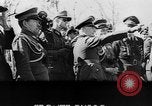
Japanese and Turkish military missions tour Eastern Front at German invitation, in World War II
Opening scene shows German Field Marshal Wilhelm Keitel gesturing as he hosts members of a Japanese military mission and a Turkish military delegation (headed by Colonel General Cemil Cahit Toydemir). At Adolf Hitler's invitation, they are on a tour of the Eastern front and English channel coasts between June 25th and July 7th, 1943, during World War 2. Here, they are seen inspecting German positions and witnessing firepower demonstration on the Russian Front near Kharkov (also Kharkiv) just south of Kursk. They observe a German artillery gun crew as they demonstrate rapid firing of their field piece. Shells explode raising black smoke. Closeup of a senior Japanese military official. Turkish and Japanese delegation visitors board two small open train cars driven by German soldiers on motorcycles adapted for the purpose. Following a pause, the scene shifts to the visiting officers inspecting German armor, including a small armored personnel carrier; a Tiger Tank of Pz.Abt.503; and other armored vehicles. They watch a Tiger tank moving along a muddy berm rotating its turret and 88mm gun as it moves. Another tank races past the camera at high speed, raising clouds of dust. A German gun crew, in a trench, fires an MG 42 heavy machine gun. They look up and camera focuses on formations of German JU 87 Stuka dive bombers flying overhead. Visiting officer peers through a periscopic viewing device, as Large explosion occurs in the field. German, Japanese, and Turkish officers converse as a huge plume of smoke rises in the background, capturing their attention.

Allied troops advance as B-24 Liberators bomb target areas in Papua New Guinea.
1943: Animated map depicts Japanese advancement and footholds of Allied troops in Papua New Guinea. Australian 6th Division troops advance through thick jungles towards Salamaua. Soldiers route for enemies in the jungle and fire guns and artillery. Machine gun nests in the jungle. An injured soldier waits to be evacuated. The natives carry soldiers on stretchers. An Australian soldier help a wounded comrade across a river. The Australian troops are relieved by U.S. troops. USAAF B-26 Marauder at a supply depot in Kela village. Native carriers wait for supplies to be dropped from airplanes. 14 August 1943: 5th AAF bombs and strafes targets in the Wewak and Salamaua areas. USAAF B-24 Liberator drops bombs over target areas. Smoke and explosions due to the bombardment. (World War II period).
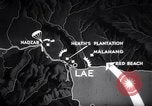
Australian 7th and 9th Division troops capture Lae in Papua New Guinea, during World War II.
September 1943, in World War 2. Animated map shows advance of the Allied troops to Nadzab and Lae in papua New Guinea. The Australian 7th Division advance towards Lae. Soldiers in jeeps, on motorcycles and on foot advance through the jungle amidst air and artillery barrage. Soldiers fire machine guns and other artillery. Animated map shows the advance of General Thomas Blamey's troops towards Salamaua. Soldiers cross the Francisco River with natives. The Australian 9th Division advances along the east coast. Soldiers in puddles and streams. A military truck stuck in the mud. Soldiers prepare for jungle fighting. Soldiers take cover among bushes as Japanese troops fire. Machine gun nests in the jungle. USAAF B-25 Mitchell bombers drop bombs over enemy territory. Fire and smoke from the explosions. AN-M40 (Para-Frag) fragmentation bombs are dropped from USAAF A -29 Havoc aircraft. Australian 7th Division troops amidst artillery and anti-aircraft fire. USAAF B-17 Flying Fortress and B-26 Marauder bombers in the sky. On 16 September 1943, the Australian 7th Division captures Lae. Bombed ruins, damaged Japanese planes, destroyed airstrips, enemy ships and boats in the harbor. Destroyed Japanese ammunition dump 'Chinatown'. Australian 9th Division crosses the Bamboo River bridge to enter Lae. Animated map shows advance of amphibious forces, paratroopers and airborne operations of the 5th AAF. U.S. General Douglas MacArthur and his men at the 90th Strategic Reconnaissance Wing quarters.
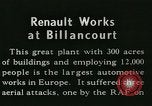
The Renault Works plant at Billancourt after three aerial attacks by the Allied forces during World War II.
Results of air assaults by the British Royal and U.S. Eighth Air Forces over industrial areas in and around German-occupied Paris during Wolrd War II. The Renault Works plant at Billancourt after one aerial attack by the Royal Air Force (March 3, 1943) and two by the U.S. Eighth Air Force (April 4 and September 15, 1943). Workers clear the plant interiors. The damaged plant, collapsed roof, rubble and debris on the floor. Workers clear the debris. Damaged steel structures, pillars and walls. Buildings at the plant. Damaged walls, wrecked equipment and material. Allied officers and workers at the plant.

Four British working men and four American counterparts visit officials concerned with war production, in New York City and Washington DC (WW2)
A British film entitled, "People to People." Four British working men, visiting America, are seen in overcoats on the deck of a ship passing the Statue of Liberty in New York Harbor during World War II. They are accompanied by four American workers who were returning on the same ship, from a similar visit to England. Closeup of the eight men, named by the narrator, who calls them trade unionists on an exchange visit. Brief view of Chiang Kai-Shek, Franklin D. Roosevelt, and Winston Churchill at the Cairo Conference in 1943.Camera pans closeup over Roosevelt and Chiang Kai-Shek. Brief views of Roosevelt, Churchill, and Joseph Stalin at the Tehran Conference in 1943. Closeup of Roosevelt and Churchill, with Anthony Eden standing immediately behind them. Closeup of Stalin and Roosevelt, with U.S. Army Air Force Chief, General Henry H.(Hap) Arnold and British General Alan Brooke, Chief of the Imperial General Staff, conversing behind them. Scene shifts back to the men aboard the ship in New York harbor, with the New York City Manhattan skyline of buildings in the background. Next, the eight men are seen climbing steps to New York City Hall. Inside they are welcomed by New York City Mayor Fiorello LaGuardia. The group is then seen entering a building in Washington, DC, where they sit down at a table with Donald Nelson, Head of the U.S. War Production Board. In the Department of Labor building they meet William Hammatt Davis, Head of the War Labor Board, and also the Secretary of Labor, Frances Perkins. After that they are seen heading into the White House, where they are met by Mrs. Eleanor Roosevelt, who comes out of the White House to greet them on the porch. (Narrator says she later invited them inside for tea.) The men are next seen climbing the Capitol steps. Vice President Henry A. Wallace comes out to greet them and comments about industrial production not only during the war, but in the time of peace to follow.
CRITICALPAST.COM: About Us | Contact Us | FAQs - How to Order | License Agreement | My Account | My Lightboxes | Shopping Cart | Advanced Search | Featured Collections | Website Terms & Conditions | Privacy Policy ©2026 CriticalPast LLC.
License Agreement |
Terms & Conditions |
Privacy Policy
©2026 CriticalPast LLC.