


 Francais
 Deutsch
 Italiano

Refine Your Search
Stalingrad Russia Soviet Union 1943 stock footage and images
- Showing 157 to 162 of 4682 results more
 Hide
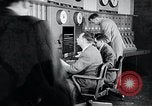
USIA operations like radio broadcast, press edition and Director Streibert explains mission to a committee in U.S.
United States Information Agency (USIA) radio operators operate radio studio controls and set frequencies for transmission and receiving. USIA staff work on gathering additional facts, with newsroom reporters and editors in a press room typing and working on stories, a woman editing motion pictures, typing, printing at USIA. Exterior view of headquarters building of United States Information Service or USIS. People enter and exit the building of USIS. Members of a Citizens Committee and Director Streibert enter into a room. Map of world in room. Citizens seated on sofa. Director Streibert explains U.S.I.A. mission to a citizens' committee and talks about America's history and involvement in the world. One Citizen Committee member smokes a pipe. The Director shows a chart of how "communist propaganda is spread by a vast worldwide machine." Director Streibert explains (via anti-communist propaganda, or reverse propaganda...during Cold War) its mechanism and control exerted via the presidium of the Soviet communist party. View of Soviet Union leaders watching a military parade in Red Square, Moscow, Russia. Khrushchev is among the leaders. Next scenes show Communist rallies and speakers in Korea and then in China. At the Chinese rally, a scene of unrest unfolds as a group filling a large truck enters a rally, jumps down, and inflames the crowd. Communist leader Khrushchev with other Soviet officials debarks an airplane and meets leaders in India. He waves at a welcoming crowd during a visit. View of piles of Motion picture canisters ,magazines, pamphlets and books distributed as propaganda by Soviet Union. High production quality of paper shown. Industrial equipment and industrial farming equipment is displayed in a large exhibit hall for visiting foreign governments and dignitaries to view and consider investment. The Director states that long term Communist goals are world domination, and short term goals include the encouragement of neutralism, dividing and confusing American allies, and isolation of the United States. Director Streibert explains how the USIS works together with the Department of State to communicate American information. He ends the explanation by giving the USIA campaign pamphlets "Atoms for Peace" and "Atomic Power for Peace" ( The Eisenhower plan) to citizens of committee as example of a communication.

Winston Churchill, President Franklin Roosevelt and Marshal Joseph Stalin meet at Crimea for the Yalta Conference
Allied Conference in Yalta, Crimea in Ukraine on coast of the Black Sea. The British, Russian and United States representatives meet to plan the political future of Europe after World War II. Livadia Palace, the summer residence of former Czar Nicolas II. Special communication lines are strung. Soviet Foreign Secretary Vyacheslav Molotov waits at air base for the British and U.S. delegations. Soldiers march in a field. Flags of Russia, Britain and U.S. Plane arrives at base. British Foreign Minister, Anthony Eden, U.S. Secretary of State Edward Stettinius, Adviser to President Roosevelt Harry Hopkins and U.S. Ambassador to the Soviet Union, W.Averell Harriman arrive. British Prime Minister Winston Churchill and U.S. President Franklin D. Roosevelt arrive by plane. Lavadia Castle at the island. Randolph Churchill, son of Sir Winston Churchill arrives by car with President Roosevelt's daughter Anna Roosevelt. Prime Minister of Soviet Union Marshal Joseph Stalin arrives. They discuss military and political postwar plans. They make decisions regarding postwar Germany. Family members of Allied officers visit the Palace. Churchill, Roosevelt and Stalin seated for a photograph.

Hitler and German General Staff plan Operation Barbarossa in Berchtesgaden
Snow-covered hills at Berchtesgaden. Inside a building, Hitler plans Operation Barbarossa (invasion of the Soviet Union) with his General staff. Among others present are, General Heinz Wilhelm Guderian; Colonel General Franz Halder and Colonel General Ludwig Beck. Animated map shows planned offensive against the Soviet Union and thence through the Caucauses and into Mideast oil fields. Further grand schemes are illustrated. Ocean supply lines needing to be choked off at Murmansk, Russia, and in the Mediterranean are diagrammed. German U-boat bases are shown on the map. View of a U-boat displaying skull and cross bones on conning tower. U-boat reinforced concrete pens. Map showing U-boat missions.
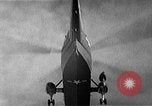
Events leading to Cuban Missile Crisis as United States military prepares for emergency in October 1962.
Events leading to the Cuban Missile Crisis of October 1962 when the United States and the Soviet Union confronted each other with nuclear destruction. A helicopter lands on the White House lawn in Washington DC. Scenes of Cuba and emergence of Castro in recent prior years. Beach views in Cuba. A military parade in an earlier time, with Cuban troops marching in front of the Monument to the Battleship Maine. Next scene shows desecration and destruction of the Battleship Maine Monument in Cuba.. A crowd of cheering Cuban people as Fidel Castro enters Havana, Cuba in 1959. Exterior view of United Nations building in New York City. Fidel Castro and Soviet Premier Nikita Khrushchev embrace during meeting in New York in September 1960. Deputy Premier of the Soviet Union Anastas Mikoyan deplanes and is greeted by Fidel Castro in Havana. A trade agreement between Russia and Cuba signed by Fidel Castro. Russian cargo ships en route to Havana. Cuban refugees in small boats. A map depicts proximity of Cuba to the U.S. U.S. surveillance aircraft heading for Cuba. A sign reads 'HQ. 4080 S W Intelligence Division'. Men examine reconnaissance photographs of Soviet nuclear missiles in Cuba. The photographs show transports and tents for fueling and maintenance. A sign reads 'Strategic Missile Facility GAM 77 Combined Systems'. U.S. missiles rolled out of hangar and readied for emergency. A U.S. Air Force B-52 bomber aircraft takes off from an airfield. U.S. Navy ships in the Atlantic Ocean. A U.S. submarine underway at sea.
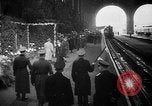
Premier Vyacheslav Molotov arrives in Berlin, Germany for German-Soviet Axis talks
Discussions between Germany and the Soviet Union in November 1940, about Russia joining the Axis together with Germany, Italy, and Japan. Diplomatic and military delegation stand at railway station in Berlin, Germany. A railway train arrives. Premier Vyacheslav Molotov of the Soviet Union arrives on the train at the railway station. German Foreign Minister Joachim Von Ribbentrop, German High Command and Japanese representatives greet Molotov. A band plays as the men come out of the railway station. German soldiers stand in lines and Molotov passes the troops in reivew. Delegation takes Molotov to the Reich Chancellery to meet Adolf Hitler, War Minister Hermann Goering, and other German officers.
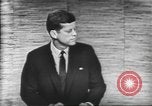
During a presidential election debate in Washington DC, Kennedy comments that its proper to express regrets to nations.
The second Kennedy-Nixon Presidential Debate in Washington DC, United States . Edward P. Morgan of ABC News asks Democratic candidate Senator John F Kennedy about sending apologies or regrets to General Secretary of the Communist Party of the Soviet Union Nikita S Khrushchev over the U-2 reconnaissance aircraft incident. Kennedy answers that if it could save the summit conference it would have been proper to express regrets. He speaks that the U-2 flights were proper from the point of view of protecting their security. But they were not in accordance with the international law. He speaks about the regrets expressed to Castro, to Southern Russia and to Eastern Germany under the Eisenhower Administration during the past years. He mentions the regrets expressed by the Soviet Union and the Chinese Communists to the U.S. over incidents. He states about they should have a stronger military force and should increase their strength all over the world. Republican candidate U.S. Vice President Richard M. Nixon presents his views and states that Senator Kennedy is wrong in thinking that Khrushchev might have continued with the summit conference if the U.S. had expressed regrets. He disagrees with Kennedy's analogies that the U.S. is a strong country and can express regrets for any wrong doings. He also disagrees in expressing regrets to anybody for doing things which has the support of the Congress and which is right from point of view to protect the security of the U.S. (This 4 part debate is sometimes called the Great Debate)