


 Francais
 Deutsch
 Italiano

Refine Your Search
Stalingrad Russia Soviet Union 1943 stock footage and images
- Showing 169 to 174 of 4682 results more
 Hide
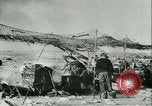
British troops fight Italians in Libya; Germany opens Eastern Front Campaign during World War II.
Images taken by military and news cameramen during World War II. The North African Campaign, 1940: Convoy of British tanks, trucks, and infantry advance over the Libyan Desert. British soldiers fire artillery. Masses of Italian prisoners marched by British soldiers. Next shown is campaign on the Eastern Front, 1941, as Germany attacks Russia: Nazi tanks advance under Luftwaffe air cover into the Soviet Union. Aerial view of German Junker Ju 87 aircraft in flight. German tanks and armored vehicles rolling. Wide view of many German tanks rolling east. German soldiers leaping down from a hill with smoke all around as they battle in a Russian town. Russian Pe-2 bomber aircraft in flight. Interior view of pilot and crew in Soviet Pe-2 bomber while in flight. Soviet soldiers on tanks during a battle. Burning tanks. Soviet soldiers run toward battle front and pass a dead German soldier on the battlefield.
Film 'Why We Fight' episode "Prelude to War" depicts battle scenes in various countries during World War II.
Series 'Why We Fight' episode "Prelude to War" depicts the battles during World War II. United States soldiers parade on street lead by a band. Japanese bombing attack on Pearl Harbor, Hawaii, on December 7, 1941. The London Blitz with buildings destroyed and burning. The Eiffel Tower in Paris with Nazi flag flying atop it. German troops marching into Paris, through the Arc de Triomphe. Japanese warplanes bombing shanghai, China, in 1937. Chinese residents running for shelter. Glimpse of German "Schwerer Gustav" 80 cmrailway gun firing during German offensive against Soviet Union in 1941. German forces entering Czechoslovakia in 1938. German mounted troops entering France in 1940. Heavy guns firing. German ships en route to Norway 1940. German Ju-52 aircraft flying low over trees. Montage showing rapid succession of war scenes, including heavy guns firing, smoke rising, explosions, an aircraft shot down and crashing straight down, German armor on the move, German Ju-52 aircraft dropping paratroopers into Holland and one flying over Athens, Greece, with Mount Lykabettus in the background. More of the same with Narrator mentioning Belgium, Albania, Yugoslavia, and Russia (where citizens are seen digging anti-tank trenches and fortifications). Cavalry charging across a field. A German tank rolling forward. A German Dornier Do-17 bomber taking off, and bombs falling.
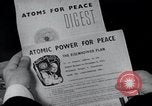
Voice of America broadcasts President's speech and USIS "Atoms for Peace" exhibits are presented worldwide
President Eisenhower of the United States addresses United Nations on December 8, 1953 about atomic bomb and atomic weapon dilemma in the nuclear age (part of Atoms for Peace initiative). Operators in radio transmission control rooms note down readings. View of time clocks of various places in the world including Honolulu, New York, London, Moscow, Calcutta, Bangkok and Tokyo displayed. The Voice of America broadcasts program in different languages by announcers. Scene of a family sitting in a living room as they listen to the president's speech on a console radio. People work at typing, printing, and translating the speech. USIA motion pictures service prepare newsreel of president's speech. A man views air mail of USIA films. Exterior views of several different United States embassy buildings worldwide. A guard standing outside the building. A Public Affairs Officer at the U.S. embassy in Japan, in Tokyo, meets with U.S. Ambassador to Japan Robert Murphy. USIA members seated around table for meeting, and, in Washington DC, creating publications about the Atoms for Peace program. People seated in a USIA library in Brazil read books and various USIA materials. Architects design 30 foot high Atoms for Peace exhibits. An exhibit being setup in a foreign country (possibly in North Africa). Exterior and interior views of the West Berlin, Germany Atoms for Peace exhibit. Prime Minister Jawahar Lal Nehru in India is seen arriving in a jeep to view the Atoms for Peace exhibit in India. Prime Minister Nehru inside the exhibit hall watching a presentation. In Japan, a woman operates remote-controlled robotic hands to hold radioactive materials, at a demonstration for Japanese citizens. In a city in Italy, a view of a mobile van unit carrying an Atoms for Peace exhibit. Scenes from a film "A is for Atom" that was translated into 30 languages and shown all over the world. Wide view of the Kremlin in Moscow, Russia, Soviet Union. A Russian radio commentator speaking at a microphone. Propaganda dramatization showing the Russian announcer attacking American plans for Atoms for Peace.
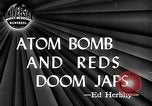
Allies demand the unconditional surrender of Japan in World War II. Entry of Soviets and use of atomic bomb ends the war.
Representatives of three nations, seated around table at Potsdam Conference held at Cecilienhof in Potsdam, Germany. British prime minister, Clement Attlee; President of United States, Harry Truman; and representative of Soviet Union, Joseph Stalin at the Potsdam Conference, July 1945. They deliver an ultimatum of unconditional surrender to Japan. Swarms of B-29 bombers and Aircraft Carrier Task Forces destroy Japanese homeland. Planes on carrier decks.Navy Grumman carrier-based TBF aircraft dropping bombs.. Destruction of ships at sea. Mushroom cloud due to atomic bombing. Chart depicts the power of one atomic bomb. Britain's 'grand slam' bomb, most destructive conventional bomb ever produced. Doctor Ernest Orlando Lawrence, inventor of the cyclotron (atom smashing machine). A man works at the Cyclotron at the University of California, Berkeley. General Leslie Groves, head of the project speaks. He is seated with Dr Vannevar Bush, government director of science and research, and Dr Richard Tolman, technical expert. Quantities of uranium shipped from Alberta, Canada are used in bombs. The atomic bomb process (Manhattan Project) is developed in widely separated areas; scenes from Hanford Project plant in Richmond, Washington. Project personnel exit cars and enter into the search area before starting their work day. Lieutenant colonel Franklin T Matthias with the army corps of engineers, appointed to the Hanford Project. Sign of 'Oak Ridge' in Tennessee. Largest of the three atomic bomb plants located near the Tennessee Valley Authority (TVA) dam. Employed personnel in atomic bomb plants are seen going to work. Man and woman employees at the plan read and smile at a Knoxville Journal newspaper in August 1945 with news headline "Power of Oak Ridge Atomic Bomb hits Japs" after the atomic bomb was dropped in Hiroshima. View of dense prefabricated home communities to house large number of Oak Ridge plant workers. View of families setting up their houses in trailer towns after the prefabricated homes were full. People come out from the Henebry's Jewelers and supermarket, among stores setup to meet the needs of the quickly built city. Scenes changes to show view of Soviet leader Joseph Stalin at conference. Russian artillery and troops in a parade at Red Square in Moscow, Russia (these parade scenes are from the May 1, 1945 May Day parade, just days before Germany's surrender). President Harry Truman reports on the latest developments regarding the war with Japan. He states that the United States is prepared to destroy every productive enterprise in Japan and the U.S. shall completely destroy its power to make war. He warns of an attack by the U.S. due to the rejection of the July 26th ultimatum at Potsdam. He warns that Japan "should expect a rain of ruin from the air; the like of which has never been seen on this earth." Truman notes that it will be followed by an unprecedented sea and land invasion of Japan.
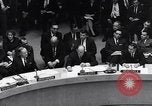
U.S. Ambassador Adlai Stevenson informs UN about steps taken in meeting of Organization of Consultation in United States.
Ambassador Adlai Stevenson addresses United Nations Assembly about United Sates action against Cuba and Russia, during timeframe of Cuban Missile Crisis. Ambassador Stevenson hopes and prays for peace. He tells Soviet Union to end their actions against United States. He refers to the initiative of President John F Kennedy to quarantine war. He informs about the Organization of Consultation meeting, which is a part of the Organization of American States. He then talks about the resolutions in 19 paragraphs adopted by them. First is immediate dismantling of offensive metals from Cuba. Second, he refers to article 6 and 8 and all necessary measure including use of arms against any offensive attempt on U.S. Third, is to inform security council of UN under article 54 of U.S. charter about the resolution, and the same information to be given to Cuba.
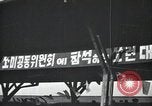
Events pertaining to withdrawal of USSR and USA from North Korea.
Events pertaining to withdrawal of USSR and USA from North Korea. Colonel General Trenty Shtikov and Kim II sung speaks at a joint assembly in Seoul. Flags of Korea USA and USSR seen in background. North Korean Flags being hosted over buildings. A scene from the People's Assembly in Pyongyang. Assembly members ask for withdrawal of USA and USA troops. North Korean flags on the walls of assembly hall. Assembly members cheer at the news of Russia's withdrawal from Korea in a later meeting. Shows a letter of thanks to Soviet Union by Koreans. Korean men,women and children collectively sign a petition. March 1946.