


 Francais
 Deutsch
 Italiano

Refine Your Search
Stalingrad Russia Soviet Union 1943 stock footage and images
- Showing 175 to 180 of 4682 results more
 Hide

Zoological students studying specimens from Sea of Okhotsk.
Students and Professors from an Institute of Zoology in Russia, Soviet Union, sorting and observing specimens on the deck of a fishing boat Toporov. Specimens are collected from the sea of Okhotsk and they are then measured and examined aboard the ship.

UN Charter signed in San Francisco Conference; President Harry S. Truman addressing General Assembly; Franklin Roosevelt speech about peace
Delegates arrive in San Francisco for United Nations Conference for World Organization in San Francisco, California. U.S. President Truman arrives by airplane at the conference and is met by representatives from U.S. delegation including Stettinius. Delegates from other countries are also present and greet the President including Jan Smuts of South Africa and William Lloyd Mackenzie King of Canada. Views of presidential motorcade traveling through streets of San Francisco in a parade-like environment, with crowds lining the sidewalks and cheering. Delegates sign the United Nations Charter during the conference. First to sign is Dr. Wellington Koo from China, signing with a traditional Chinese brush. Also shown signing is Gromyko from the Soviet Union, Lord Halifax from Great Britain, and the delegation from France led by acting delegation chairman Joseph Paul-Boncour. Next is Edward Stettinius and Senator Tom Connally, Senator Arthur Vandenberg, Commander Harold Stassen, from the United States. U.S. President Harry S. Truman addresses the general assembly. Representatives of different nations like Lord Halifax of Great Britain, Mackenzie King of Canada, Jan Christian Smuts of South Africa, Andrei Gromyko of Russia and Pandit Jawahar Lal Nehru of India can be seen. Flashback to President Franklin D Roosevelt, shortly before his death, addressing Congress about the coming San Francisco Conference. Roosevelt speaks, expressing his hope that Congress and the American People would "accept the results of this conference as the beginning of a permanent structure of peace, upon which we can begin to build, under God, that better world in which our children and grandchildren -- yours and mine - children and grandchildren of the whole world -- must live and can live."

Various views of Soviet soldiers preparing for combat during a lull during battle against German invasion in World War II
Opening of film shows image of famous statue being projected on a screen. The statue depicts a Soviet worker and a collective farm woman, respectively, raising a hammer and sickle high above their heads. The statue is a stainless steel art work created by Vera Mukhinafor the 1937 World's Fair in Paris, France. (It was later moved to Moscow, Russia.) Next a field and forest is shown on the Western front of the Soviet Union (Eastern Front of World War 2, in Europe). Soviet soldiers are preparing for combat during a temporary lull in their defense against German forces in their Operation Barbarossa offensive ,begun in June, 1941. Soviet soldiers place branches and foliage upon a BT tank as camouflage. Others assemble loose ammunition rounds into machine gun belts. Soldiers camouflaging an artillery field piece with foliage. Soviet soldiers refueling a tank. Soldiers moving through wooded area past another camouflaged gun. Several Soviet soldiers at a shelter in the woods, placing ammunition rounds in a clip. A printer producing a daily newspaper for soldiers. A soviet soldier picks one up to read. Closeup of the newspaper. Soviet munitions handlers inserting fuses into noses of artillery shells. A T-34 tank sitting in foliage. Soldiers looking at charts as they sit in the woods. A Soviet soldier running (possibly to deliver a dispatch).
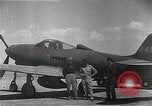
U.S. Lend-lease aircraft being supplied to USSR by way of Iran in World War II
Film about the shipping of American Lend-Lease aircraft to the Soviet Union, via the " Persian Corridor " during World War 2. It focuses on activities at Abadan Airfield, Iran. U.S. Army Air Forces (USAAF) Colonel Charles Porter, Commanding Officer of the Allied Abadan military establishment in Iran, stands with a Soviet Colonel, who supervises Soviet work on the field. With them is USAAF Brigadier General Macmillan., who was visiting the base at this time. They pose in front of a P-39 Bell Aircobra airplane displaying a red Soviet Star insignia. Next, ground crews are seen towing aircraft on the field, including a Douglas A-20 Havoc and a Curtiss P-40 Warhawk. Mechanics work on several P-40 airplanes on the ramp. A North American Aviation T-6 Texan aircraft is being refueled from a truck .Closeup of ground crewman holding refueling hose over the wing of the T-6. USAAF mechanics conduct post-assembly checks on a North American B-25 Mitchell bomber and tow another one (Serial number 41-3225) from a hangar, to the Soviet side of the field, after completing its inspection. Soviet mechanics are seen checking guns in the rear cockpit of an aircraft. Glimpse of several P-40 aircraft and a T-6 aircraft on a ramp. Soviet and American mechanics working together on the wings of aircraft. Closeup of two working together. As a Soviet soldier watches, an American airman uses a paint brush to change the American white star on an airplane, into the Soviet red star. The two shake hands when the painting is done. Soviet ground crew push a P-40 aircraft into position for starting. A soviet pilot, wearing a seat pack parachute, climbs into the cockpit. Closeup of him as he nods to a ground crewman for engine start. He taxis out and takes off. Several T-6 aircraft on the Soviet side of the field are seen, ready to be flown away. Views of other aircraft being readied for ferrying to Russia. Camera pans over the airfield and the many aircraft parked there.
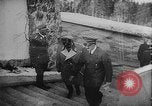
Events leading to World War II in Europe and German attack on Poland in 1939
Adolf Hitler and Hermann Goering walk together up the steps of Hitler's Berghof residence in Berchtesgaden, Bavaria, Germany. Inside the two walk about and converse. Views of them in several different rooms of the building. Hitler and Goering silhouetted against the large windows in one room, containing a long table and a world globe. Change of scene showing Nazi foreign minister, Joachim von Ribbentrop, being greeted by Soviet Union Minister of Foreign affairs, Vyacheslav Molotov, in Moscow, Russia, where they negotiated the signing of the German–Soviet non-aggression pact (also called the Molotov–Ribbentrop Pact) in August 1939. Von Ribbentrop is seen seated with Soviet negotiators. Various newspapers reflect mixed world wide views. Some question whether war or peace is ahead. Another notes that the Reichstag supports the diplomatic initiative. Another suggests that England and France must decide. One headline says Chamberlain will want war. Next, Polish forces are seen on parade being reviewed by General Władysław Bortnowski. Among forces parading are mounted cavalry, marching infantry, a formation of PZL P.11 fighter planes, Tk-3 tankettes (Tankietka), 120 mm wz. field guns, CP7 Ursus artillery tractors pulling wagons, antiaircraft guns mounted on trucks, and army trucks carrying soldiers. Scene shifts to German airmen loading bombs on aircraft; arming machine guns; refueling; and testing functionality of aircraft elements, such as turrets. Pilot in cockpit as engines start on a Dornier Do 17 bomber. Ground crew pull chocks and aircraft taxis out. A Heinkel He 111 bomber taxiing. Two of them take off. A Do 17 takes off, followed by more He 111s. Closeup of one flying low over the camera on takeoff. A mixed formation of German aircraft aloft, including several fighters flying top cover; nine Dornier Do 17s; and other bombers. Aerial closeup of a Do 17 seen from adjacent wingman. Closeup of several He 111s in formation. Closeup of gunner in turret. View from above of three camouflaged Do 17s flying far below. Closeup of pilot in cockpit of He 111 with wingman off to left side. More views of Do 17s flying over patchwork of farmlands. Gunner preparing in his turret. Clouds from antiaircraft fire seen from plane cockpit. Bombs falling and exploding on city below. Succession of bomb craters in a line across a flat area of land. View from aircraft of damaged Polish aircraft on an airfield. Scenes of devastation on the ground including destroyed buildings and Polish aircraft. Waves of German Junkers Ju 87 (Stuka) dive bombers taking off; in formation; and peeling off to dive on targets. View from cockpit of one, through rotating propeller, as it dives to bomb a railroad marshaling yard, and view back as it pulls out, showing clouds of smoke rising in its wake. Several German officers peruse damage at rail site. Destroyed Bridge and shipyard. The German battleship, Schleswig-Holstein bombarding the Polish base at Danzig's Westerplatte on September 1st, 1939. German artillery firing in Poland. Formation of Do 17 bombers overhead. Damaged and abandoned wooden wagons at side of road traveled by Polish civilians evacuating in a horse-drawn wagon and herding their cattle to safety. Destroyed Polish artillery and equipment and horses during German invasion. Men dig graves and bury dead Polish soldiers. Vies from air of bombed out part of Warsaw. Polish citizens gathered in places seeking assistance. German forces on parade in Warsaw, including German soldiers goosestepping. Closeups of Adolf Hitler reviewing them.
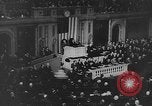
United States passes and implements the Lend Lease Act during World War II. War materiel flows to Allies.
President Franklin D. Roosevelt addressing Congress on January 6, 1941, asking for authority to supply war materiel to Britain and allies. Animated map showing streams of war materiel going to china and to European allies. Views of transport ships, Douglas A-20 Havoc aircraft with British roundel on them. A U.S. light tank M2; a large artillery barrel; and sacks of goods, being loaded on a ship. View of U.S. Capitol. Lend Lease Act passed. Animated map shows German forces overrunning Yugoslavia and Greece, and attacking Soviet Union. German troops in small boats crossing river to invade. German tanks and artillery operating on the Eastern front. Civilian men and women digging fortifications. Lend lease war materiel being unloaded in Britain, and at Red Sea port for British in Africa.Trucks carrying supplies over the Burma road to China. Lend lease supplies piled up in Murmansk, Russia, and Iran. "Hammer and Sickle 'em" chalked on a shipment.Stevedores rolling large tires.Hitler speaking. Head of Statue of Liberty. Animated illustrations about effects of Axis victory. U.S. Forces entering Greenland and Iceland, with consent of their governments.