


 Francais
 Deutsch
 Italiano
Refine Your Search
Stalingrad Russia Soviet Union 1943 stock footage and images
- Showing 2275 to 2280 of 5654 results more
more Hide
Hide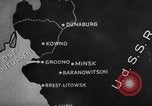
German Forces attack villages and defenses near Grodno, Belorussia, during Operation Barbarossa in World War II
German offensive on the Eastern Front in Operation Barbarossa, during World War 2. Three German soldiers ride into a burning village, near Grodno, Belorussia, in, what appears to be, a fully tracked armored personnel carrier. They are followed by some armored cars and other vehicles. Huge flames and clouds of smoke obscure the background. The entire place is in flames. German troops on horseback pull artillery and caissons. Camera pans over flaming buildings. Several mounted soldiers move slowly along the village street, as fires rage. Hundreds of disarmed Soviet troops rush across a bridge and toward the rear as German troops march past them toward the battle front. Camera focuses on the blazing buildings as one structure collapses. Huge numbers of German infantry march slong a dirt road. Some of them carry shovels. Camera pans across line of horses pulling artillery pieces and caissons. Closeup of German General of Artillery, Wilhelm Fahrmbacher as he orders a gun crew to direct their 105mm artillery piece toward a line of bunkers. Soldiers manning a truck-mounted weapon accompanied by infantry, move along a dirt road. Another glimpse of the howitzer gun crew. A soldier crawling along, in underbrush and others running across the field. The 105 howitzer crew firing some more (and the soldiers holding their ears). Troops hurrying across open fields and then attacking concrete bunkers (one carrying a hand grenade). Notable closeup images of the German infantrymen fighting their way into the bunker complex. Soldier with hand grenade moving past the remains of a concrete wall. (Only steel reinforcement is left.) He and a comrade clamber down into the bunker proper. Infantry riflemen scour damaged bunkers for Soviet defenders. Some emerge and surrender.
German surrender scenes and views from wrecked German cities at end of World War 2
Documentary titled 'Deutschland Erwache' recounts Germany's wartime experiences. Explosion seen as the Nazi Swastika emblem is blown up on top of the Zeppelintribüne (at Zeppelinfeld) at the Nazi party rally grounds in Nuremberg in 1945 by the U.S. Army. Following explosion, the pieces from the destroyed emblem fall from the sky. Montage shows: German Prisoners Of War (POWs) marching; Ratification of the German surrender documents (from surrender two days earlier at Reims) held at Soviet headquarters in Karlshorst, Berlin, Germany on May 9, 1945. German officers present include Colonel-General Hans-Jürgen Stumpff from the Luftwaffe, Field Marshal Wilhelm Keitel as Chief of Staff of OKW, and Admiral Hans-Georg von Friedeburg as Commander-in-Chief of the Kriegsmarine. They are seen entering room and signing documents. View of Keitel signing the surrender document. Soviet Russian General looking at surrender documents. General Eisenhower, General Montgomery and others shown in brief glimpses. Stalin, Roosevelt and Churchill at Yalta. Aerial views of heavily bomb-damaged cities in Germany, including wrecked German cities of Cologne, Nuremberg, Hamburg, and Berlin. View of Brandenburg gate in background and rubble of bombing in foreground as two people carry a stretcher down the street. A wrecked street sign for the Unter Den Linden lies on the ground partially covered in mud. Ground level views of smoking ruined buildings in Berlin and a few German citizens walking on the streets following Battle of Berlin. Views of dead German soldiers on a battlefield. German soldiers helping to carry and tend to wounded and bandaged German soldiers. Large group of German citizens gathered in a public square.
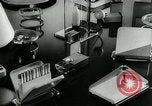
The challenges of reconstruction and rise of communism in Europe after World War II
Reconstruction problems in Europe in the aftermath of World War II. Examples of prewar Germany's industrial and commercial prowess, showing its consumer products and famous cameras. A German coal-burning power plant and miners extracting coal from Germany's vast natural supplies. Coal being transported by conveyer belt. Open rail cars loaded to capacity with German coal. A German iron and steel plant dependent on coal. Shift to postwar destruction including destroyed: German factory; locomotive; rail yards; trucks; farm machinery; fertilizer plant; farm fields lacking crops. Shift to prewar era with view of British coal cars getting ready to be emptied for export to Europe. Current postwar view of British coal cars and coal, that narrator says are barely enough for her own needs. View of prewar German coke being loaded onto conveyers. Coal miners receiving food ration cards. Animated map showing "Iron Curtain," of Soviet occupation, separating traditional German regions of agriculture from those of industry. British Foreign Secretary, Ernest Bevin; French Foreign Minister, Georges Bidault; Soviet Foreign Minister Vyacheslav Molotov; and U.S. Secretary of State, George Marshall; are seen at the Paris Conference in 1946 where they negotiated the postwar future of Germany. Reminder footage of Hitler with brownshirts in 1930s. Italian police coping with communist inspired unrest in Italy. Bombed out buildings in snow. Europeans literally scratching for bits of food from pavement and trash heaps. Two women fighting with each other during time of shortages and ration. Dejected woman. French Communist party leader, Maurice Thorez, speaking to a large crowd. Party flag with hammer and sickle behind him.
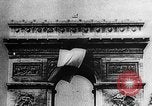
Montage of scenes illustrating the final stages of World War II in Europe
Liberation of Paris August 22, 1944. Tricolor flying from Arc de Triomphe. Crowds celebrate. Young people dance in street. Tanks firing guns. Bombs dropping on Germany. American tanks firing in Cologne, Germany. Spires of Cologne Cathedral loom above destruction and rubble in streets of Cologne. German civilian refugees on the streets. Germans in front of air raid shelters. Animated map showing Soviet advance from East.Formation of Ilyushin Il-2 aircraft. Soviet tanks in farm field. Silhouetted German soldiers surrendering. Wounded and dead German soldiers. Destroyed German military equipment. A long line of surrendered German soldiers. Allied forces driving into Germany beyond the Rhine River. Suffering German civilians and refugees including men, women, and children in desperate circumstances after the devastation of war. German refugees walking on roads, including babies in carriages or prams.
Austrian Peace Treaty frees Prisoners of War from Red slavery and prisoners welcomed at railroad station by their families.
The signing of the Austrian Peace Treaty brings about the withdrawal of Soviet troops in Austria and the return of POW's from many years in Soviet prison camps, ten years after the end of World War 2. Shows repatriation of German Prisoners of War to Austria as the freed prisoners return in a railroad train. Families of prisoners wait for prisoners' arrival. Women hold hands of prisoners from train windows. A prisoner kisses his wife. A father hugs his son as the boy cries.
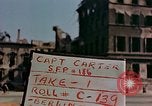
The Brandenburg Gate and bomb damaged buildings on side of Unter den Linden, Berlin.
Bomb damage in Berlin after World War II. The Brandenburg Gate or Brandenburger Tor (Pariser Platz, 10117 Berlin, Germany). Buildings near the Brandenburg Gate suffered heavy damage (Unter den Linden 74, 10117 Berlin, Germany). A large portrait of Soviet Leader Joseph Stalin stands in the middle of Unter den Linden. Red Soviet flags fly. Bomb damaged buildings on side of Unter den Linden. Wreckage of vehicles are also seen in the middle of the boulevard.
CRITICALPAST.COM: About Us | Contact Us | FAQs - How to Order | License Agreement | My Account | My Lightboxes | Shopping Cart | Advanced Search | Featured Collections | Website Terms & Conditions | Privacy Policy ©2026 CriticalPast LLC.
License Agreement |
Terms & Conditions |
Privacy Policy
©2026 CriticalPast LLC.