


 Francais
 Deutsch
 Italiano
Refine Your Search
Stalingrad Russia Soviet Union 1943 stock footage and images
- Showing 2281 to 2286 of 5654 results more
more Hide
Hide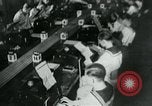
Mine warfare conducted by the German Navy's Northern Fleet during World War II.
Group of German Navy sailors in the communications center of the German headquarters of the Kriegsmarine Northern fleet, work at numerous teletype stations. Next, the Admiral (Generaladmiral) in command, Rolf Carls, is seen pouring over nautical charts and maps and discussing them with officers of his staff. Scene shifts to naval armory where marine mines are being prepared for deployment. They move through the processing lines and then transported by railroad train cars. At a port, a crane lifts a mine, on a wheeled dolly onto the minelayer ship, "Tannenberg," where crew members roll it along the deck. Sailors write on it with white chalk. The Tannenberg seen underway, and then with sailors rolling mines (on their dollys) off the stern of the ship in the Baltic Sea. Sailors moving mines along the deck to the stern for launching. View from another ship of the mines dropping from astern the Tannenberg. Next, officers on deck in cold weather gear, look through binoculars as they sight threat from Soviet aircraft. Interior of the ship as sailors manipulate controls for an anti-aircraft gun. The ship's gun and a machine gun being fired. Soviet bombers seen very high overhead. Camera pans about the deck showing sailors firing at aircraft. Something raises a plume of water astern (a near-miss?). Next, several German patrol boats are seen moving at high speed. Sailor on a speeding patrol boat, stands precariously atop it as he signals with semaphore flags. From a patrol boat, bombs (or mines) are seen exploding behind in its wake. (Note: The Tannenberg was a passenger and ferry built in 1935. On 2 September 1939 the German Navy had her converted to a minelayer. In August 1940 she served as flagship of the minelaying ships, in the North Fleet. She was sunk on 9 July, 1941, off Sweden.)
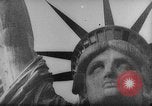
Communist demonstrators carry banners and march on the streets in New York City. Police pursue and arrest agitators
Communist citizens in the United States demonstrate in favor of a Soviet Republic. A view of the Statue of Liberty in New York Harbor. Communists carry banners and march on the streets. The banners read 'For a Soviet Republic'. Communists on the streets of New York City. Buildings and a huge crowd rally in the background. New York City police chase down and forcibly arrest several Communist agitators, taking them to a waiting paddy wagon. Police officers and officials beat and scuffle with agitators and forcibly carry a man away. Police putting arrested agitators into Police van (Paddy wagon). The police officers keep a vigil.
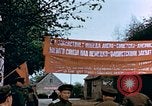
American generals talk to Russian generals at meeting place in Germany.
The meeting place of Soviet and American forces in Torgau Germany late in World War 2 in Europe. Russian banner stretched across village street. A banner in Russian and English. Russian soldiers and women of the Red army. American generals talk to Soviet generals. American GI with two Russian soldiers. American officer and two Russian soldiers. American officer shaking hand with Russian soldier. Russian Major as he greets displaced Russian girls.
World wide demonstration in various nations supporting Polish solidarity and freedom from military rule, during Poland crisis.
Crisis in Poland after the imposition of Martial Law by its Military Government. World wide demonstrations and protests against the military rule in Poland supported by Soviet government. A large crowd of demonstrators in Tokyo, Japan protests on roads carrying banners and their leader addresses on a microphone. A solidarity leader addresses an assembly of demonstrators in Lisbon, Portugal. Protesters assemble at the Sydney Opera House in Sydney, Australia. Girls with Polish flags sing freedom songs. Hans Dietrich Gentscher from Federal Republic of Germany addresses the people assembled. U.S. Senator Henry Jackson and Dr Jerzy Milesewski support the solidarity and Polish people. A huge demonstration in London with people holding banners and placards in support of solidarity in Poland. Civilians demonstrate on the snow covered roads of Ottawa in Canada. People shout for freedom of Poland. A leader reads his speech. A large crowd assembled to support solidarity in Washington DC, United States. U.S. Ambassador to United Nations condemns the Soviet supported military rule in Poland. German Confederation Labor leader supports Polish solidarity during a summit in Germany. A crowd demonstrates in Philadelphia and marches for Polish solidarity. People in a church pray for freedom and prosperity of Polish people.
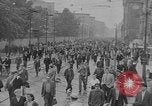
Uprising of 1953 in East Germany: Crowds in East Berlin protest against East German Communist government policies
Unrest in Berlin, East Germany. A large crowd gathers to demonstrate against East German government. A banner carried by some demonstrators calls for free elections. Armed Stasi watch the demonstrators. Demonstrators burn banners and posters and damage public property. People stands on roofs of houses and watch the demonstrations. Armed East German police and some Soviet soldiers watch the demonstrators from their headquarters. Demonstrators tear up and burn signs and start a bonfire. East German Stasi reinforce the checkpoint between the Soviet and American sectors of Berlin. A uniformed Berlin police officer, wearing traditional hat, assists a person who was manhandled by the mob. A building set afire by the demonstrators. View from West Berlin of mob in East Berlin. Sign reads: "You are leaving the American Sector."
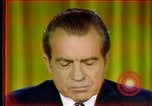
U.S. President Nixon addresses U.S. citizens on the Watergate scandal in Washington DC.
U.S. President Richard Nixon's speech on the Watergate scandal in Washington, DC. The President states that some people will find that the Watergate scandal demonstrates the bankruptcy of American political system, but this is not true. He states that the Watergate issue represents a series of illegal acts and their judgment by people, a system which will bring the guilty to justice and it includes a grand jury, honest prosecutors, courageous Judge John J. Sirica and vigorous free press. The President sates that it is essential to have faith in American judicial system and they should not be distracted to that extent where the vital works get neglected. He states that he will give his complete attention to his office duties irrespective of the case situation. The President expresses his faith in Attorney General Elliot Richardson responsibilities. He mentions about his meeting with the Chancellor of West Germany Willy Brandt which is scheduled the next day. He states that they are preparing for the Soviet American Summit meeting. He talks about the negotiation for mutual and balanced reduction of their forces in Europe in order to reduce the defense budget. U.S. and Soviet negotiators will work on limiting the nuclear arms so as to reduce the danger of nuclear wars. He states that a lot of work has to be done: to maintain peace in southeast Asia, to ensure prosperity, jobs, better life and to control inflation.
CRITICALPAST.COM: About Us | Contact Us | FAQs - How to Order | License Agreement | My Account | My Lightboxes | Shopping Cart | Advanced Search | Featured Collections | Website Terms & Conditions | Privacy Policy ©2026 CriticalPast LLC.
License Agreement |
Terms & Conditions |
Privacy Policy
©2026 CriticalPast LLC.