


 Francais
 Deutsch
 Italiano
Refine Your Search
Stalingrad Russia Soviet Union 1943 stock footage and images
- Showing 2605 to 2610 of 5654 results more
more Hide
Hide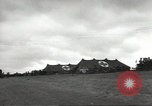
Wounded U.S. and German soldiers treated at field hospital after Allied invasion of Normandy during World War II.
View of U.S. Army Field Hospital set up in Normandy, France, following the Allied invasion in World War 2. U.S. DUKW (six-wheel-drive amphibious truck) passes along a road. American wounded being carried on stretchers to hospital tent. Intravenous treatment being administered to a wounded soldier; man standing holds IV bag. American Army nurses and corpsman preparing bandages inside a field hospital tent. Nurses seated near a tent. One drinks coffee from her metal mess cup. Nurses comforting and assisted wounded soldiers. Two German prisoners of war (POWs) pose for camera. It is unusual that two of the German soldiers appear to be of East Asian descent. (It has been reported that there was a Korean man named Yang Kyoungjong who was three times captured and conscripted into the Japanese army, then the Soviet Army, and then the German Wehrmacht during World War 2. He was captured by the U.S. Army during the invasion of Normandy. The identify of the two German soldiers of Asian descent seen in this footage is unknown.) German POWs carrying a wounded comrade toward a treatment tent. A German POW Army doctor and his assistant treating a soldier for shrapnel wounds. The doctor waves toward German POWs to bring their wounded, on a litter, to him. POWs carrying wounded on a litter. Paratrooper of the U.S. 101st Airborne Division, with bandages across his face, carries a wounded buddy to treatment area. Closeup of the trooper smiling in spite of his bandaged face. Ambulatory wounded U.S. soldier being registered by Army nurse. Corpsman of 101st Airborne, on stretcher on the ground.
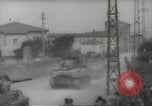
U.S. liberate Leghorn and advance into Livorno, Italy during the Italian Campaign of World War II.
U.S. tanks and soldiers in Livorno, Italy during the Italian Campaign of World War II. The soldiers and the tanks advance. The soldiers walk past a sign which reads 'PISA'. The soldiers and the tanks move along a street. Italian civilians cheer as the troops advance. Soviet partisans carry an American flag and march along the street. A unit of Japanese-American U.S. Army soldiers from the 442nd Regimental Combat Team rest and lean against a wall. Wrecked buildings in the city. Close-up views of the faces of three Japanese-American U.S. Army soldiers of the 442nd regiment as they look at a bulletin board with warning notices written in German and Italian, and then walk away. A Japanese-American soldier looks at a road sign on which an arrow points to Rome and Pisa and has an extra sign added for Los Angeles. He smiles and laughs at the sign.

Hitler Youth and Reich Labor Service units dig defensive trenches on Germany's eastern border during World War II.
The Germans dig defensive positions on the eastern border of Germany during World War II. Hitler Youth, Reich Labor Service units and Baltic people dig defensive trenches on Germany's eastern border. View of Hitler youth lined up with shovels ready to fall out and dig. Hitler youth ride to the eastern front trench digging site on bicycles while holding shovels. At the trenches, men and women march carrying shovels and dig defensive positions. Mass hand digging effort underway by men and women and Hitler youth. Ground and aerial views of the trenches being dug. Wide aerial view of long line of jagged defensive trenches separating German held areas from the front with the Soviet Russian forces. English overlay narration describes difficult working conditions for the Baltic forced laborers, virtually slave labor, with poor working and living conditions.
Aerial views and blueprints of Nazi concentration camp Auschwitz in Poland after its liberation (WW2)
Nazi concentration camp city of Auschwitz in Poland after its liberation by Soviet troops towards the end of World War II. Numerous concentration camp inmates, who have been freed, march on snow. Prisoners behind barbed wires after the surrender of German SS guards. Buildings at Auschwitz. Aerial view of Auschwitz. A blueprint of Auschwitz including barracks and crematoriums. Architectural elevation drawings of the crematoriums and gas chambers. Architectural elevations of the barracks.
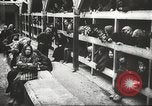
Polish prisoners after the liberation of Auschwitz Nazi German concentration camp in Poland during World War II.
Nazi concentration camp Auschwitz in Poland after its liberation by Soviet troops towards the end of World War II. Bunk beds at Auschwitz show camp prisoners. Electrified wire fences at the camp. 'Arbeit Macht Frei' sign at Auschwitz. A sign reads '6000 volt raum vorsicht lebensgefahr'. Women prisoners inside barracks. Pictures of various prisoners, from Poland, Czechoslovakia,and Hungary and Jews, Romanians,and others.
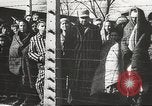
Prisoners leave barracks after the liberation of Auschwitz concentration camp in Poland during World War II.
Prisoners after the liberation of Nazi concentration camp Auschwitz in Poland by Soviet troops towards the end of World War II. The prisoners stand behind barbed wires. An old prisoner. An old Yugoslavian woman and a young Czech boy standing amid corpses outside barracks. The prisoners walk out of the barracks in huge numbers after German surrender of the concentration camp.
CRITICALPAST.COM: About Us | Contact Us | FAQs - How to Order | License Agreement | My Account | My Lightboxes | Shopping Cart | Advanced Search | Featured Collections | Website Terms & Conditions | Privacy Policy ©2026 CriticalPast LLC.
License Agreement |
Terms & Conditions |
Privacy Policy
©2026 CriticalPast LLC.