


 Francais
 Deutsch
 Italiano
Refine Your Search
Taiwan stock footage and images
- Showing 145 to 150 of 162 results more
more Hide
Hide
The first Chinese refugees arrive in Chicago, Illinois and meet their family.
First Chinese refugee family arrives in Chicago, Illinois under an emergency immigration plan. The Eng family arrives under emergency immigration laws to allow the refugees to enter the country and receive asylum from Communist rule in China. The family had been waiting in Taiwan since 1955 and had not succeeded in entering the U.S. under a quota that permitted only 105 Chinese persons per year. Chinese refugees get off an airplane. They meet their family. They enter a building. Food on a table. The family seated at the table eats the food.
Kennedy and Nixon comment on nuclear disarmament before summit conference during a presidential election debate in the U.S.
The third Kennedy-Nixon Presidential Debate in the United States. Douglass Cater from Reporter magazine asks Democratic candidate Senator John F Kennedy about what sort of prolonged period does he envisage before there could be a summit conference and if he thinks that there could be any new initiatives on the grounds of nuclear disarmament during that period. Kennedy answers and talks about the need of strengthening of U.S. conventional forces and increasing missile production. On the question of nuclear weapon disarmament he states that the new administration should renew negotiations with the Soviet Union. He disagrees with the present administration's efforts regarding nuclear controls and general disarmament. He states that if he would get a chance he would make efforts to provide for control of nuclear weapons testing and begin general disarmament levels. Republican candidate U.S. Vice President Richard M Nixon mentions about his speech on this subject. He disagrees with Kennedy's statement that the administration is not making any effort because this is the highest level of operations in the whole State Department which is under the President himself. Roscoe Drummond from New York Herald Tribune asks Vice President Nixon about defending Quemoy and Matsu islands. Nixon answers and states that the U.S. should not deal with dictators and should not indicate which particular area it would defend. He gives the examples of the Korean War and World War II where the U.S. made a mistake. He says that Kennedy should change his position in this regard and not encourage the Chinese Communist and Soviet aggressors to react. Kennedy says that the treaty with the Republic of China excludes Quemoy and Matsu from the treaty area. He states that the treaty only includes defending of Formosa (Taiwan) and the Pescadores. He concludes that the U.S. should meet its commitments and raise war if the Chinese Communists attack the Pescadores and Formosa.
Kennedy and Nixon comment on the Indochina War, Quemoy and Matsu islands, and U-2 flights during their third debate.
Nixon and Kennedy debate questions regarding relations with Communists during the third Kennedy-Nixon Presidential Debate in the United States. Douglass Cater of Reporter magazine asks Republican candidate U.S. Vice President Richard M Nixon to comment whether there was a valid criticism of his statement of foreign policy. Nixon answers and states that the criticism is not valid. Regarding Indochina, he says that the U.S. would not have tolerated Indochina falling under Communist domination. And as a result of that the civil war there ended. He states that he supports the President's position and thinks that the President was correct in ordering the U-2 flights. Referring to Quemoy and Matsu he states that he objects to the constant reference to surrendering these islands. Democratic candidate Senator John F Kennedy disagrees with Nixon's statement on Indochina and states that reason Indochina was preserved was the Geneva Conference. On the question of the U-2 reconnaissance aircraft flights he states that he has never criticized them and never suggested stopping of espionage. On the question of keeping the Communists in doubt about the U.S. defending Quemoy and Matsu he states that the U.S. should meet its commitments to Formosa (Taiwan) and the Pescadores. He concludes by saying that he disagrees with Nixon as Nixon is extending the administration's commitment.
U.S. Vice President Nixon talks about the foreign policy of America prior to presidential elections in the United States.
The fourth presidential election debate between Democratic nominee Senator John F. Kennedy and Republican nominee U.S. Vice President Richard Nixon on 21st October 1960 in in New York, United States. News correspondent Quincy Howe speaks prior to the fourth Kennedy-Nixon presidential debate. Mr. Howe reads out the rules and conditions under which the candidates will proceed. He says that Senator Kennedy will make the second opening statement and the first closing statement. Vice President Nixon speaks about the present issue in the United States which is keeping peace without surrender. The peace which is threatened by international communist movements. Nixon says that the United States has to learn from mistakes made in past. He relates to this by mentioning the period of the Iron Curtain in Europe and during the Korean War. Nixon says that situation in President Dwight Eisenhower's administration is reversed. He says that the United States made errors in the past in misjudging the Communists, applying same rules of conduct that are applied to the leaders of the free world. Nixon mentions East-West Paris summit conference of 1960 and Eisenhower's policy regarding Formosa Strait (Taiwan). Nixon speaks that that United States should increase its military strength to high level regardless of what potential opponents have and if any surprise attack is launched, the United States can destroy their war-making capacity. Nixon further says that American policies of military strength, economic strength, and diplomatic firmness will keep the peace without surrender.
U.S. Senator John Kennedy talks about the foreign policy of America prior to presidential elections in the United States.
The fourth presidential election debate held between Democratic nominee Senator John F. Kennedy and Republican nominee U.S. Vice President Richard Nixon in New York, United States on 21st October 1960. ABC news correspondent Quincy Howe speaks prior to the fourth Kennedy-Nixon presidential debate. Senator Kennedy says he agrees with the policy of Eisenhower's administration regarding the Formosa Strait (Taiwan). He speaks about Communist influence of Cuban Prime Minister Fidel Castro on Latin Americans which is becoming a threat for the United States. Kennedy also mentions Communist Russians broadcasting ten times as many programs in Spanish to Latin America as the United States does. He talks about technical assistance given to Africa by the United States. He speaks about future of increasing communist influence in world. Kennedy mentions Liberia and the Union of South Africa who voted with America on the question of admission of Red China in the United Nations. Senator Kennedy speaks about Communist influence increasing in the world and relates to it by saying that there are six counties in Africa that are members of the United Nations and there is not a single American diplomatic representative in any of these six. He further speaks about military progress of Communist nations.
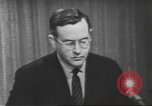
Vice President Nixon and Senator Kennedy debate over Quemoy and Matsu issue prior to presidential elections in the U.S.
The fourth presidential election debate held between Democratic nominee Senator John F. Kennedy and Republican nominee U.S. Vice President Richard Nixon in New York, United States on 21st October 1960. ABC News correspondent Quincy Howe speaks during the debate and allows NBC correspondent John Chancellor to pose a question to Richard Nixon a . Correspondent Chancellor asks a question about Quemoy and Matsu issue. Vice President Nixon points out inconsistency of Senator Kennedy. He further explains it by saying that Senator Kennedy signed a resolution in 1955 which gave the president the power to use United States forces to defend Formosa (Taiwan) and offshore islands. But he also voted for an amendment which was lost, an amendment which would have drawn a line and left out those islands. Vice President Nixon supports President Eisenhower's position. Correspondent Howe asks Senator Kennedy to comment on the topic. He speaks about President Eisenhower sending a mission to persuade Chiang Kai-shek in the spring of 1955 to withdraw from Quemoy and Matsu because they were exposed. The President was unsuccessful. He refers to the fact that in 1958, as a member of the Senate Foreign Relations Committee, he was very familiar with the position that the United States took in negotiating with Communist China (PRC) on these two islands. He further that the U.S. was unable to persuade China's Chiang Kai-Shek to withdraw and thus it was decided by the U.S. to defend the islands.