


 Francais
 Deutsch
 Italiano
Refine Your Search
Taiwan stock footage and images
- Showing 151 to 156 of 162 results more
more Hide
Hide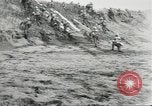
Japanese forces landing on Kiska, Aleutian Islands, during World War II
Japanese No. 3 Special Landing Party of 500 Imperial Marines are seen landing and proceeding inland on Kiska, Aleutian Islands. They carry the rising sun flag. They are seen searching two captured Americans from the U.S. Naval Weather Detachment. The rising sun flag is seen in right foreground. The Japanese troops continue walking across the island. Buildings of the weather detachment seen in background.The Japanese troops assemble in formations near the weather detachment buildings as their commander addresses them. A Japanese Type 97, 4EFB (Mavis) flying boat seen taxiing into the bay and being tended by Small boats. (Reportedly, the Tail code "O" identifies the seaplane's unit as Taiwan-based Toko-tai, also active in Solomon islands.)
Various scenes showing Tokyo streets, Torii gates, festivals and a courtier looking at scroll in Japan
Map of North America and the United States, with a white outline for the United States border. Map of the Empire of Japan, including the Korean peninsula and Taiwan, and its borders in white. View of a lake with Mount Fuji. A train on top of Manseibashi bridge (1-1 Sotokanda, Chiyoda City, Tokyo 101-0021, Japan). Trams, vehicles, and bicycles in downtown Tokyo (likely Ginza or Marunouchi). A white Torii gate inside a Shinto shrine. People visit a Shinto shrine during spring. Japanese performers perform with fans on a Danjiri shrine cart during the Kishiwada Danjiri Festival in Osaka. Smokestacks in an industrial town. A wooden Torii gate. Japanese children flying a kite. A Buddhist monk blows a horn while deer graze in Nara. Spanish conquistadors and Japanese samurais ride horses. 18th century British woodcut showing metal tools and blacksmiths at work. 18th century prints showing European peasants working in a mill and horses in a grinding machine. A Japanese courtier opens and looks at a scroll with illustrations.

The Chinese communists forces attack again after a respite of 15 days on Quemoy.
Damage seen after mainland Chinese communist forces bomb Quemoy (Formosa, later Taiwan), following a 15-day respite. Shells on the beach. Wrecked houses in a town on Quemoy island. Nationalist Chinese soldiers come out of an airplane. Chinese soldiers dig trenches and are seen on guard near an artillery position on the island.
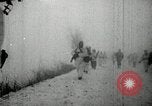
U.S. troops retreat as Chinese forces enter the Korean War.
United Nations forces retreat through snow as Chinese Communist troops enter Korean War in late 1950. An animated map of Korea shows Chinese forces overtaking North Korea. U.S. Marines marching in retreat from Chosin Reservoir region while artillery fires at enemy. Troops in sleeping bags covered in snow. Wounded loaded in small planes that take off from a field marked with a sign reading, 'Panicky Pocket Air Strip' View of retreating civilians and refugees moving south including many North Korean families with small children. Marines are evacuated from Hungnam. Civilians are transported in trucks with their belongings. General Ridgeway is shown sitting in a jeep after taking command of forces in Korea. A map highlighting Hungnam. Views of Security Council meeting. Shots of soldiers from many countries, including Belgium, Turkey, Greece, Taiwan, Philippines, Australia, and Canada. A sign marked with '25th Canadian Infantry Brigade'.
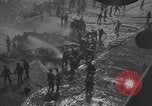
Fire fighting aboard the USS Hancock (CV-19) in the Pacific after explosion of TBF Avenger on deck
Fire fighting aboard the USS Hancock (CV-19) in the Western Pacific Ocean off the coast of Formosa (Taiwan). Sailors direct fire hoses on a burning TBF Avenger and hole in the flight deck. The TBF Avenger had returned from a sortie, landed on the deck, taxied near the island and then exploded. 50 sailors were killed and 75 injured. Corpsmen carry wounded man on stretcher across flight deck. (World War II period).
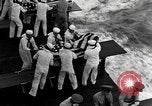
Bodies committed to ocean and Marine rifle salute in mass funeral ceremony aboard USS Hancock (CV-19) in the Pacific Ocean.
Mass funeral aboard the USS Hancock (CV-19) in the Pacific Ocean. Bodies committed to ocean in Mass Funeral Ceremony. Multiple crews of six men each carry dead sailors, wrap each in the U.S. flag, place them on a board and tip them into the ocean. Marines fire rifle salute. View of sheet covered bodies on lower deck awaiting burial at sea. The 50 men were killed in a January 21, 1945 accident when a TBF Avenger returned from a sortie in the area of Formosa (Taiwan). It landed on the deck and taxied near the island, and then exploded killing 50 men and injuring 75. (World War II period).