


 Francais
 Deutsch
 Italiano

Refine Your Search
Tangermunde Germany 1945 stock footage and images
- Showing 4429 to 4434 of 10471 results more
 Hide
Color Sound
German invasion of France,sinking of RMS Lusitania and resignation of William Jennings Bryan
Events during World War I. Sketches : workers in a German arms factory. German soldiers advance towards France. Animation of a map shows the German invasion of France through Belgium. Kaiser Wilhelm II, the German Emperor. Buildings damaged by invading Germans. U.S. president Thomas Woodrow Wilson advises Americans to stay calm. American people read papers. Cartoon depicts the President about his domestic reforms. The German atrocities in Belgium. Man holds a dead person. Sketch depicts Germany crushing everything on its way. The apprehensive people of America. Sketches of American man against a German leader. Trucks and taxi cabs on the Orne river. A gun barrel. Bombs being dropped on the German ships. Worker at a factory in America. Sketch of a man standing beside a flag having the dollar sign shows the prosperous America. Sketch shows the various resources required by the American industries. An American ship carrying war materiel. Sailors in German submarines. German submarines target allied ships. Sketches of U.S. president Wilson warning Germany. On 1st May 1915 RMS Lusitania a British luxury ship at sea as it starts from New York. Paper shows a warning by the German government. A German sailor on board a submarine as it targets a ship. The RMS Lusitania ship sinks killing many, including Americans. The U.S. secretary of State William Jennings Bryan and Thomas Woodrow Wilson with other officials. The former U.S. president Theodore Roosevelt addresses people opposing President Wilson's policy. The President prepares a note for Germany. Sketch of U.S. Democratic Presidential candidate William Jennings Bryan during his resignation. Sketch of Kaiser Wilhelm II.
Improvement of miners, condition of mines and factories and civilians of war affected countries of Europe, by Marshall Plan.
Film titled 'Me and Mr. Marshall' depicts developments of coal mines in Germany and aid to other European nations affected by World War II. German coal miners dig deep in a coal mine soon after the end of World War 2. Volunteers awarded at a ceremony. Volunteers board a train and proceed for work at coal mines. Volunteers eat food, give their shoe size, under go training on mine machinery. Miners on lift move underground. Miners at end of the day walk out tired and blackened by coal dust, from a mine. Miners take hot showers after work and get clean clothing hung high on ropes. Salary given to workers for a day's work. Headlines of German newspapers about Marshall Plan. General George C. Marshall speaks his plans at a meeting in Washington DC, America. Aerial views of ruined buildings and factories, wrecked harbor, refugees in tenements in Europe after World War II. Buildings, monuments and bridges in London and Eiffel Tower and other buildings and civilians on roads in Paris, and view of Kremlin in Moscow, Soviet Union. Map shows countries under Marshall recovery plan. View of meeting in progress of Conference for European Economic Cooperation in July 1947, in the Grand Dining Room of the French Foreign Office. Meetings of leaders of nations adopting Marshall plan. Ruins of industries of Germany. Ruins on the ground after war in London, with Big Ben in the far distance. Workers at a factory. Miners take a horse inside a coal mine. Empty coal cars at a German coal mine. Men push coal cars full with mined coal out from mine, on rails. Views of buyers in suits at a German trade show and conference, promoting German products and industries to potential buyers in other countries, a few years after the end of World War 2. U.S. Congress and President Harry Truman in Washington DC approve the Marshall Plan and provide monetary aid to other European countries. Scenes in Germany as it recovers economically after the war: Workers in a factory. Harbor, fruit and vegetable market; customers in a bakery; coal cars and machinery at a coal mine under normal operation under the plan.
Shooting of Bernt Leuton in 1961 explained in context of Soviet history, beginning with Czar Nicholas II and Russian Revolution of 1917
A picture of Bernt Leuton, a resident of East Berlin East Germany, who fled to West Berlin West Germany. Border guards at the Communist side of Berlin in East Germany. View of Leuton on August 13, 1961 after being shot by an East German guard, after successfully swimming across the connecting canal. He is hauled out by West German guards. A map of the world. Narrator begins to trace history of Bernt Leuton's shooting by recounting prior events in history of Russia and Soviet Union. View of the Winter Palace of Czar Nicholas II, with the Czar and Czarina Alexandra standing on a balcony. Saint Petersburg, Russia on January 22nd , 1905 : Peasants and workers, with their leader Russian Orthodox Priest, Father Georgi Gapon, gathered outside the palace to deliver a petition to Czar Nicholas II. A number of the people carry banners. A picture of Czar Nicholas II. Reenactment of Czar's armed cossack cavalry dispersing the crowd, The words 'My autocracy will remain unchanged' issued by the Czar to which Father Gapon replies that they "no longer have a Czar." Picture of Father George Gapon. Picture of Vladimir Ilyich Lenin, and moving images of Lenin speaking. The Czar Nicholas II and his wife, escorted by guards, moving on a path during a ceremony. The Czar mounting a horse and the guards saluting him. A picture of the Czar's wife and hemophiliac son. Picture of Russian mystic Grigori Rasputin, whose occult powers were believed to have kept the Czar's son alive.

Farming, marketing and recreation activities of citizens in the town of Madison, Indiana, alongside the Ohio River in the U.S.
Life in the town of Madison, Indiana, on the banks of the Ohio River. Scenes in and around the town: View of the Milton-Madison bridge across the Ohio River (US-421, Milton, KY 40045, United States) ; the town of Madison on hillside across the river; Church steeples protruding above tree tops in view from above; tree lined and shaded sidewalk; a tower with ramparts; Italian Campanille- style tower; gothic doorway on a church; slate rooftops with chimneys protruding and towers and cupola building top visible; Greek-inspired column; a renaissance-style fountain with statuary. A fraternal building with ramparts; the Madison Fair Play Fire Company fire department building with Italian-style tower (403-405 E. Main St. Madison, IN 47250, USA); Roman columns on the Jackson safe deposit and trust Company “National Branch Bank” building. Children play in the fountain on a hot afternoon. A Stern-wheeler Riverboat plying the river with dense black smoke streaming from its twin stacks. Men from Greece, Ireland, Germany and other parts of the world have settled in Madison. They include a confectioner, a county agent and others. A Greek confectioner inside his shop. A journalist works on a typewriter in an office. He speaks on the phone during a telephone call. A county agent of Dutch descent speaks to clients. An elderly couple from Germany chat and have drinks at a restaurant. A toddler eats pasta while sitting on a highchair. An Italian family eats pasta together at a dining table. Effigy of James Madison, a founding father and the namesake of Madison, Indiana. Farming activities: Farms and houses. Farmer and other men harvest grapes from grapevines. Other farmers harvest tobacco. A woman brings eggs from a hen house. A farmer loads baskets and milk containers on a truck for market day. Market day activities: An open market is set up around the Madison courthouse. A produce merchant sells his products to customers. View of the main street. Buildings seen on either side of the street. Mountains in the background. Recreation activities: Citizens bowling in a club. Ball seen hitting pins up close. They drink at a bar and play billiards and checkers. They dance and watch a movie. Citizens outside the box office, beneath the movie theatre marquee. People inside a movie theater watching a movie. Faces of audience members as they watch the movie screen. Customers get refreshed at a corner drug store where a crowded soda fountain bar area and tables are shown. Students play band instruments during a school concert. View of churches. Parishioners enter a church gate. They worship and pray. A man holds a fishing rod. He walks towards a lake. (World War II period).Life in the town of Madison, Indiana, on the banks of the Ohio River, in the United States. Scenes in and around the town: Steel highway bridge across river; the town on hillside across the river; Church steeples protruding above tree tops in view from above; tree lined and shaded sidewalk; a tower with ramparts; italian-medieval style tower; gothic doorway on a church; slate rooftops with chimneys protruding and towers and cupola building top visible; Greek-inspired column ; a renaissance-style fountain with statuary. A fraternal building with ramparts; the fire department building with Italian-style tower; Roman columns on the Jackson safe deposit and trust Company building. Children play in the fountain. A Stern-wheeler Riverboat plying the river with dense black smoke streaming from its twin stacks. Men from Greece, Ireland, Germany and other parts of the world have settled in Madison. They include a confectioner, a county agent and others. A man works on a typewriter in an office. He speaks on the phone during a telephone call. A man and a woman chat and have drinks at a restaurant. A family eats dinner or another meal together at a dining table. Farming activities: Farms and houses. Farmer and other men harvest grapes from grapevines. Other farmers harvest tobacco. A woman brings eggs from a hen house. A farmer loads baskets and milk containers on a truck for market day. Market day activities: An open market is set up around the Madison court house. A produce merchant sells his products to customers. View of the main street. Buildings seen on either side of the street. Mountains in the background. Recreation activities: Citizens bowling in a club. Ball seen hitting pins up close. They drink at a bar and play pool and checkers. They dance and watch a movie. Citizens outside the box office, beneath the movie theatre marquee. People inside a movie theater watching a movie. Faces of people as they watch the movie screen. Customers get refreshed at a corner drug store where a crowded soda fountain bar area and tables are shown. Students play band instruments during a school concert. View of churches. Parishioners enter a church gate. They worship and pray. A man holds a fishing rod. He walks towards a lake. (World War II period)
Allied Army paratroopers land at Arnhem Netherlands and advance inwards fighting with enemy during World War II.
United States Army and British Army airlifts paratroopers from England to the border of Holland during World War II. British and American transport airplanes and gliders land near Arnhem Holland (Netherlands). Soldiers, tanks and guns supplies offloaded and soldiers begin fighting with the enemy. Soldiers of Dutch Army aid the Allied forces. Allied soldiers rescue injured soldiers and advance towards enemy lines. Allied soldiers meet with Dutch Resistance or Dutch Underground Army members wearing identifying armbands. Group of German Army prisoners is seen including many young boy soldiers. Allied landing draws attention of German units allowing U.S. Army units to cross border into Germany. American soldiers near a bridge and crossing into Germany. They pass near railroad station at Roetgen Germany. Nazi German prisoners use horse carts and bicycle transport while being led away under Allied guard.
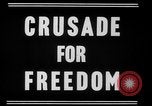
Ronald Reagan talks about how Radio Free Europe pierced Iron Curtain and appeals for help to keep it operating, in New York.
Public Service Announcement (PSA) for Crusade for Freedom in New York. Ronald Reagan, famous Hollywood actor, talks about how Radio Free Europe has pierced the Iron Curtain (approaching people beyond reach in Communist countries). Reagan stands beside a poster advertising the campaign. Close-up view of the "World Freedom Bell" ringing atop Berlin City Hall or Rathaus Schöneberg (John-F.-Kennedy-Platz, 10825 Berlin, Germany) in West Berlin, Germany. View of the 135,000-watt radio transmitter and radio tower. Personnel in radio studio working on transmitter and radio station in West Germany. Views of various men speaking into microphone in radio studio. Dramatized view of people handing over letters of gratitude to Radio Free Europe, "smuggled past the secret police" under hats identifying Communist informers by name. View of a letter being cut into multiple pieces for safe transport in secret. U.S. Army General Lucius Clay steps to podium during unveiling ceremony for the bell unveiling ceremony on October 24, 1950. Animated map shows Radio Free Europe transmission tower and locations of planned future transmitter towers to penetrate the Iron Curtain (during Cold War). Another map is shown with a transmitter location east of China "to establish Radio Free Asia to stop the spread of Communism in the far east." Ronald Reagan appeals for help to keep Radio Free Europe operating. He holds up a large envelope with the New York City mailing address to send contributions for the radio campaign: "General Clay, Crusade for Freedom, Empire State Building, New York City."
CRITICALPAST.COM: About Us | Contact Us | FAQs - How to Order | License Agreement | My Account | My Lightboxes | Shopping Cart | Advanced Search | Featured Collections | Website Terms & Conditions | Privacy Policy ©2026 CriticalPast LLC.
License Agreement |
Terms & Conditions |
Privacy Policy
©2026 CriticalPast LLC.