


 Francais
 Deutsch
 Italiano

Refine Your Search
Tangermunde Germany 1945 stock footage and images
- Showing 4567 to 4572 of 10470 results more
 Hide
Color Sound

Newspaper headlines about start of World War 1; later U.S. entry into World War 1, and building of U.S. Navy ships for war effort
A map of Europe with German cross superimposed on it. Shows various newspaper headlines about World War I. First one indicating the death of Archduke Franz Ferdinand in 1914; next "Germany Declares War - All Europe in Arms"; next "Germany Invades France"; then "French Resist at Marne"; then "Lusitania Sunk", followed by "U.S. Declares War." The latter is seen after an image of a newspaper printing press running at high speed. A worker at the printing plant stands beside the printing press and reads the newspaper. Various headlines about America entering into World War I, including "U.S. At War" and "U.S. Troops Land in France." Scene shows several posters to promote Liberty Bonds; one reads, "Beat Back the Hun with Liberty Bonds." U.S. Navy ships being constructed during World War 1 at a shipyard. Ships at piers as men work on them. A U.S. vessel underway at sea. A United States Navy destroyer ship underway at sea.
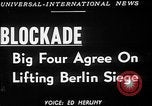
Russia agrees to lift blockade from Berlin during a conference in New York, United States.
Berlin blockade to be lifted. Public and press gathered outside United States Mission building to the United Nations in Lake Success New York, USA. Inside the building, Russian and American dignitaries and UN representatives negotiate an end to the blockade. Closeups of the negotiators, including American diplomat Philip Jessup, Soviet diplomat Yakov Malik, and Sir Alexander Cadogan and Jean Chauvel, the United Nations permanent representatives from England and France, respectively. During the talks, Russia agrees to lift blockade from Berlin, Germany, via the Jessup-Malik Agreement. Dignitaries leave after the conference concludes. A railroad yard in Germany with rail cars filled with coal and other supplies, but idle due to the blockade. View of a busy city street in Berlin and Kaiser Wilhelm Memorial Church in the distance. German pedestrian and vehicular traffic in Berlin.
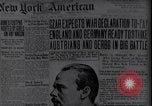
Headlines of prominent newspapers show rising tensions in Europe, assassination of Archduke and Russia's entry in World War I
Headlines of prominent newspapers show rising tensions prior to World War 1. Headline of New York American 'Czar expects war declaration today, England and Germany ready to strike, Austrians and Serbs in big battle'. Montage of headlines from various newspapers regarding looming war. Berliner Tageblatt New York Times headlines say 'Austria and Serbia ready for war, Russia gives warning to Germany, London still sees hope for peace'. New York Times and Freier Press headlines about the assassination of Archduke Ferdinand of Austria. Serbian police dragging the assassin. Blood stained tunic of Archduke. Burial ceremony of Archduke Ferdinand with coffin covered with Austrian flag. Czar Nicholas II of Russia reviews troops. Various Cossack regiments being reviewed. Russian Revolution scenes and mass demonstrations and riot in streets of Moscow as Bolsheviks seize power in 1917. Russian civilians and Bolshevik loyal soldiers armed with rifles marching in mass funeral processions and demonstrations in Russia against the Czar led government. Leon Trotsky speaking to a crowd and saluting Red forces as Bolshevik troops parade. Food distribution to Russian children and people eating on snow covered streets of Moscow around time of revolution. Headlines showing Russian entry in World War I. Snow covered Kremlin. Vladimir Lenin at a desk talking. More views of newspaper headlines regarding outbreak of World War 1.
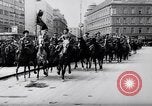
White Russian cavalry are honored by German forces in Zagreb, Croatia during World War II
White Russian Cossack Cavalry, who had fought with Germany, against Communist Soviet forces, parade on horseback on a street in central Zagreb, Croatia, during World War 2. They are being honored by Germany. German Cavalry officer, Lieutenant General Helmuth von Pannwitz, in fur hat, standing next to Field Marshal Paul Ludwig von Kleist, salutes the Cossacks as they pass. (He organized Cossack volunteers into the 1st Cossack Cavalry Division.) View of Cossack cavalry soldiers as they parade past the base of the equestrian statue of Josip Jelacic (Ban Josip Jelačić) in Jelacic Square, Zagreb, Croatia. (The statue is in its original north-facing placement in Ban Jelačić Square). Storefront sign in background for Cerjak I Drugovi, manufacturers of knitted goods, located at 6 Jelačić Square (Trg bana Josipa Jelačića 6, Zagreb). Individual White Russian soldiers and some German soldiers are decorated by Field Marshal Von Kleist. Afterwards, in a large field, Cossacks ride past and demonstrate a charge brandishing sabers.
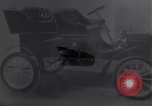
Newspaper headlines relating to World War I.
View of picture of 1908 McLauglin-Buick and 1915 sedan auto. Map of Europe with German Iron Cross superimposed. Newspapers running off presses. Headline on paper reading, 'Arch Duke Assassinated.' Headline reading, 'Germany Declares War; All Europe is in Arms.' Headline reading, 'Germany Invades France', superimposed over German troops marching in background. Headline, 'French Resist at Marne.' Headline, 'Lusitania Sunk' with picture of the ship. Newspaper presses running. Printer reading paper with headlines 'U.S. Declares War.' Paper reading, 'U.S. At War.' Headline, 'U.S. Troops Land in France.' Billboard sign, 'Beat Back the Hun With Liberty Bonds' superimposed over picture of troops marching in background. Ships under construction. Destroyer underway.
German Kaiser Wilhelm II is greeted by British officialdom at Guildhall, in London, during a visit with King George V and Queen Mary
Film opens with scenes of British Horse Guards on parade along street in London, England, watched by crowds on the sidewalks. Next, an elaborate coach, bearing an image of the Coat of Arms of the city of London, is seen arriving at the Guildhall (71 Basinghall St, London EC2V 7HH, United Kingdom). Footmen step to the coach door, where one places a step stool while the other takes the ceremonial mace for bewigged Lord Mayor, Sir Thomas B. Crosby, who steps from the coach, followed by London Sheriff, Sir Charles Augustin Hanson, and other city officials. Four uniformed trumpeters stand in front of the Guildhall and play a fanfare announcing arrival of a royal open coach carrying the monarchs of Great Britain and Germany. When it arrives, King George V quickly steps from the coach and assists Queen Mary as she alights. They are followed by the King's cousin, Emperor (Kaiser) Wilhelm II, of Germany, who steps from the coach. The Kaiser is dressed in Hussar uniform including fur Busby adorned with Totenkopf (Death Head) emblem. A flurry of activity ensues as the King and Queen and the Kaiser engage in greeting various officials and dignitaries. The Kaiser recognizes a woman, likely a relative, in the group and hurries to greet and kiss her.
CRITICALPAST.COM: About Us | Contact Us | FAQs - How to Order | License Agreement | My Account | My Lightboxes | Shopping Cart | Advanced Search | Featured Collections | Website Terms & Conditions | Privacy Policy ©2026 CriticalPast LLC.
License Agreement |
Terms & Conditions |
Privacy Policy
©2026 CriticalPast LLC.