


 Francais
 Deutsch
 Italiano
Refine Your Search
Tontouta New Caledonia 1943 stock footage and images
- Showing 2371 to 2376 of 10521 results more
more Hide
Hide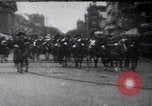
Cavalry leads a land parade on “Dewey Day” in New York City
Commodore George Dewey leads a land parade on “Dewey Day” after his arrival in the United States following the Spanish-American War. Army cavalry, one of the soldiers holding the United States flag, in the parade along Eighth Avenue, Manhattan, New York City. Men in uniform follow the cavalry. U.S. cavalry soldiers with sabers follow the uniformed men.

View of South Bronx from elevated train in New York City
View of community in South Bronx in New York City. The film gives details like the population size and the number of unemployed males. A plane in view. Aerial views of South Bronx New York show children playing on roofs of buildings. Aerial view of woman collecting clothes from clothes line on roof. Aerial view of pigeon coops and pigeons on roof. Boy flying kite from roof. Girl balancing on roof while boy hammers wood on roof. Aerial view of elevated train. Boys play basketball. POV sequence shows views of South Bronx and New York from a moving elevated train moving along Westchester Avenue near E. !56th Street, first through front of train and then through side. Short sequences cut in show boy swinging baseball bat, man smoking, youth choking another from behind.
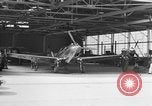
New P-40 aircraft rolled out of Curtiss hangar in Buffalo, NY during World War II.
New United States Army Air Force Curtiss P-40 aircraft being placed on flight line at Curtiss Aircraft company facility in Buffalo, NY (the Buffalo Municipal Airport) during World War II. A new P-40 aircraft being rolled out of the Curtiss hangar. Employees push several new P-40s. The aircraft are seen parked on the ramp.
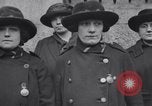
Women join ranks of police reserves in New York City, during World War I.
Closeup of women in the New York City Police reserve, during World War 1. They stand outside the 23rd Police Precinct ("Tenderloin") Station House on West 30th Street, Manhattan, New York City. Their uniforms include round-brimmed hats and overcoats, and they have round badges topped with eagles, pinned to their coats. Next, about 15 are seen, walking two abreast. All wear white gloves and badges, but otherwise, their uniforms are not identical. One supervisor woman walks beside the group, wearing a slightly different badge. Walking casually, a short distance behind the group is a woman (probably Mary Noonan) in the uniform of a captain (with "railroad tracks" insignia on her collar). Scene shifts to a street filled with a traffic mix of horse-drawn and motor vehicles, all staying fairly clear of trolley tracks visible in the center of the road. A police reserve woman stands in the center of the street, directing traffic. Next, a large group of school children is seen standing on a street corner, accompanied by a woman police officer. They begin to cross the street under the watchful eye of another woman reserve police officer, directing traffic in the street. Some adults cross behind the children. (Note: On May 9, 1918, the New York City Police Department announced formation of a new Police Reserve, that would include a women's contingent. This was the idea of Special Deputy Commissioner Rodman Wanamaker, who reasoned, since New York women had received the vote, on November 6th 1917, they should have a role in enforcing the laws. Over 3,000 women were recruited. Their Captain was Mary Noonan. Their duties did not involve direct dealings with criminals. According to the New York Times of May 10, 1918, "If need arose for use of the nightstick or other instrument for curbing crime,the work would be referred to the men members of the force.")
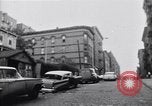
Routine activities of residents in a section of the South Bronx, New York City.
Scenes shot on a Wednesday afternoon in the South Bronx, New York City. View from car driving slowly uphill on Eagle Avenue heading towards 149th Street in the South Bronx, New York City. Among cars parked at the left side of a one-way street, is a 1957 Chevy that has been stripped of its tires and wheels. Apartment buildings line the street. Residents are out and about walking on the sidewalks. One man has the hood up on his big-fin 1960 Plymouth Fury automobile. Closeups as the camera car drives past some residents. Closed business establishments have heavy steel gates locked across their doors and windows. A sign advertising Ballantine beer is mounted on a building. Below it someone has painted message with partial words:"...Jtch Unknown Sinners." Small glass blocks have been broken out of an adjoining building. Camera pans down an apartment building on Crimmins Avenue, following path of external fire escape ladders. A number of people are gathered socially on the apartment house steps. A group of mixed age men play a game of stick ball in the street. A car turns into the street hugging the left side of the road to avoid interfering with the ballgame. Closeups of some players, as one (unseen) is recorded speaking about the game. (The narrator notes that this is filmed on a Wednesday afternoon in the middle of a "work week.") Camera pans people "hanging out," in the vicinity. Two men walk along the edge of an apartment building roof. A dog walks past a man tearing up a cardboard box. Men seated alone, on a fire escape; on a park bench; in a doorway; and on a box in front of a store. Boys playing frisbee and two with baseball gloves, playing catch. Police cars: one parked at a curb and one driving along the street. A young man wearing a sweatshirt with "Latin Crowns" written on it, goes into a building. Outside, another youth, in similar sweatshirt, does pull-ups on a bar at the bottom of a fire escape. A boy swings on the bar. Juvenile delinquency: Several boys start fighting and an older one steps in to break it up. A boy inhaling illegal drugs or chemicals from a paper bag, or using it to hyperventilate.
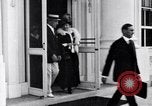
United States President Woodrow Wilson at his Summer White House, Shadow Lawn, in New Jersey
United States President Woodrow Wilson and his party enter a car and leaves the White House in Washington DC for his Summer White House (or "Summer Capitol"), Shadow Lawn, in Long Branch New Jersey. Well-wishers at the White House stand and wave as the car departs the dirt road driveway of the White House, and a 2nd car with a security detail follows. View of Shadow Lawn, the estate of Joseph Benedict Greenhut. (The estate shown here was originally built in 1903 by John A. McCall of New York Life Insurance Company. He sold it to Greenhut. It was later destroyed by fire, and a mansion belonging to F.W. Woolworth President Hubert T. Parsons was built on the site. That estate is now part of Monmouth College). Large group of people gathered on the front lawn of Shadow Lawn to hear President Wilson speak at a 1916 campaign event. He is introduced and then approaches the podium as people cheer. The estate and podium area at the front of a soaring exterior portico is decorated with many American flags and swags.
CRITICALPAST.COM: About Us | Contact Us | FAQs - How to Order | License Agreement | My Account | My Lightboxes | Shopping Cart | Advanced Search | Featured Collections | Website Terms & Conditions | Privacy Policy ©2026 CriticalPast LLC.
License Agreement |
Terms & Conditions |
Privacy Policy
©2026 CriticalPast LLC.